Last Updated: October 24, 2026
Quick Summary
Durable vinyl graphics survive high-traffic offices when the film thickness, adhesive strength, overlaminate, and slip rating are specified correctly before printing. We recommend heavy-duty film, high-tack adhesive, and a textured overlaminate in lobbies, entrances, and queue lines, with monthly edge inspections.
- Standard floor graphic film runs around 4 mil, and thicker films resist curling and scuffing better.
- Never install a floor graphic in a high-traffic area without an overlaminate.
- A wet dynamic COF of 0.42 or higher is a common industry rule of thumb for level walking surfaces.
- Clean graphics with a damp mop and mild cleaner, avoiding harsh solvents and abrasive pads.
- LVT and vinyl plank demand a high-tack adhesive rated for low-surface-energy floors and a longer cure.
Table of Contents
- What Makes Durable Vinyl Graphics Survive an Office Floor
- Slip-Resistant Floor Graphics: Ratings, Testing, and What to Ask For
- Vinyl Floor Graphics Laminate: Why the Overlaminate Does the Heavy Lifting
- Floor Graphic Installation: A Step-by-Step Walkthrough for Busy Offices
- Floor Graphics Durability: Traffic Zones, Cleaning, and Replacement Triggers
- Matching Vinyl Film to Office Surfaces: Carpet, Tile, Concrete, and LVT
- Planning Your Office Floor Graphics Project with Triton Sign
- Frequently Asked Questions
What Makes Durable Vinyl Graphics Survive an Office Floor
Durable vinyl graphics are adhesive-backed films engineered to hold their print and stay put through constant foot traffic, cleaning, and sunlight. At Triton Sign, we have over 30 years of combined industry experience in fabricating and installing signage, and the difference between a floor graphic that lasts months and one that lasts years comes down to four specifications. Get those right and a lobby decal survives thousands of footsteps.
The Four Specs That Decide Lifespan
Four numbers on a spec sheet predict almost everything about how a floor graphic will age:
- Film thickness. Standard floor graphic film runs around 4 mil. Thicker films resist curling and scuffing better in heavy foot traffic.
- Adhesive strength. A stronger adhesive grips textured and low-energy surfaces. Removable vinyl is easier to pull later but shifts sooner under constant foot traffic.
- Overlaminate. A clear overlaminate shields the printed graphics from wear, moisture, and cleaning chemicals.
Most buyers fixate on the artwork. The film underneath does the real work.
Slip-Resistant Floor Graphics: Ratings, Testing, and What to Ask For
Slip-resistant floor graphics are vinyl films with a textured top surface or a textured overlaminate that keeps traction close to the bare floor. The safety question is not whether a product is labeled “slip-resistant” but whether the finished, installed graphic still performs when wet, dirty, and worn. That is where most office buyers get into trouble.
How Slip Resistance Is Actually Measured
In the United States, slip resistance is commonly expressed as a coefficient of friction (COF), the ratio of the force needed to move one surface across another to the force pressing them together. Two test methods show up most often in manufacturer literature:
- ASTM D2047, the standard test method for static coefficient of friction of polish-coated floor surfaces as measured by the James Machine (D2047 Standard Test Method for Static Coefficient of Friction of Polish-Coated Flooring…). It is widely used for walkway surfaces and is the number many floor-care products cite.
- ASTM C1028, a historical standard test method for determining the static coefficient of friction of ceramic tile and other like surfaces by the horizontal dynamometer pull-meter method. It was withdrawn, so treat any C1028 claim as legacy data and ask what replaced it.
- ANSI A326.3, the current American National Standard for measuring dynamic coefficient of friction of hard surface flooring materials. Dynamic COF better reflects the sliding motion of a footstep than static COF does.
A common industry rule of thumb is that a wet dynamic COF of 0.42 or higher is generally considered acceptable for level walking surfaces, but that is a guideline, not a universal legal mandate. The Americans with Disabilities Act (ADA) and the Occupational Safety and Health Administration (OSHA) impose general duties to keep walking surfaces safe and accessible; they do not publish a single COF number that every floor graphic must hit.
What to Request in Writing
Before you approve a proof, ask the installer or fabricator for a documentation packet, not a verbal assurance:
- The film manufacturer’s slip test report, including the test method (ASTM D2047, ANSI A326.3, or another named standard), the condition tested (dry, wet, or contaminated), and the measured COF value.
- Confirmation that the overlaminate, not just the base film, carries the rating, because the overlaminate is the surface a foot actually touches.
- The manufacturer’s cleaning and maintenance instructions, since some cleaners and polishes can leave a film that changes traction.
A glossy printed decal without a textured overlaminate can turn a dry tile floor into a slip hazard near entryways and water coolers. That is a genuine liability in a busy office, and it is the single most common shortcut we see.
Why Performance Changes After Installation
A slip rating is a snapshot, not a guarantee. Traction degrades when the textured surface fills with dirt, floor wax, or cleaning residue; when the graphic lifts at an edge and creates a lip; or when a glossy overlaminate is used in a wet zone.
Build a simple verification routine into your facility schedule:
- Confirm the installed graphic matches the tested product and overlaminate.
- Inspect wet zones after cleaning and after rain or snow events.
- Re-check edges monthly in heavy-traffic areas; a lifted edge is both a trip hazard and a traction change.
- Keep the test report and maintenance log on file so you can show due diligence if an incident is reported.
For offices weighing DIY against professional work, our article on why professional sign installation matters for branding explains the trade-offs.
Vinyl Floor Graphics Laminate: Why the Overlaminate Does the Heavy Lifting
The overlaminate is the sacrificial layer on top of a floor graphic, and it absorbs almost all the abuse. Printed graphics without it fade and scratch fast, especially in sunlit lobbies.
Our rule of thumb: never install a floor graphic in a high-traffic area without an overlaminate. For a deeper look at how protective coatings extend graphic life, see our guide to UV-resistant clear coat for signs.
Floor Graphic Installation: A Step-by-Step Walkthrough for Busy Offices
Floor graphic installation is a sequence of surface prep, placement, and pressure, and skipping any step shortens the lifespan. Here is how we approach a busy office so work continues around us.
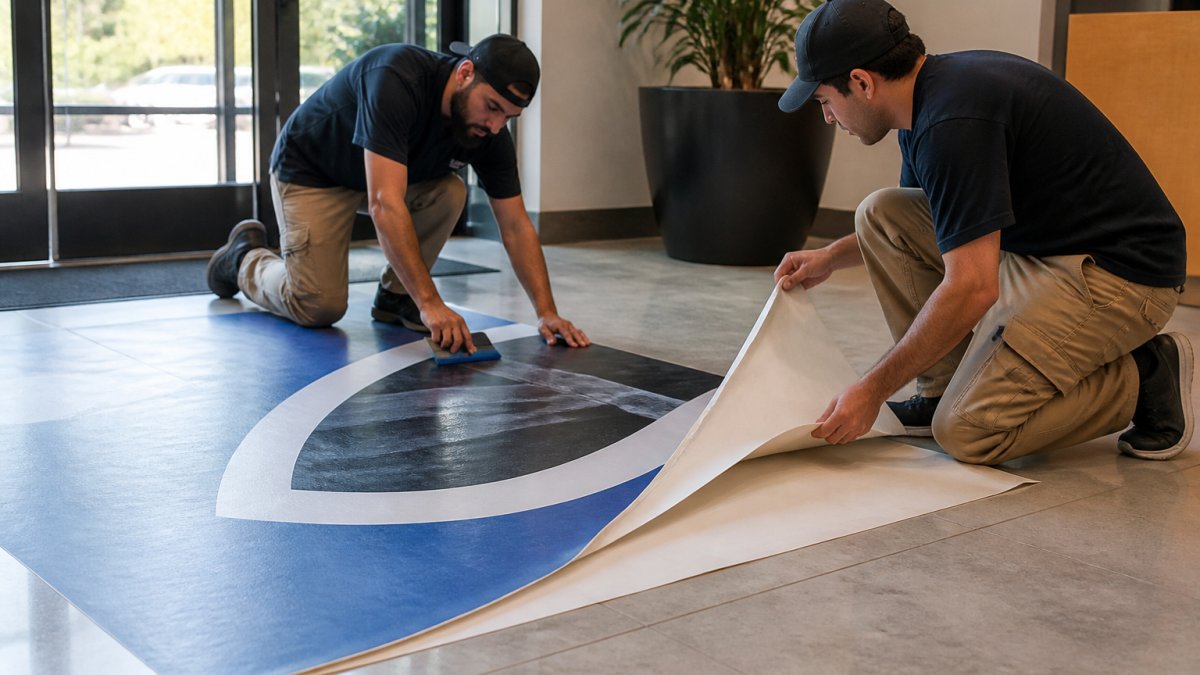
- Clean and dry the floor. Dust, wax, and moisture are the enemies of adhesive strength.
- Test surface compatibility. Fresh concrete needs curing time before any adhesive-backed film goes down.
- Lay out and tape the position. Dry-fit the graphic before peeling any liner.
- Apply from one edge. Peel the liner back gradually and smooth with a squeegee to push out air.
- Roll the edges. Firm pressure on the perimeter prevents lifting.
- Keep traffic off until cured. Block the area per the adhesive’s instructions.
For offices weighing DIY against professional work, our article on why professional sign installation matters for branding explains the trade-offs.
Floor Graphics Durability: Traffic Zones, Cleaning, and Replacement Triggers
Floor graphics durability depends more on where you place a graphic than on the material itself. Map your office into three zones before you order:
| Zone | Typical Location | Cleaning Routine | Expected Wear |
|---|---|---|---|
| Light traffic | Private offices, back corridors | Damp mop weekly | Slow, print stays sharp |
| Medium traffic | Break rooms, copy areas | Daily damp mop | Gradual edge wear |
| Heavy traffic | Lobbies, entrances, queue lines | Daily mop plus spot cleaning | Fastest wear, inspect monthly |
Clean graphics with a damp mop and mild cleaner. Avoid harsh solvents and abrasive pads, which dull the overlaminate. Replace a graphic when edges lift, the print fades noticeably, or the surface feels slick when wet. For a fuller maintenance schedule, read our post-installation maintenance tips for commercial signs.
Matching Vinyl Film to Office Surfaces: Carpet, Tile, Concrete, and LVT
Surface compatibility decides whether an adhesive-backed graphic stays flat or fails within weeks. The mechanism is surface energy and porosity: adhesives bond best to clean, smooth, higher-energy surfaces, and they struggle on dusty, waxy, wet, or low-energy ones. In an office, the same building can present four or five different surfaces within a hundred feet, so match the film to the floor, and to the traffic, before anything is printed.
A Surface-by-Surface Guide
- Carpet: Direct-to-carpet decals wrinkle, trap dirt, and pull up fibers. Use a rigid insert or a carpet-rated film with a low-tack adhesive, and expect a shorter service life than on hard floors. In reception areas, a rigid insert under a mat or frame is the more reliable choice.
- Sealed tile: Standard floor graphic film with an overlaminate works well after a proper clean. The risk is wax and cleaning residue, which act as a release layer; strip and neutralize the floor first, then let it dry fully.
- Polished concrete: Concrete must be fully cured, sealed, and dust-free. Fresh concrete releases moisture for weeks, and trapped moisture blisters adhesive. Test for moisture before application and follow the sealer manufacturer’s recoat window.
Match the Graphic to the Traffic Zone
Surface choice is only half the decision. Map the office into zones and let traffic intensity drive film thickness, adhesive, and overlaminate:
| Zone | Typical location | Surface priority | Film guidance |
|---|---|---|---|
| Light | Private offices, back corridors | Cleanability | Standard 4 mil film with overlaminate |
| Medium | Break rooms, copy areas | Moisture and stain resistance | Thicker film, textured overlaminate |
| Heavy | Lobbies, entrances, queue lines | Slip resistance and edge hold | Heavy-duty film, high-tack adhesive, textured overlaminate, monthly inspection |
Entrances deserve special attention: grit, snow-melt, and moisture arrive there first, so a graphic at the door sees more abuse in a week than one in a back corridor sees in a month. Place the most durable product where the building meets the weather.
Accessibility and Safety Placement
Accessibility is not just a product feature. The ADA requires accessible routes to stay clear, and a floor graphic that lifts at an edge becomes a trip hazard on that route. Keep graphics out of the required clear width of an accessible path, avoid placing them where they could be mistaken for a change in level, and use high visual contrast rather than relying on texture alone to signal a change.
If your project is part of a larger branding rollout, our article on custom interior graphics for corporate branding shows how surface-matched vinyl fits the bigger plan.
Planning Your Office Floor Graphics Project with Triton Sign
A floor graphics project succeeds when material, surface, and traffic are matched before anything is printed. That is where Triton Sign comes in.
Our customers keep coming back for the same reasons: deadlines met, budgets respected, and workmanship that holds up. Whether you are refreshing a single lobby or rolling out consistent branding across multiple offices, we build the plan around your surfaces and foot traffic.
To see what we offer for interior branding and start your project, contact us.
Frequently Asked Questions
What type of vinyl is best for high-traffic floor graphics?
A calendered or cast vinyl floor graphic film with a textured or slip-rated overlaminate is the standard choice for high-traffic office areas. Look for a film around 4 mil thick paired with a laminate that carries a slip-resistance rating, and confirm the supplier states compatibility with your specific floor surface. Thinner promotional films and paper-backed decals break down under constant foot traffic and should be reserved for short-term use.
How long do durable vinyl graphics last in busy office areas?
Lifespan depends on traffic volume, surface, and laminate. A laminated floor graphic in a moderate-traffic office corridor typically holds up for months to a few years, while an unlaminated decal in a main entryway can show wear far sooner. Ask your installer for a lifespan estimate tied to your specific traffic count and cleaning routine, and plan replacement around visible edge lifting or surface scuffing rather than a fixed calendar date.
Are vinyl floor graphics slip-resistant?
The vinyl itself is not what provides slip resistance; the overlaminate is. A clear overlaminate with an anti-slip texture gives the graphic a slip-resistant surface, and suppliers should be able to state the rating and the test method behind it. In office settings, specify slip-resistant floor graphics for entryways, stairs, and any area that sees moisture, and verify the rating applies to the finished product, not just the raw film.
Can vinyl floor graphics be removed without damaging the floor?
Removable vinyl is designed to peel away cleanly, but the result depends on surface compatibility and how long the graphic stayed down. On sealed tile or LVT, removal is usually straightforward with gentle heat and a slow pull. On unsealed concrete or older finishes, adhesive can bond more aggressively. Ask your installer to confirm the adhesive is matched to your floor and to include removal in the project scope so replacement does not damage the substrate.
High-traffic offices punish weak materials, and a floor graphic that fails early costs more than the upgrade would have. Triton Sign brings over 30 years of combined experience, full-service design, fabrication, and installation, and a track record of meeting tight deadlines and budgets. Get started with Triton Sign and put durable vinyl graphics underfoot that keep your brand looking sharp through every footstep.
