Table of Contents
- Why Professional Sign Installation Matters for Branding
- How Installation Precision Protects Brand Identity and Visual Impact
- Signage Permitting and Local Regulations: What Project Managers Need to Know
- ADA Signage Compliance Requirements and Why They Matter for Your Brand
- The Benefits of Professional Sign Maintenance for Long-Term ROI
- DIY Installation Mistakes That Undermine Brand Credibility
- The Psychology of Signage Placement and Customer Perception
- Frequently Asked Questions
Last Updated: September 17, 2026
Why Professional Sign Installation Matters for Branding
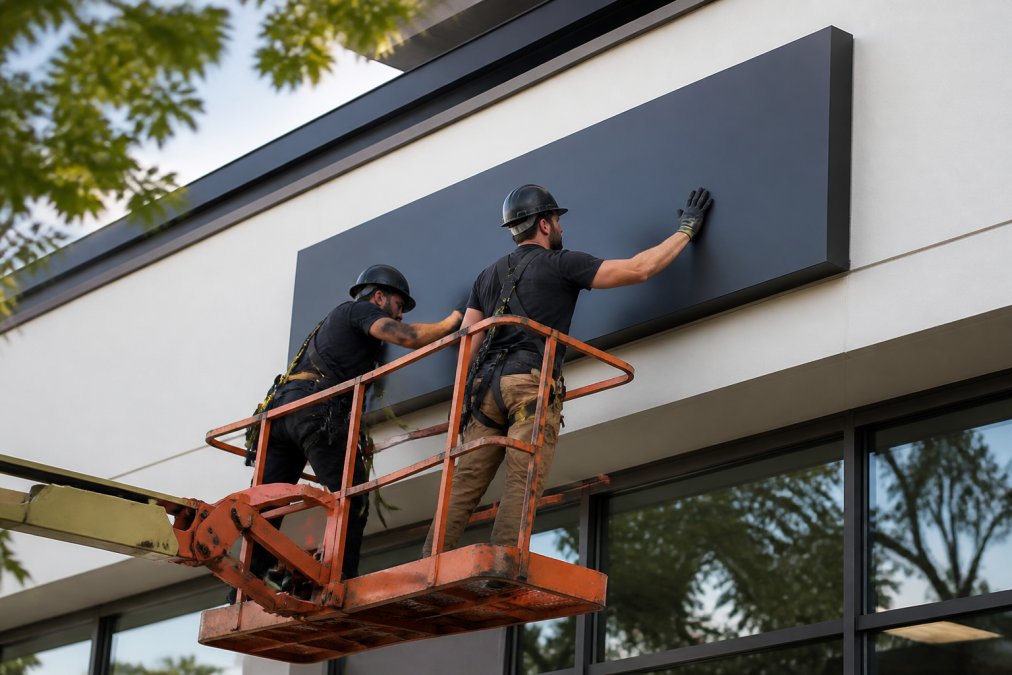
A storefront sign hung two degrees off level quietly tells customers the business cuts corners everywhere else. Professional sign installation is the practice of mounting, wiring, and anchoring commercial signage to manufacturer and code specifications so it stays level, lit, and legible for years. At Triton Sign, we have over 30 years of combined industry experience, and we understand how mounting quality shapes brand perception. Precision reads as competence.
What a Crooked Sign Actually Costs You
A sign that leans, flickers, or peels within a year signals instability to every passerby. Customers do not audit your mounting hardware, but they absorb the impression. The common mistake is treating signage as a one-time purchase rather than a long-term brand asset.
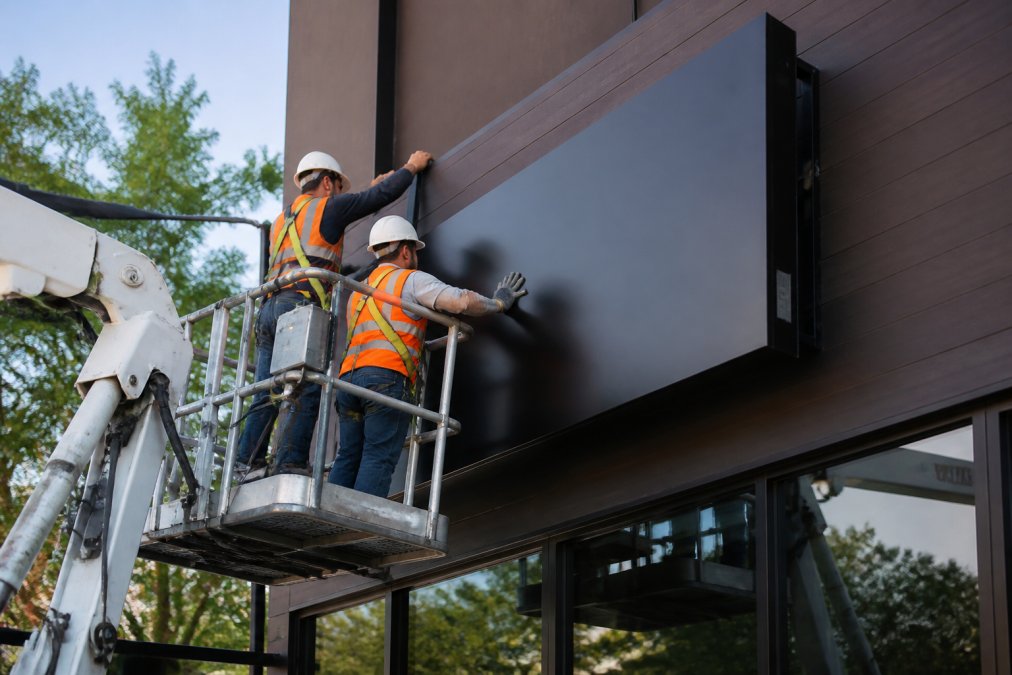
Skipping a professional survey to save time often means drilling into a facade that cannot bear the load. The consequence is not just a wobbly sign, it is water intrusion, cracked masonry, and a repair bill that dwarfs the original installation quote.
How Installation Precision Protects Brand Identity and Visual Impact
Precision is the difference between a sign that reinforces your brand and one that undermines it. Brand identity depends on consistency, which starts with how a sign is mounted.
Ask your installer how they verify level and alignment before final anchoring. A crew that templates and dry-fits first will catch facade irregularities that a same-day drill-and-hang approach misses entirely.
Signage Permitting and Local Regulations: What Project Managers Need to Know
Signage permitting is the process of securing municipal approval for a sign’s size, placement, illumination, and structural attachment before it goes up. Skipping it creates legal exposure larger than the sign itself.
The permit path, step by step
Most sign permits follow the same sequence, though office names change by jurisdiction:
- Zoning review, confirms the sign type, size, and placement are allowed at that address. This is where overlay districts, historic districts, and design-review boards add conditions.
- Building/structural review, confirms the attachment method, wind load, and, for projecting or freestanding signs, the foundation or footing design. This is often a separate submittal from zoning.
- Electrical permit, required for any illuminated sign, and typically inspected after the sign is wired but before the circuit is energized.
- Sign permit issuance, the actual authorization to install. Some jurisdictions issue this before fabrication; others require stamped drawings first.
- Post-install inspection, a final sign-off that the installed sign matches the approved drawings.
Why this matters for insurance and liability
An unpermitted or non-compliant sign can affect more than a fine:
- Property insurance, carriers can deny a claim tied to a structure installed without required permits or inspections. If a sign falls and damages a vehicle or injures a pedestrian, the permit record is one of the first things an adjuster pulls.
- General liability, a sign that fails because it was anchored to a facade that could not carry the load, or because wind load was never calculated, is a foreseeable failure that turns a routine claim into a coverage dispute.
- Lease obligations, most commercial leases require the tenant to maintain signage in compliance with law and restore the facade on removal. An unpermitted sign can put the tenant in default.
- Municipal fines and removal orders, many jurisdictions issue daily fines for unpermitted signage and bill the owner for removal if it is not taken down voluntarily.
What to confirm before fabrication begins
- The sign’s dimensions, height, and setback meet the current sign code for that specific address, not the code for a neighboring jurisdiction.
- Any overlay, historic, or design-review district has approved the design in writing.
- Electrical work for illuminated signs is permitted and will be inspected.
- The attachment method and, where required, the footing or foundation have been reviewed structurally.
- The permit is issued and posted before the crew mobilizes.
Because rules vary by jurisdiction and change with code cycles, the fastest path is to have your signage partner pull the requirements for the specific address and confirm them with the local building department in writing. Triton Sign offers comprehensive design, fabrication, and installation services, and we can assist with permitting coordination to keep your project on schedule.
A permit that was issued for a different sign design does not cover the sign you actually install. If the approved drawings and the fabricated sign diverge, different dimensions, different illumination, different mounting, the inspection can fail and the sign can be ordered down even though a permit exists.
ADA Signage Compliance Requirements and Why They Matter for Your Brand
ADA signage compliance requirements are the accessibility standards governing permanent room and wayfinding signs under the Americans with Disabilities Act. Non-compliant signage is both a legal risk and a signal that a business does not welcome every customer.
- Tactile characters must be raised and readable by touch
- Braille must accompany raised lettering on permanent room signs (Chapter 7: Signs)
- Mounting height and location are specified, not left to preference
- Finish must reduce glare so characters stay legible
The Benefits of Professional Sign Maintenance for Long-Term ROI
Professional sign maintenance is the scheduled inspection, cleaning, and repair of installed signage to extend its service life. The benefits show up directly in your budget, and the mechanism is where the ROI case lives.
The installation-to-maintenance link
The quality of the original installation sets the maintenance curve for the life of the sign. A sign that was templated, dry-fitted, and anchored with load-rated hardware to a surveyed facade starts its service life with fewer failure points. A sign drilled and hung in an afternoon starts with more.
The differences show up years later:
- Anchor placement. A fastener set into a stud, a structural member, or a properly rated substrate holds. A fastener set into veneer or hollow masonry loosens with thermal cycling and wind vibration, and the sign begins to work against itself.
- Penetration sealing. Every hole through a facade is a water path. Professionally sealed penetrations stay sealed; poorly sealed ones let water into the wall cavity, where it damages masonry, insulation, and interior finishes, a repair that dwarfs the sign.
- Electrical terminations. Properly made connections at the sign and at the junction box resist moisture intrusion and corrosion. Marginal connections fail early and can take out a driver or a run of LEDs.
- Wind load. A sign engineered and anchored for the local wind load moves less, which means less fatigue on brackets, welds, and fasteners over time.
A maintenance rhythm that protects the investment
- Inspect anchors, brackets, and electrical connections twice a year, and after any significant wind or hail event.
- Clean faces and channels to protect curb appeal and to catch cracks or crazing early.
- Replace burned-out lamps or LED modules promptly; a failed module can stress the driver and shorten the life of the remaining modules.
- Re-seal any penetration points to stop water intrusion.
- Photograph the sign at each service visit so you have a visual record of condition over time.
The ROI math, framed honestly
Tracking maintenance against your original investment is how you measure signage ROI. The comparison that matters is not “maintenance cost versus no maintenance cost” but “maintenance cost versus replacement cost, amortized over service life.” A sign that lasts fifteen years with routine service instead of five without it changes the math entirely: the replacement is deferred and the annualized cost of the asset drops.
- Cost per year of service life. Divide total cost of ownership, fabrication, installation, permits, and maintenance over the life of the sign, by the number of years the sign remains legible and compliant. That number is what you are actually buying.
- Cost of a failed sign. A sign that fails inspection, loses illumination, or has to come down for structural reasons carries removal, disposal, facade repair, re-permitting, and re-fabrication costs, plus the brand cost of a dark or missing storefront sign during the gap.
Maintenance is not a cost center. It is the cheapest way to protect the largest single piece of permanent branding most businesses own, and the quality of the original installation determines how much maintenance the sign will need in the first place.
DIY Installation Mistakes That Undermine Brand Credibility
DIY installation mistakes are the fastest route to a sign that looks worse than no sign at all. Brand credibility is fragile, and a visibly botched install damages it in ways that are hard to reverse.
The most common errors:
- Mounting on a facade that cannot carry the sign’s weight
- Ignoring wind load calculations for exterior panels
- Using hardware not rated for outdoor exposure
- Skipping the permit and risking a removal order
- Misaligning multi-panel signs so the lettering steps
The Psychology of Signage Placement and Customer Perception
Signage placement is a study in attention. Where a sign sits changes how quickly a customer finds you and how they feel about the business before they walk in.
Frequently Asked Questions
What are the most common signage installation mistakes?
The most frequent errors are mounting signs out of level, using inadequate anchors for wind load, placing signs at the wrong height for ADA compliance, and ignoring local permit requirements. Each mistake creates a visible brand problem and often forces a full redo. A professional sign installation team measures twice, verifies structural attachment points, and confirms compliance before drilling a single hole.
How does professional installation affect the longevity of business signs?
Correct mounting spreads wind and vibration loads across the full substrate rather than concentrating stress on a few fasteners. That reduces fatigue cracking, water intrusion, and premature fading. Signs installed to manufacturer and code specifications routinely outlast poorly mounted ones by years, which lowers replacement cost and keeps brand visibility consistent across every location.
Why is ADA compliance critical during sign installation?
ADA compliance requires specific mounting heights, tactile characters, braille, and contrast ratios for permanent room signs. Installing at the wrong height or with incorrect materials means the sign fails inspection and must be removed and replaced. Getting ADA signage compliance requirements right the first time avoids fines, protects accessibility for all visitors, and keeps your brand associated with professionalism rather than shortcuts.
What are the risks of improper exterior sign mounting?
Improper exterior mounting can lead to structural failure in high winds, water infiltration that corrodes electrical components, and safety hazards for pedestrians below. It also typically violates local zoning laws and building codes, exposing the property owner to fines and liability. Professional mounting with engineered fasteners and weather-rated sealants eliminates those risks and keeps the sign performing as designed.