Table of Contents
- Why Fleet Branding With Custom Vehicle Wraps Pays Off
- Vehicle Wrap Design Best Practices for Multi-Truck Fleets
- Commercial Vehicle Wrap Cost: What Drives the Quote
- How Long Do Commercial Wraps Last?
- Fleet Graphics Maintenance Tips That Protect Your Investment
- Wrap or Paint? Choosing the Right Finish for Your Fleet
- Frequently Asked Questions
Last Updated: September 17, 2026
Why Fleet Branding With Custom Vehicle Wraps Pays Off
Custom vehicle wraps for fleet branding turn every truck, van, and service vehicle into a moving billboard that works every hour the vehicle is on the road. This guide from Triton Sign covers what actually drives cost, how long the film holds up, and how to keep a multi-vehicle fleet looking sharp for years.
A wrapped fleet reaches thousands of commuters and pedestrians daily, and the cost per impression stays low because the vehicle was already going to make that trip. For contractors and service businesses, that math is hard to beat.
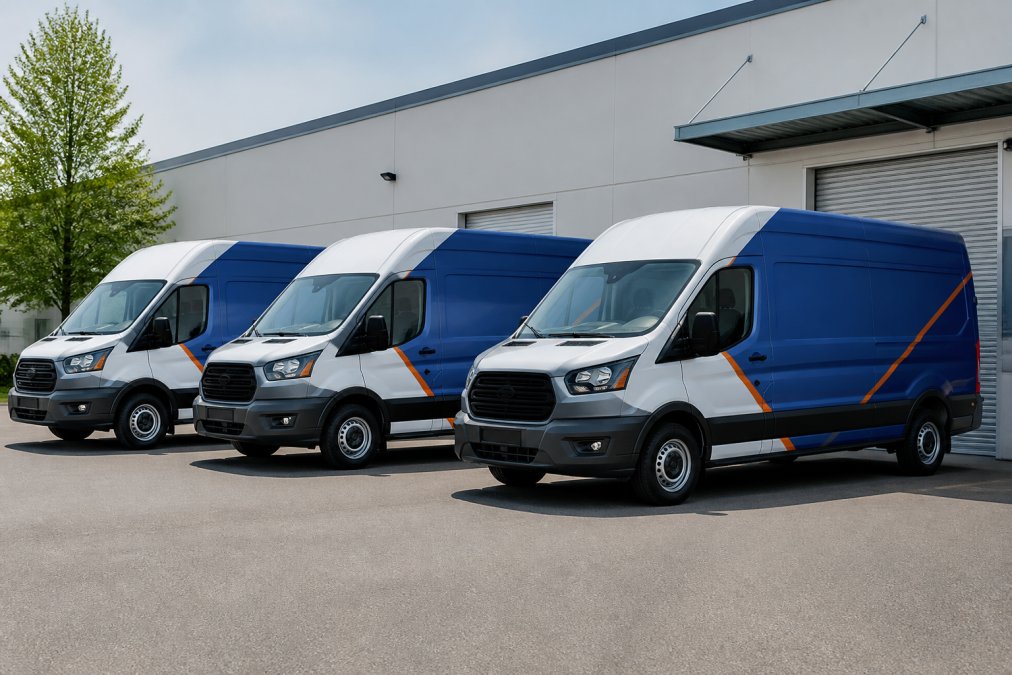
The upside isn’t just visibility. A consistent fleet signals that a business is established, organized, and accountable. When a homeowner sees three matching vans on the same street, the brand reads as a real operation rather than a one-person outfit.
The strongest argument for fleet wraps isn’t reach, it’s repetition. The same truck passes the same commuters every day, which builds recognition faster than a single ad ever could.
Vehicle Wrap Design Best Practices for Multi-Truck Fleets
Good fleet design starts with a system, not a single layout. Build one master template, then adapt it to each vehicle type so every truck, van, and pickup reads as part of the same family.
Keep the Layout Consistent Across Every Vehicle Type
Lock the logo size, color codes, and font choice before anything else. Place the logo in the same relative position on every vehicle, then let the body lines of each model dictate where secondary text goes. A box truck and a cargo van have different proportions, so a rigid copy-paste rarely works.
- Primary logo: same size and corner on every vehicle
- Phone number and website: one consistent typeface, one color
- Secondary services line: adjusted per vehicle, never invented per vehicle
Design for the Distance, Not the Desktop
A wrap is read at 20 to 50 feet in motion, not on a monitor. What looks elegant on a laptop screen often disappears on the road.
- Limit the design to three or four core elements
- Use large, high-contrast lettering for the phone number
- Avoid thin serifs, gradients, and fine detail that blur at speed
- Test the layout at thumbnail size before approving it
Print a full-size mockup and tape it to the side of the actual vehicle before production. Designers catch proportion problems in person that never show up on screen.
Commercial Vehicle Wrap Cost: What Drives the Quote
Commercial vehicle wrap cost depends on square footage, film grade, design complexity, and installation labor. There is no single flat rate, and any provider quoting one without seeing the vehicles is guessing.
Variables That Move the Number Up or Down
The size and shape of the vehicle matter most. A compact car takes far less film than a box truck, and rivets, deep curves, and recessed panels add labor because the installer has to work the film into every contour.
| Cost Driver | Lower End | Higher End |
|---|---|---|
| Vehicle size | Compact van | Box truck or bus |
| Coverage | Partial panels | Full wrap |
| Film grade | Standard calendared | Premium cast |
| Design complexity | Logo and phone | Full custom artwork |
| Surface condition | Clean and smooth | Rust, dents, old decals |
Pricing depends on quantity, vehicle mix, and timeline, so the only reliable number comes from a quote based on your actual fleet. Triton Sign provides quotes after reviewing vehicle types and coverage goals.
How Long Do Commercial Wraps Last?
A quality commercial wrap typically lasts five to seven years when it’s installed correctly and maintained. That range assumes quality cast film, professional installation, and reasonable care.
Cheaper calendared films may fail in two to three years, especially on horizontal surfaces exposed to constant sun. The film itself is only half the equation. Poor surface prep or a rushed install shortens lifespan regardless of material grade.
- Cast film on a vertical panel: longest service life
- Calendared film on a horizontal hood or roof: shortest
- Vehicles parked outdoors year-round: expect the lower end of the range
Fleet Graphics Maintenance Tips That Protect Your Investment
Fleet graphics maintenance tips come down to washing correctly and addressing damage early. Most premature wrap failures trace back to harsh chemicals, abrasive brushes, or ignored edge lifting.
Washing Without Damaging the Film
Hand wash with mild soap and a soft mitt, or use a touchless automatic wash. Avoid brush-style car washes, which catch film edges and lift them over time.
- Rinse loose dirt before washing to avoid scratching
- Use pH-neutral soap, never solvent-based cleaners
- Keep pressure washers at least 12 inches from edges and seams
- Dry with a soft microfiber towel, not a stiff brush
Inspect the wrap monthly for lifting edges, bubbling, or fading. A small edge lift fixed early costs far less than a full panel replacement later.
Ignoring a lifted edge for a few weeks lets water and dirt get underneath, and the film can peel across the whole panel. Catch it early and it’s a quick fix.
Wrap or Paint? Choosing the Right Finish for Your Fleet
Wraps win for most fleets because they cost less upfront, install faster, and protect the paint underneath. Paint delivers a factory finish and can last longer, but it takes vehicles out of service for days and complicates resale.
| Factor | Wrap | Paint |
|---|---|---|
| Upfront cost | Lower | Higher |
| Downtime per vehicle | 1-3 days | 1-2 weeks |
| Reversible | Yes | No |
| Protects factory paint | Yes | N/A |
| Design changes | Easy | Difficult |
For a fleet that needs to stay on the road and may rebrand within a few years, wraps are the practical choice. Paint makes sense for a single vehicle kept long-term with no design changes planned.
That’s the honest trade-off. Wraps trade a slightly shorter lifespan for flexibility and speed, and for most multi-vehicle operations that’s the right call.
Keeping a fleet consistent and on the road is a scheduling problem as much as a design one, and that’s where an experienced partner matters. Triton Sign handles design, fabrication, and installation in-house, with over 30 years of combined experience and a track record of meeting tight deadlines and budget requirements. From vehicle graphics to ADA signage and interior displays, the team delivers high-quality workmanship and reliable project completion. Contact Triton Sign for a fleet wrap quote built around your vehicles and timeline.
Frequently Asked Questions
How much does it cost to wrap a commercial fleet?
There is no single number, because pricing depends on vehicle size, wrap coverage, film type, design complexity, and how many vehicles are in the order. A partial wrap on a cargo van costs far less than a full wrap on a box truck. Fleet discounts usually apply once you commit multiple vehicles to one production run. For a current quote on your specific fleet, contact Triton Sign directly.
How long do custom vehicle wraps last on fleet trucks?
Most quality commercial wraps hold up for several years, and the exact lifespan depends on film grade, sun exposure, wash habits, and how the vehicle is stored. Trucks kept outdoors in strong sun and washed with harsh chemicals age faster than garaged vehicles rinsed with plain soap and water. Following fleet graphics maintenance tips, like hand washing and prompt repair of nicks, is the most reliable way to reach the upper end of that range.
Does a vehicle wrap damage the original paint?
A professionally installed wrap does not damage factory paint. The vinyl film actually shields the surface from sun, road debris, and minor scuffs. Problems only appear when a low-quality film is left on far past its service life, or when removal is done with the wrong tools and technique. Having a qualified installer handle removal protects the paint underneath.
How do I keep fleet wraps looking sharp across multiple vehicles?
Consistency starts with one master design file that specifies exact colors, logo placement, and panel measurements for each vehicle type in your fleet. That way a van, a pickup, and a box truck all read as the same brand. Pair that with a shared wash schedule and quick repair of any damage, and the whole fleet stays uniform for years.