
Table of Contents
- Start with Your Sign’s Purpose and Placement
- Match the Sign Type to Your Business Needs
- Check Zoning Regulations for Business Signs First
- Understand ADA Signage Requirements
- Choose Materials and Lighting for Durability
- Budget for the Cost of Custom Business Signs
- Plan for Installation and Maintenance
- Conclusion: Make Your Sign an Asset, Not an Afterthought
- Frequently Asked Questions
Last Updated: September 6, 2026
Choosing the right business sign directly impacts how many people notice you, remember you, and walk through your door. This guide walks through the practical steps of selecting, budgeting, and installing a business sign that actually performs.
Below, we show you how to evaluate your needs, navigate regulations, and choose a sign that serves your business for years.
Start with Your Sign’s Purpose and Placement
A business sign needs a defined job before it needs a design. Are you catching the attention of drivers passing at 40 miles per hour, or guiding pedestrians to an entrance tucked off the main street? The primary function determines its size, legibility, and placement.
Your sign must be readable from the distance and speed at which your target customer approaches it. On a busy road, font size and contrast matter more than intricate details.
Trees, utility poles, and neighboring buildings can block sight lines. Look at your location from every angle a customer will see it, including across the street and from both directions of travel.
A sign that is too small for its viewing distance is a wasted investment. If drivers cannot read your name before they pass, they will not turn in. Always prioritize legibility over clever design.
Match the Sign Type to Your Business Needs
Once you know the purpose, match it to the right type of signage. Exterior signage is your primary identifier, such as a building-mounted sign, monument sign, or projecting sign.
Interior signage covers lobby signs, wall graphics, and directional elements. Wayfinding signage is critical for larger facilities, multi-tenant buildings, or offices.
Window graphics advertise promotions and hours while providing privacy and brand reinforcement. Vehicle wraps turn fleet vehicles into mobile advertisements.
| Sign Type | Primary Use | Best For |
|---|---|---|
| Exterior Building Sign | Identify your business from the street | High visibility for passing traffic |
| Monument Sign | Ground-level identification | Multi-tenant complexes, roadside visibility |
| Interior Lobby Sign | Brand reinforcement at entry | Offices, reception areas |
| Wayfinding Signage | Direct visitors through a space | Large facilities, hospitals, campuses |
| Window Graphics | Promotions and brand presence | Retail storefronts |
| Vehicle Wraps | Mobile advertising | Businesses with fleet vehicles |
Check Zoning Regulations for Business Signs First
Before you fall in love with a design, confirm it is legal. Zoning regulations vary by city and county, dictating everything from maximum square footage to height limits and illumination rules.
Local ordinances often restrict where signs can be placed, how bright they can be, and whether they can project over public sidewalks. Contact your local planning or permitting department early.
The permitting process can take time. A sign that requires a zoning variance or a special permit will add weeks to your timeline. Account for this in your project schedule, especially if you are coordinating with a construction deadline. Failing to secure the proper permits can result in fines and a mandated removal, which is far more expensive than doing it right initially. For a detailed overview of what to expect, review the U.S. Small Business Administration guidance on signage and local compliance.
Understand ADA Signage Requirements
ADA signage requirements are not optional for most businesses. The Americans with Disabilities Act sets clear standards for signs identifying permanent rooms and spaces, including tactile lettering, Braille, and specific mounting heights.
The key requirements include high contrast between text and background, non-glare finishes, and characters that are raised a minimum of 1/32 of an inch (ada.gov). Braille must be Grade 2 and placed below the corresponding text. The sign must be mounted at a specific height, typically 48 to 60 inches from the floor to the centerline of the sign.
ADA compliance is not limited to new construction; any renovation affecting a permanent space triggers the need for compliant signage. Working with a fabricator that understands these codes saves you from liability and costly rework.
Choose Materials and Lighting for Durability
Material selection determines how your sign will look in three years versus the day it is installed. Exterior signage faces constant sun, rain, and temperature swings, so weather resistance is a top priority.
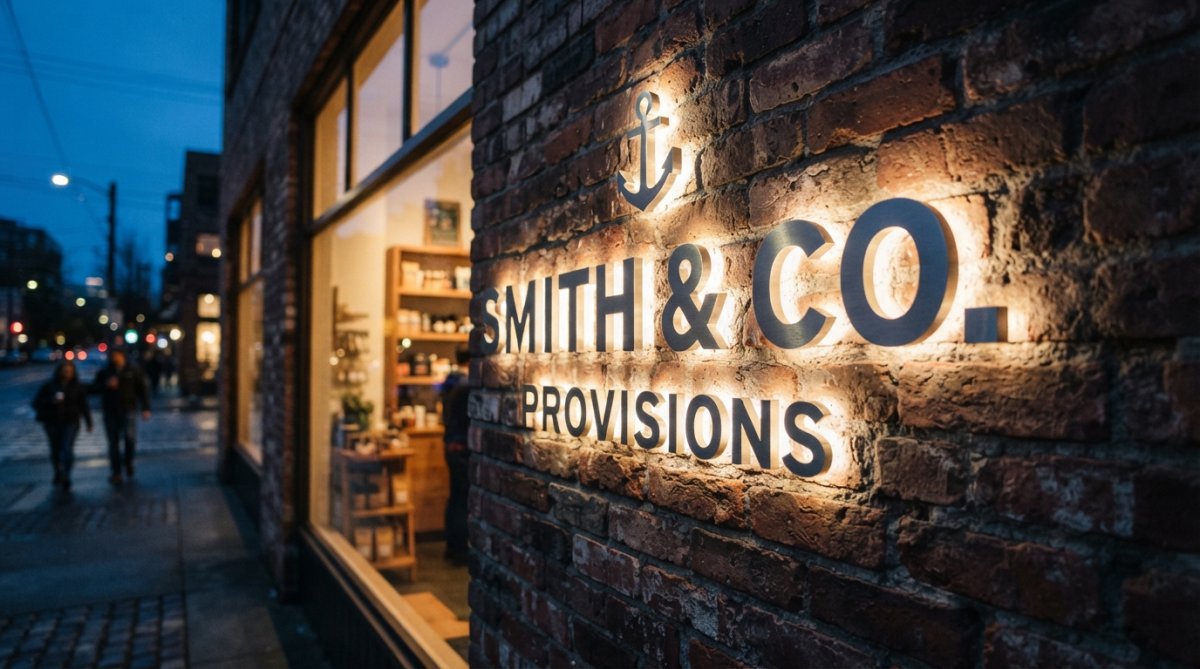
Aluminum is the workhorse of the sign industry. It is lightweight, resists corrosion, and handles temperature swings without warping. For most exterior channel letters and cabinet signs, a .080 to .125-inch thick sheet is standard. The main trade-off is that aluminum can dent on impact, so it is not ideal for ground-level signs in high-traffic areas.
Acrylic (often sold under brand names like Plexiglas or Lucite) offers a sleek, modern look and holds color well. Cell-cast acrylic is more impact-resistant and better for exterior applications. The trade-off is that acrylic scratches more easily than metal, and UV exposure can cause yellowing. Ask for a UV-stabilized grade and a matte finish.
High-density urethane (HDU) is a dense foam often carved into dimensional letters or logos. It is significantly lighter than wood or metal, reducing installation costs on tall walls. HDU is rot-proof and holds paint well, but it is not as impact-resistant as metal. It is best suited for signs mounted above reach or in protected areas.
Stainless steel and copper are premium options for a high-end look. Stainless steel resists corrosion and is nearly maintenance-free, but it is heavy and expensive. Copper develops a natural patina over time, which some brands embrace but others find unpredictable. For a polished metal look without the cost, aluminum with a metallic paint finish is a common alternative.
Do not choose a material based on appearance alone. A sign facing direct afternoon sun in Arizona will degrade differently than one in a shaded, humid climate. Ask your fabricator for a material warranty that covers fading, peeling, and delamination for at least five years.
Illumination is what makes your sign work after dark. LED lighting is the standard for its energy efficiency and bright, even output. But there are meaningful differences in how LEDs are deployed:
- Backlit channel letters (halo-lit) mount the LED module inside the letter, casting light onto the wall behind it. This creates a premium, floating effect but produces less direct light on the letter face itself. It works best on dark or textured walls where the halo is visible.
- Front-lit channel letters have a translucent face with LEDs shining through. This provides maximum legibility from a distance and is the better choice for high-speed roads.
- Cabinet signs (box signs) use a single large enclosure with a translucent face. They are the most cost-effective illuminated option for large formats but can look dated if not designed well.
LED color temperature matters more than most owners realize. A warm white (2700K-3000K) creates a welcoming feel. A cool white (5000K-6000K) reads as crisp and modern but can feel clinical. If your brand uses a specific color, verify that the LED color rendering index (CRI) is above 80 so the sign does not wash out your logo colors.
Maintenance is the most overlooked aspect of signage, and the one that determines whether your material and lighting investment pays off. A dirty sign with burned-out letters or fading sends a negative message. Establish a simple maintenance routine that includes:
- Quarterly cleaning: Use a mild soap and water solution for acrylic and painted metal. Avoid ammonia-based cleaners, which can cloud acrylic. For aluminum, a soft cloth and non-abrasive cleaner prevents scratching.
- LED inspection: Check the lighting output every 3-4 months. LEDs do not burn out like old bulbs; they gradually dim. If one section looks noticeably dimmer, the driver module may be failing. Catching this early prevents a full letter outage.
- Weather-proofing checks: After severe storms, inspect the sign for water intrusion, loose mounting bolts, or damaged gaskets. Water is the leading cause of electrical failure in illuminated signs.
- Annual professional inspection: Have a licensed sign technician check the wiring, ground fault protection, and structural mounting once a year. This is especially important for signs mounted above 10 feet, where wind load can loosen fasteners over time.
Most sign manufacturers require proof of regular maintenance to honor warranty claims. Keep a simple log of cleaning dates and repairs. Knowing who to call for repairs before you need them saves you from extended downtime.
Budget for the Cost of Custom Business Signs
The cost of custom business signs varies widely based on size, materials, complexity, and illumination. Rather than focusing on a single price, plan for a range that reflects the quality and longevity you need. To budget effectively, understand what drives the price, and how to measure whether the sign pays for itself.
The five primary cost drivers are:
-
Size and square footage. Sign fabricators price most work by the square foot. A 4-foot by 4-foot monument sign will cost roughly 2-3 times more than a 2-foot by 2-foot version, not just because of materials, but because the structural framing, footing, and installation labor scale up.
-
Material grade. A sign face made from .080-inch aluminum costs less than one made from .125-inch aluminum. Thicker material costs more but resists wind damage better. Acrylic thickness (1/8-inch vs. 1/4-inch) similarly affects both price and durability.
-
Illumination complexity. A non-illuminated sign is the least expensive option. Adding LED lighting increases cost for the modules, wiring, transformer, and the electrician’s time to connect it. Backlit channel letters cost more than front-lit because the light source must be precisely positioned inside each letter.
-
Custom fabrication vs. stock components. Standard channel letters in a common font are cheaper than fully custom dimensional letters with a unique profile. If your logo requires a custom die or mold, that tooling cost is a one-time expense that can add $500-$2,000 to the first order.
-
Installation conditions. A sign mounted on a ground-level concrete pad is less expensive to install than one requiring a crane, a bucket truck, or work on a second-story facade. If your building has no existing electrical conduit near the sign location, running new conduit adds significant labor cost.
A simple, non-illuminated interior sign (such as a lobby sign) is generally less expensive than a custom-fabricated, illuminated exterior monument sign with concrete footing and electrical work. The cheapest option is rarely the most cost-effective. A lower-priced sign made from thinner materials may need replacement in a few years, while a higher-quality sign lasts a decade or more. Consider the total cost of ownership.
Signage ROI and conversion tracking, the question most guides skip. A business sign is not just an expense; it is a marketing asset. To know if yours is working, you need a way to measure its impact:
-
Establish a baseline. Before your new sign goes up, track your foot traffic for two weeks. If you are a retail store, count walk-ins manually or use a simple people counter. If you are a service business, track how many new customers mention how they found you.
-
Set a conversion window. After installation, track the same metrics for 30-60 days. A well-placed sign typically shows measurable results within the first month, as regular passersby begin to notice and act on it.
-
Use a simple attribution method. Ask new customers, “How did you hear about us?” and include “saw your sign” as an option. For businesses near a road, compare sales on days when the sign is lit versus days when it is not (e.g., during a power outage or maintenance period).
-
Calculate the payback period. Divide the total installed cost of the sign by the average profit per new customer. If your sign costs $8,000 and each new customer generates $80 in profit, you need 100 new customers to break even. If the sign drives 10 new customers per month, the payback period is 10 months, a strong return for a long-term asset.
A sign that pays for itself in under 12 months is performing well. If your payback period extends beyond 24 months, revisit your placement, size, or illumination, the sign may not be visible enough to do its job.
For an accurate estimate, request itemized quotes from at least two full-service providers that handle design, fabrication, and installation in-house. Ask each provider to break out the cost of materials, fabrication labor, permits, electrical work, and installation separately. This approach often results in better coordination and fewer surprises than hiring separate contractors. The International Sign Association resources on planning and budgeting signage offers a helpful starting point for understanding what drives costs.
Plan for Installation and Maintenance
Installation is where a good sign can go wrong. A sign mounted crooked, wired incorrectly, or placed at the wrong height undermines your brand and can create safety hazards. Professional installation ensures the sign is secure and meets all code requirements.
Proper installation also protects your warranty. Most manufacturers require professional installation to keep the warranty valid. A full-service provider manages the entire process, from securing permits to coordinating the electrical connection.
Conclusion: Make Your Sign an Asset, Not an Afterthought
Your business sign is a long-term asset that works for you every single day. A well-planned sign, from initial purpose and placement through to materials and ongoing maintenance, delivers a return that far exceeds its cost.
The process requires attention to detail, from navigating zoning regulations to meeting ADA signage requirements. Working with an experienced partner eliminates the guesswork. With over 30 years of combined experience, Triton Sign provides full-service design, fabrication, and installation, ensuring your project is completed on time and within budget.
Get started with Triton Sign and turn your signage into a reliable driver of business visibility.
Frequently Asked Questions
What are the four main types of business signs?
Business signs generally fall into four categories: exterior signs (building-mounted or freestanding), interior signs (lobby displays and wall graphics), wayfinding signs (directional and informational), and digital or illuminated signs. Your choice depends on your goals. Exterior signs attract foot traffic, wayfinding guides customers inside, and interior signs reinforce your brand. Many small businesses need a combination to be effective.
How do local zoning laws affect business sign choices?
Zoning regulations for business signs dictate size, height, placement, and illumination. They can also restrict certain sign types in residential or historic districts. Before you invest in design, contact your local planning or permitting department to understand the rules. Your sign maker can often help navigate this process, but securing the permit is your responsibility. Skipping this step can lead to fines and forced removal.
How does ADA compliance impact sign design?
ADA signage requirements apply to permanent room identification and directional signs in most public buildings. These rules mandate specific color contrast, non-glare finishes, and tactile characters. The Americans with Disabilities Act requires braille and raised letters for signs that identify permanent rooms. Your sign provider should be well-versed in these standards to ensure your project passes inspection and is accessible to everyone.
What is the most common signage mistake to avoid?
The most common mistake is prioritizing aesthetics over legibility. Complicated fonts, low color contrast, and cluttered layouts make signs hard to read from a distance. A sign that is beautiful but illegible fails its primary job. When reviewing a design, step back and ask if a passerby can understand your message in under three seconds. If not, simplify the design to focus on clarity.
This article was published by Triton Sign. For more information on how we can support your signage project, contact our team today.