
Table of Contents
- Why Fast Signage Projects Fail Without Exceptional Customer Service
- The Commercial Sign Installation Timeline: Where Delays Actually Happen
- How We Evaluate a Signage Partner for Speed and Service
- Best Practices for Signage Project Management on Tight Deadlines
- Practice 1: Front-Load All Decisions in a Single, Structured Kickoff
- Practice 2: Mandate a 24-Hour Revision Turnaround with a Service-Level Agreement (SLA)
- Practice 3: Sequence Work for Parallel Processing and Manage the Bottlenecks
- Practice 4: Build a Service Recovery Plan for the Compressed Schedule
- How to Expedite Custom Sign Fabrication Without Sacrificing Quality
- Red Flags to Avoid in Fast-Track Signage Partners
- Final Verdict: What to Demand From Your Signage Partner
- Frequently Asked Questions
Last Updated: September 7, 2026
Why Fast Signage Projects Fail Without Exceptional Customer Service
A construction schedule is only as reliable as the vendors who feed into it. When a sign contractor misses a delivery window, the ripple effect stalls interior finishes, inspections, and ultimately your certificate of occupancy. The difference between a project that lands on time and one that spirals into delay is rarely fabrication speed. It is the quality of communication, responsiveness, and accountability wrapped around the production work. Exceptional customer service is the operational discipline that keeps a fast-track signage project moving, and it is the first thing to disappear when a vendor is overwhelmed.
Most project managers have a version of the same story: a sign company that went silent for two weeks, then delivered a product that did not match the approved mockup. The failure was not in the shop. It was in the absence of proactive status updates, a clear escalation path, and a single point of contact who owned the outcome. When you are managing a commercial build, you need a partner who treats your deadline as their own.
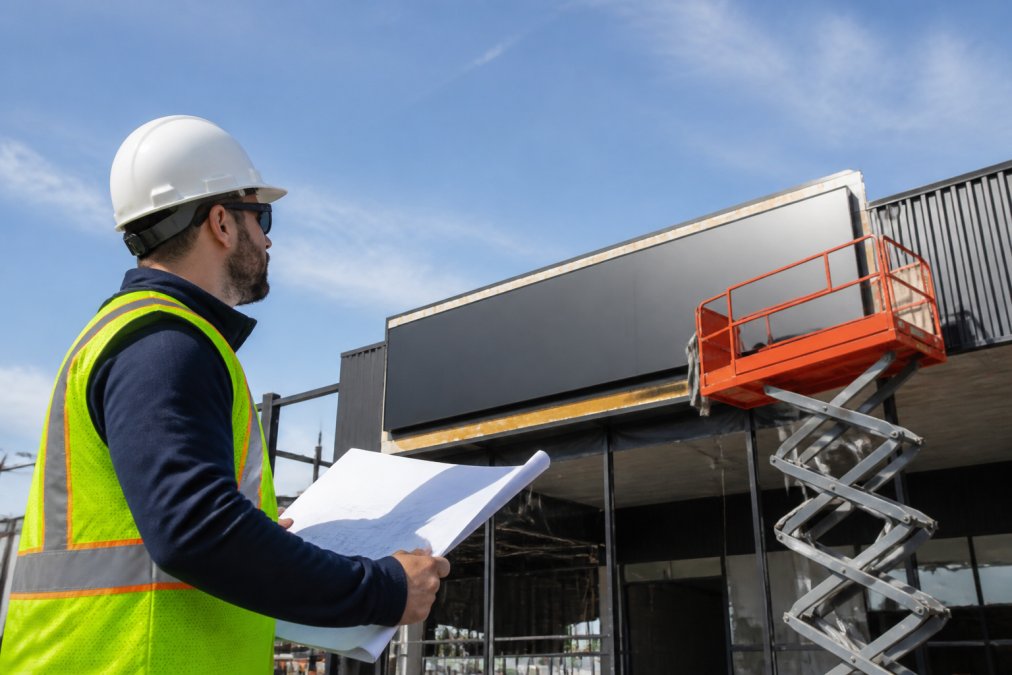
That level of service is not a luxury add-on. It is the mechanism that prevents small issues, like a missing permit or a dimensional conflict, from becoming schedule-killing problems. Without it, even the fastest fabrication shop in the region will fail you.
The Commercial Sign Installation Timeline: Where Delays Actually Happen
A typical commercial sign installation timeline spans several distinct phases, and delays concentrate in predictable places. The standard process includes design and engineering, permit procurement, fabrication, and finally installation and inspection. Most project managers budget for fabrication time, but the hidden bottlenecks are almost always in the steps that require coordination between parties.
The first common delay is the permit process. Sign permits require approved drawings, structural calculations, and often electrical details. If your vendor does not have a dedicated permitting department or a pre-existing relationship with local authorities, this step alone can add weeks. The second bottleneck is the design approval cycle. Every revision round that takes three days instead of one pushes the entire schedule back. A vendor that assigns a dedicated project coordinator to chase approvals internally and externally will compress this window significantly.
The final delay zone is installation readiness. A crew arrives on site only to find the power supply is not roughed in, or the mounting surface is not prepared. An experienced partner flags these dependencies during a pre-installation survey, not on the day of the install. According to guidance from the Signage and graphics industry standards on project workflows, front-loading coordination is the most effective way to protect a downstream timeline. When evaluating a partner, ask them to walk you through their timeline for a project similar to yours, and press them on where they have seen delays occur.
How We Evaluate a Signage Partner for Speed and Service
When we assess a signage partner for a fast-paced project, we look for evidence of systems, not promises. A vendor can claim they prioritize speed, but the proof lives in their workflow documentation, their staffing model, and their track record. We evaluate on four core criteria: communication cadence, permitting capability, fabrication capacity, and installation crew experience.
Communication cadence is the first indicator. Does the vendor provide a single point of contact, or are you routed through a general inbox? Do they offer scheduled status updates, or do you have to chase them? A partner who provides a weekly written progress report, including photos from the shop floor, is demonstrating a commitment to transparency that directly supports your ability to manage your own stakeholders.
Permitting capability is the second differentiator. A vendor that handles permit submission and retrieval in-house removes a major source of timeline risk. Fabrication capacity matters too; you need to know if they have the shop space and crew size to handle your order without queueing it behind larger jobs. Finally, installation experience with your specific building type, whether that is a high-rise facade or a ground-level monument sign, prevents on-site surprises. For a deeper look at how to structure vendor evaluations, the Project Management Institute’s guidance on vendor selection criteria offers a useful framework for weighting these factors against your specific risk tolerance.
Best Practices for Signage Project Management on Tight Deadlines
Managing a signage project on a tight deadline requires a different operating rhythm than a standard timeline. The best practices for signage project management center on compressing the approval cycle, not just the production cycle. You can save a week in fabrication, but if you lose that week waiting for a client sign-off, you are back where you started. However, the most critical practices are the ones that prevent the service experience from collapsing when the schedule compresses. Here is how to maintain exceptional communication and responsiveness when every day counts.
Practice 1: Front-Load All Decisions in a Single, Structured Kickoff
Schedule a kickoff meeting where every stakeholder, including the end client, the general contractor, and the architect, reviews the design mockups and makes final selections on materials, colors, and mounting methods. This single meeting eliminates the back-and-forth email chains that typically consume a week of the schedule. But to make it work, you must circulate the full design package and a decision log 48 hours in advance. The decision log should list every open item, the required approver, and the deadline for a response. Without this structure, the meeting itself becomes another delay.
Practice 2: Mandate a 24-Hour Revision Turnaround with a Service-Level Agreement (SLA)
Agree upfront that design feedback will be provided within 24 hours, and hold your internal team to that standard. But a verbal agreement is not enough. The SLA must be written into the project contract and include a clear escalation path. For example, if the client’s approval is not returned within 24 hours, the vendor’s project coordinator should automatically escalate to the client’s senior stakeholder and the general contractor’s project manager. This is not about being aggressive; it is about creating a mechanism that surfaces a stalled decision before it silently consumes three days of your float. A written SLA with a named escalation contact can reduce average approval cycles.
Practice 3: Sequence Work for Parallel Processing and Manage the Bottlenecks
While the permit is being approved, the vendor should be fabricating non-permit items, such as dimensional letters or interior wayfinding. While the fabrication runs, the installation crew should be conducting their pre-installation site survey. This overlap is where real schedule compression happens. However, parallel processing introduces a new bottleneck: coordination. When multiple workstreams run simultaneously, the vendor must hold a daily 15-minute stand-up meeting to review the critical path. The project coordinator’s job is to identify which workstream is falling behind and reallocate resources before the delay compounds. A common pattern in fast-track projects is that the permit workstream stalls, and the vendor keeps fabricating items that cannot be installed without the permit. The coordinator must flag this dependency and shift crew hours to other tasks, such as prefabricating mounting brackets or pre-wiring electrical components, to keep the team productive.
Practice 4: Build a Service Recovery Plan for the Compressed Schedule
When deadlines are compressed, the margin for error is zero. A single missed delivery can cascade into a week of delay. Therefore, the project plan must include a service recovery protocol. This means the vendor identifies, in advance, which steps have a single point of failure and what the backup plan is. For example, if the primary fabrication crew is delayed by a material shortage, is there a secondary crew available for overtime? If the permit office is backed up, does the vendor have a relationship with a private expediter? The table below summarizes the key practices and their impact on the timeline.
| Practice | Time Investment | Schedule Impact | Service Impact |
|---|---|---|---|
| Front-loaded kickoff meeting with decision log | 2-3 hours plus 48 hours prep | Eliminates days of email approval cycles | Sets clear expectations for responsiveness |
| Written 24-hour revision SLA with escalation | 30 minutes to draft contract language | Prevents 3-5 day approval stalls | Creates a transparent escalation path |
| Daily 15-minute stand-up for parallel workstreams | 15 minutes per day | Prevents bottleneck-driven delays | Keeps all stakeholders informed of progress |
| Pre-identified service recovery plan | 1 hour in project planning | Prevents day-of-install failures | Demonstrates accountability and reduces client anxiety |
The key insight is that fast project delivery is not just about speed; it is about predictability. A vendor who can articulate exactly where a delay might occur, and what they will do about it, provides a level of service that a generic ‘we prioritize your project’ promise cannot match.
How to Expedite Custom Sign Fabrication Without Sacrificing Quality
Expediting custom sign fabrication is possible, but it requires a vendor with the right internal systems. Rushing a fabrication process that lacks quality checkpoints produces a sign that fails inspection or looks unprofessional on your building. The goal is to compress the schedule without cutting the steps that protect the final product.
The first lever is material availability. A vendor that stocks common substrates, like aluminum composite panel and acrylic, can start production immediately. A vendor that must order materials after receiving your purchase order adds a week or more to the timeline. Ask about their inventory levels during the quoting phase. The second lever is crew allocation. A vendor with multiple fabrication teams can dedicate a crew to your project rather than slotting it into a single production line.
The third lever is digital proofing. A vendor that uses high-resolution digital mockups for approval reduces the need for physical samples, which take days to produce and ship. This is where the National Electrical Manufacturers Association guidance on illuminated sign quality reinforces the importance of standardized electrical components; using pre-listed parts means fewer custom engineering hours and faster inspection sign-off. The trade-off for speed is that you must be decisive. Every change request, no matter how small, resets the fabrication clock.
Red Flags to Avoid in Fast-Track Signage Partners
Spotting the warning signs early saves you from a mid-project crisis. The most telling red flag is a vendor who is eager to quote your project but vague about their current production capacity. If they cannot tell you how many jobs are ahead of yours in the queue, assume your project will be queued behind larger, more profitable work. But beyond the obvious signs, there are four specific red flags that indicate a vendor cannot deliver exceptional customer service under the pressure of a fast-track schedule.
Red Flag 1: No Written Service-Level Agreement (SLA) for Communication
A vendor who cannot define their communication cadence in writing will not meet your expectations under pressure. Ask for their standard SLA: How often will you receive a status update? Who is the single point of contact? What is the maximum response time for a critical question? If the vendor says ‘we are always available’ but cannot put a specific response-time commitment in the contract, they are not prepared for the realities of a compressed schedule. A credible partner will commit to a specific response time for critical issues and regular written progress reports during the final two weeks before installation.
Red Flag 2: No Defined Escalation Path for Bottlenecks
Fast-track projects fail when a bottleneck is discovered late. A vendor who cannot describe their escalation path for a stalled permit, a material shortage, or a fabrication error is a liability. Ask them directly: ‘If the permit is delayed by five days, what happens to the installation date?’ A vendor with a mature process will explain how they re-sequence the work, which tasks can be pulled forward, and who has the authority to make that call. A vendor without a plan will say ‘we will figure it out,’ which means you will be the one explaining the delay to your client.
Red Flag 3: No Pre-Installation Site Survey Process
A vendor who does not conduct a pre-installation site survey is gambling with your schedule. The survey is not a courtesy; it is the mechanism that identifies missing power supplies, unprepared mounting surfaces, and dimensional conflicts before the crew arrives. Ask to see their survey checklist. Does it include verifying the electrical rough-in location, measuring the mounting surface, and confirming access for a lift or crane? If the vendor treats the survey as an afterthought, they will discover problems on installation day, and you will lose a week or more.
Red Flag 4: No Service Recovery Plan in the Contract
Finally, be wary of a vendor who cannot articulate their service recovery process. Ask them directly what happens if they miss a delivery date. A partner with a clear plan, whether that involves overtime installation crews or expedited shipping, is more trustworthy than one who insists it will never happen. The Federal Trade Commission’s guidance on deceptive business practices and reliability claims is a useful reference for understanding what constitutes a substantiated promise versus marketing language. But the deeper issue is operational: a vendor who has not planned for failure will improvise under pressure, and improvisation is the enemy of a fast-track schedule. Trust your instincts: if a vendor feels disorganized during the sales process, they will be less organized during execution. The absence of a written SLA, a defined escalation path, a survey checklist, and a recovery plan are not minor oversights; they are structural indicators that the vendor’s customer service model is not built for the speed you require.
Final Verdict: What to Demand From Your Signage Partner
The commercial sign installation timeline is unforgiving, and your choice of partner determines whether you meet your deadline or explain the delay to your client. Demand a partner who provides a single point of contact, a written project schedule, and a proactive communication cadence. Require in-house permitting capability and a pre-installation site survey. Insist on a clear service recovery plan before you sign the contract, not after a problem arises.
At Triton Sign, we have built our workflow around these principles. With over 30 years of combined sign and display experience, our team delivers full-service design, fabrication, and installation while consistently meeting tight deadlines and budget constraints. We handle everything from ADA-compliant signage to complex architectural installations, and we treat your project timeline as our own. Whether you are managing a multi-location rollout or a single office renovation, we provide the project management discipline that keeps your build on track.
Frequently Asked Questions
What defines exceptional customer service in commercial signage?
In commercial signage, exceptional customer service means proactive communication, realistic timeline setting, and a partner who flags issues before they become delays. It includes a dedicated project manager who responds quickly, provides clear installation schedules, and coordinates with your construction team. The goal is to deliver a high-quality sign that meets code and looks right, without you having to chase updates. This level of service is what separates a vendor from a true project partner.
How do top sign contractors balance fast project delivery with quality?
Top sign contractors balance speed and quality with structured project management and proven fabrication processes. They use clear best practices for signage project management, such as early material ordering and design reviews, to prevent rework. They also maintain strict quality control checks during fabrication to catch issues before installation. This approach allows them to meet tight deadlines without cutting corners on materials, craftsmanship, or code compliance, ensuring a final product that is both on time and built to last.
What should you look for in a signage partner for tight deadlines?
Look for a partner with a verifiable track record of hitting commercial sign installation timelines. Ask about their in-house fabrication capacity, which reduces reliance on third-party vendors that cause delays. A strong partner offers a dedicated project manager who provides regular updates and a clear point of contact. They should also offer guidance on permitting and ADA compliance to avoid costly rework. Most importantly, they should be honest about what is achievable within your timeframe rather than overpromising.
How does proactive communication impact signage project timelines?
Proactive communication is the single biggest factor in keeping a signage project on schedule. When a contractor flags a potential material shortage or an installation conflict early, you have time to make adjustments. This approach prevents small issues from becoming major delays that push your opening date. A partner who provides regular status updates and answers questions quickly helps you manage your own stakeholders. This transparency builds trust and ensures that the fast project delivery you planned for actually happens.
Fast-moving projects do not need to be chaotic. They need a vendor who brings structure, communication, and accountability to the table. Triton Sign combines high-quality workmanship with reliable project completion, even under the tightest timelines, and we stand behind our work long after the installation is complete. Contact us today to discuss your project timeline and see how we can deliver exceptional customer service for your next fast-paced build.