Table of Contents
- Why Sign Maintenance Projects Miss Deadlines (And How to Prevent It)
- Sign Maintenance Project Management Best Practices for Tight Timelines
- Step 1: Prioritize Critical Path Tasks for Sign Work
- Step 2: Establish Communication Protocols That Keep Stakeholders Aligned
- Step 3: Use a Technology Stack for Real-Time Field Tracking
- Emergency Sign Repair Turnaround Time: What Realistic Schedules Look Like
- How to Choose a Reliable Sign Repair Company for Your Next Project
- Common Pitfalls That Derail Sign Installation Schedules
- Frequently Asked Questions
Last Updated: September 5, 2026
Sign maintenance projects fail on schedule for reasons that have little to do with the work itself. Permits arrive late, site access gets blocked, or a component backorder stalls the critical path. At Triton Sign, over 30 years of combined experience has taught us that the difference between a delayed install and an on-time finish is rarely the crew’s skill, it is the planning architecture built before the first ladder goes up.
When a construction project misses its signage deadline, occupancy certificates get delayed, retail openings slip, and brand launches lose momentum. Below, we show how to structure scope, risk, and communication so your next sign project lands on time.
Why Sign Maintenance Projects Miss Deadlines (And How to Prevent It)
Most missed deadlines trace back to a single failure: the project baseline was never established. Without a documented baseline covering scope, schedule, and budget, every change order becomes a crisis rather than a controlled adjustment.
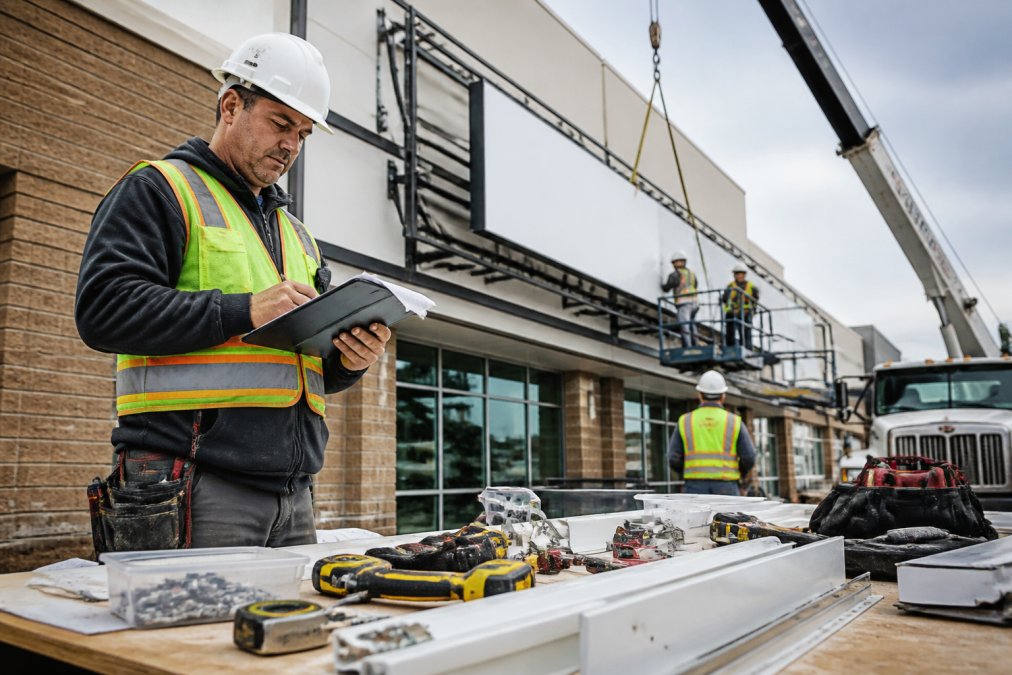
The sign industry carries unique risks that generic advice ignores. Site access for crane work depends on weather, property owner permissions, and permitting timelines. Electrical connections require coordination with utility providers and licensed electricians. Fabrication delays cascade differently when a custom neon unit or ADA-compliant panel is involved.
Prevention starts with honest scheduling. Build buffer time into every phase, but place the largest buffer before installation, not after. A skilled project manager knows that fabrication can be expedited, but a permit appeal cannot.
Skipping the baseline to “save time” guarantees rework later. Every unplanned change becomes a negotiation, and the schedule absorbs the cost. Establish the baseline in writing before fabrication begins.
Sign Maintenance Project Management Best Practices for Tight Timelines
Reliable project completion under tight timelines depends on four disciplines: scope definition, risk documentation, critical path management, and communication protocols. Skipping any of them introduces schedule risk.
The best approach treats scheduling as a living document, not a one-time estimate. Project milestones should be reviewed weekly, and the critical path should be recalculated whenever a task slips.
Define Scope and Baseline Early
Scope definition is the foundation of reliable project completion. The scope document must specify every deliverable: the exact sign types, mounting methods, electrical requirements, and finish specifications. Ambiguity becomes a delay when the client approves a design that cannot be fabricated in the promised window.
Project baselining locks the scope, schedule, and budget into a formal agreement. Once baselined, any change triggers a documented review of its schedule impact. This is the mechanism that keeps tight timelines intact when a client requests a mid-project modification.
Build a Risk Register for Site Access and Permits
A risk register is a simple table listing every identified risk, its likelihood, its impact, and a mitigation plan. For sign work, the top entries are almost always site access restrictions and permit delays.
Document the following for every site before scheduling installation:
- Required permits and their expected approval windows
- Crane access constraints, including overhead lines and weight limits
- Property owner rules for working hours and noise
- Weather contingencies for exterior work
- Electrical disconnect and reconnect coordination
Step 1: Prioritize Critical Path Tasks for Sign Work
The critical path is the sequence of tasks that determines the earliest possible project completion date. For sign installation, the critical path typically runs from permit approval through fabrication, then to site prep, and finally to installation and inspection.
Map your tasks and identify which ones have zero float, meaning any delay directly pushes the finish date. These tasks get first priority for resources and attention. Non-critical tasks, such as interior graphics that can be installed after the main sign, should be scheduled flexibly around the critical path.
A common mistake is treating all tasks as equally urgent. This guarantees that the truly critical work gets starved of attention. Use a simple prioritization: critical path tasks first, near-critical tasks second, and flexible tasks last.
Step 2: Establish Communication Protocols That Keep Stakeholders Aligned
Stakeholder expectations drift when communication is sporadic. A documented communication protocol fixes the cadence: a weekly status report, a mid-project check-in, and a pre-installation walkthrough.
The weekly report should cover schedule status against the baseline, any risks that have materialized, and upcoming milestones. This keeps the client informed without requiring them to chase updates, which is a primary source of friction on construction projects.
For multi-location branding rollouts, consistency depends on the same protocol running at every site. Standardized checklists ensure that a sign installed in one market matches the one installed in another, down to the mounting height and finish color.
Assign a single point of contact for the client. When stakeholders receive updates from different people, version confusion multiplies. One voice, one report, one accountable owner.
Step 3: Use a Technology Stack for Real-Time Field Tracking
Real-time field tracking is the difference between reacting to delays and preventing them. The most reliable project completion is built on a simple, three-tier technology stack that connects the office, the field crew, and the client. It is not about buying the most expensive platform; it is about creating a disciplined system of record that eliminates guesswork.
Tier 1: The Project Management Hub (The System of Record)
This is the central database for all project information, not a chat app. The hub should be a tool like Monday.com, Asana, or ClickUp that allows for task dependencies, milestone tracking, and file attachment. The critical feature is defining a task list that mirrors your critical path.
- What to Track: Every task from permit application submission to final inspection sign-off. Each task should have an owner, a due date, and a status (e.g., Not Started, In Progress, Blocked, Complete).
- The Key Discipline: The project manager updates the task status based on field reports, not on the original schedule. If a task is blocked, it is marked as ‘Blocked’ immediately, triggering a review of the critical path.
Tier 2: The Field Communication Channel (The Source of Truth)
This tool connects the crew in the field to the project manager in the office. Email is too slow and creates fragmented threads. The most effective option is a dedicated channel in Slack, Microsoft Teams, or a purpose-built field service app like Fieldwire or Jobber.
- What to Track: The crew logs their arrival time, a photo of the completed work, and any site issues (e.g., ‘discovered conduit is blocked’, ‘wall is not plumb’) in real-time.
- The Key Discipline: The project manager’s rule is to respond to any ‘blocked’ or ‘issue’ message within 30 minutes during working hours. This immediate response loop is what allows for rapid resource reallocation before a delay becomes a missed deadline.
Tier 3: The Client-Facing Dashboard (The Trust Builder)
This is a simple, read-only view of the project hub shared with the client, providing transparency without requiring them to ask for updates. It can be a shared spreadsheet, a folder of weekly photo logs, or a ‘Guest View’ in your project management tool.
- What to Track: A high-level status of the critical path milestones (e.g., Permits Approved, Fabrication Complete, Installation Scheduled) and a weekly photo log of progress.
- The Key Discipline: The dashboard is updated every Friday at 4:00 PM. This consistent cadence prevents the client from calling the office for status updates, freeing up the project manager to focus on execution.
The ‘Photo Log’ as a Non-Negotiable Deliverable
The single most underrated tool in sign maintenance is the photo log, irrefutable evidence of progress and quality. For every site visit, the crew must take three photos: a wide shot of the site, a close-up of the work performed, and a shot of the completed task. Uploaded to the project hub, they become part of the permanent record and do more to prevent disputes than any other action.
Do not over-engineer the stack. A provider that uses a disciplined Google Sheets log with mandatory photo attachments can outperform a provider with an expensive, unused CRM. The discipline is the deliverable, not the software. The technology simply makes the discipline visible.
Why This Stack Prevents Delays
When a delay occurs, the project manager sees it in hours, not days. If a crew member logs ‘Blocked: No power at the disconnect’ at 10:00 AM, the manager can call the electrician and have a resolution plan by noon. Without this stack, the issue might not surface until the crew returns at day’s end, losing a full day. This proactive visibility defines reliable project completion.
Emergency Sign Repair Turnaround Time: What Realistic Schedules Look Like
Emergency sign repair is a distinct workflow from scheduled maintenance; treating it as an afterthought causes extended downtime and compliance risk. Reliable completion hinges on a clear, pre-defined emergency response protocol that accounts for the physical and regulatory realities of a failed sign.
The Two-Phase Response: Triage and Repair
The most effective model separates the response into two distinct phases: making the site safe and restoring full function. This is not a minor scheduling detail; it is the core mechanism that protects both the public and your project timeline.
Phase 1: Triage and Securing (Within 24 Hours)
For any failure that poses a public safety hazard, a loose cabinet, a dangling raceway, exposed wiring, or a sign that is dark over a public walkway, the response clock starts immediately (osha.gov). The goal is not a full repair but to remove the hazard and secure the site. This involves:
- Immediate Dispatch: A technician is dispatched within a 24-hour window to assess the situation.
- Site Securing: The technician’s first action is to disconnect power to the sign and secure any loose components. This may involve temporary bracing, tarping, or, in severe cases, a partial takedown.
- Documentation: The technician documents the failure with photos and a written report, which is immediately sent to the project manager and the client. This documentation is critical for insurance claims and for planning the permanent repair.
- Permit and Utility Coordination: If the repair requires a permit or an electrical disconnect, the project manager begins that process immediately upon receiving the technician’s report, not after the repair is scheduled.
Phase 2: Permanent Repair (3-10 Business Days)
Once the site is safe, the permanent repair is scheduled. The realistic turnaround time here depends on parts availability and the nature of the failure (signs.org).
- LED Module Failure: If the sign uses standard, off-the-shelf modules, the repair can often be completed within 3-5 business days. The delay is rarely the part itself but rather scheduling a crew for the follow-up visit.
- Custom or Obsolete Components: If the sign uses a custom neon unit, a non-standard transformer, or a proprietary controller, the timeline extends to 7-10 business days or more. The project manager must immediately verify parts availability and, if the part is obsolete, initiate a retrofit plan.
- Structural Damage: If the sign’s cabinet or mounting structure is compromised, the repair becomes a mini-construction project. This requires a structural assessment, potentially a new fabrication, and a full installation, pushing the timeline to 2-4 weeks.
The Critical Role of the Pre-Authorized Service Agreement
The single biggest bottleneck in emergency repair is not the repair itself, it is the approval process. Waiting for a purchase order before dispatching a technician adds 24-48 hours of avoidable downtime.
A pre-authorized service agreement (PSA) solves this (ifma.org). Established before an emergency, it authorizes the provider to perform triage and safety-securing work up to a pre-defined dollar amount without a new PO. This allows immediate dispatch, ensuring the site is safe and the clock on the permanent repair starts right away.
Do not confuse ‘making the site safe’ with ‘completing the repair.’ A site is not compliant until the sign is fully functional and passes any required electrical inspection. A temporary fix that is left in place for weeks is a liability, not a solution. Always schedule the permanent repair before the technician leaves the site.
Why This Workflow Matters for Your Bottom Line
For a retail tenant, a dark or unsafe sign can mean a lease violation, loss of foot traffic, or forced closure. For a construction project, it can delay a certificate of occupancy. A documented, two-phase emergency response plan protects your operational continuity and compliance standing.
How to Choose a Reliable Sign Repair Company for Your Next Project
Choosing a reliable sign repair company requires vetting their project management capability, not just fabrication quality. Ask how they handle site access, permit coordination, and schedule changes before asking about pricing.
A reliable provider should offer a documented scope definition process and a named project manager as your single point of contact. They should articulate their critical path and contingency plan for common delays like weather or parts backorders.
Look for evidence of consistent deadline performance across past projects. A provider that has completed work for construction firms, property managers, and retail operators across multiple sites has proven they can handle the logistics that separate on-time delivery from repeated delays.
| Selection Criteria | What to Ask | Why It Matters |
|---|---|---|
| Project management | Who is my single point of contact? | Prevents communication gaps |
| Site access planning | How do you handle permits and crane access? | Avoids schedule-killing delays |
| Emergency response | What is your turnaround for safety hazards? | Keeps sites compliant fast |
| Deadline track record | Can you show past on-time completions? | Evidence beats promises |
| Full-service capability | Do you fabricate and install in-house? | Reduces coordination risk |
Common Pitfalls That Derail Sign Installation Schedules
Several recurring pitfalls derail sign installation schedules regardless of the provider. Recognizing them early is the best defense.
The first pitfall is underestimating permit lead times; municipal review cycles vary widely. The second is failing to verify site conditions before the crew arrives, such as confirming the mounting surface can bear the sign’s weight or that electrical service is available.
The third pitfall is scope creep disguised as a “small change”; every modification should be routed through change control. The fourth is poor contractor accountability, where subcontractor slippage becomes the project’s slippage.
Reliable project completion under tight timelines is not about working faster. It is about planning better: define scope, document risk, manage the critical path, and communicate relentlessly. Providers who master these disciplines deliver on time, every time.
Choosing the right partner solves most of these problems before they start. Triton Sign brings over 30 years of combined experience to every project, with full-service design, fabrication, and installation under one roof. Our proven ability to meet project deadlines and budget constraints, paired with high-quality workmanship and exceptional customer service, makes us the trusted choice for reliable project completion even under tight timelines. Get started with Triton Sign and keep your next signage project on schedule.
Frequently Asked Questions
What is a realistic emergency sign repair turnaround time?
For urgent issues like a sign falling or a complete electrical failure, a reliable sign maintenance company should be able to dispatch a technician within 24 hours for an on-site assessment. The actual repair turnaround time depends on parts availability and whether it is a temporary fix or a permanent solution. Ask your provider what their average response window is before you need them.
How do you prioritize sign maintenance tasks when facing tight deadlines?
Start by separating safety hazards from cosmetic issues. Code violations, electrical shorts, and structural damage go to the top of the list. Then, focus on signs that impact revenue or public access. For a multi-site project, group tasks by geographic proximity to cut travel time. Finally, confirm which tasks fall on the critical path of the overall construction schedule so you do not delay other trades.
What are the key indicators of a reliable sign maintenance company?
Look for a provider that offers a dedicated project manager rather than a call center, carries liability insurance, and provides a written schedule with clear milestones. They should share their safety record and confirm they handle permit applications in-house. Ask for references from recent projects with similar scope. A company that proactively flags potential site access issues during the bid phase shows they understand field operations.