
Last Updated: October 27, 2026
Quick Summary
Evaluate a signage partner by scoring every bidder on the same weighted criteria, including in-house site surveys, in-house fabrication, employed installation crews, permit experience, and delivery benchmarks. Ask each bidder for quote turnaround, design approval time, on-time milestone rate, and rework rate, then put named milestones and dates in the contract.
- Run a documented site survey of every location before design is finalized and before bids are compared.
- Score each bidder 1 to 5 per row, multiply by the weight, and total; a perfect score is 105.
- Ask who fabricates the sign and where, and confirm installers are employees rather than subcontractors.
- Request the percentage of milestones hit on time over the last 12 months from every bidder.
- Put named milestones with dates, a change-order process, and a remedy in the contract.
Table of Contents
- Why Fast Signage Delivery Starts With Partner Selection
- Run a Signage Site Survey Before You Compare Bids
- Use a Sign Company Project Checklist to Score Each Bidder
- Map the Signage Project Timeline You Should Expect
- Test Production Capacity and Delivery Accountability
- What Actually Causes Signage Project Delays
- Contract Terms That Protect Your Schedule
- Request a Signage Project Quote From Triton Sign
- Frequently Asked Questions
Why Fast Signage Delivery Starts With Partner Selection
Most signage project delays are decided before a single sign is fabricated. They are baked in at the moment you choose who builds and installs it.
Run a Signage Site Survey Before You Compare Bids
A signage site survey is a documented physical assessment of every location where a sign will be mounted, covering wall substrate, dimensions, power access, sight lines, and code constraints. It happens before design is finalized and before bids are compared.
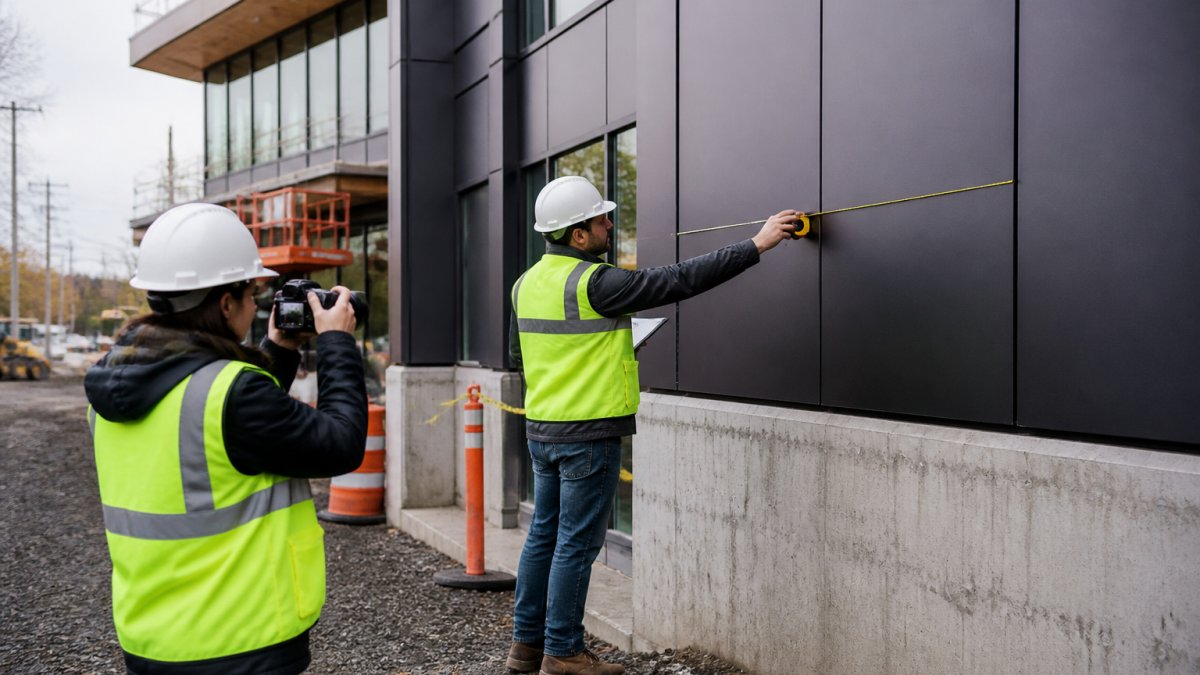
A proper site assessment for each location should capture:
- Exact mounting dimensions and substrate type
- Electrical availability for illuminated or digital signage
- Local zoning and historic-district constraints
- Installation access, including equipment staging and loading zones
- Wayfinding sight lines for interior and exterior signs
Ask every bidder whether they perform the survey themselves or subcontract it.
Use a Sign Company Project Checklist to Score Each Bidder
Use the same criteria, the same weights, and the same 1-to-5 scale for every bidder, and total the points before you negotiate.
| Criterion | What to Look For | Weight | Score (1-5) | Weighted Score |
|---|---|---|---|---|
| Site survey | Performed in-house, documented with photos and measurements | 3 | ||
| Production capacity | In-house fabrication and printing, not brokered | 3 | ||
| Installation crew | Local, employed installers, not day labor | 3 | ||
| Permit experience | Handles approvals and compliance in your jurisdiction | 3 | ||
| Delivery benchmarks | Can produce quote turnaround, approval time, and on-time rate | 2 | ||
| Design and proofing | Structured approval workflow with named approver | 2 | ||
| Communication | Named project manager, set reporting cadence | 2 | ||
| Risk and contingency | Written escalation plan and schedule buffers | 2 | ||
| Warranty and service | Written post-install response terms | 1 |
Score each bidder 1 to 5 per row, multiply by the weight, and total. A perfect score is 105.
Questions to Ask During Vendor Selection
The scorecard only works if you ask the same questions of every bidder. Use this interview checklist and record the answers verbatim:
- Who performs the site survey, and can I see a sample survey report?
- Who fabricates the sign, and in which facility?
- Are installers employees or subcontractors, and how are they scheduled?
- What is your average quote turnaround and design approval time?
- What percentage of milestones did you hit on time over the last 12 months?
- How many concurrent locations can you handle without adding lead time?
- What is your written escalation process when a milestone is at risk?
- Who owns permit filing, and what happens if a permit is delayed?
- How do you handle change orders, and how do they affect the schedule?
- What are the warranty terms and the response time for post-install issues?
Weight the scorecard before you send the RFP, not after the bids come back. Changing weights once you have seen the numbers is how price quietly becomes the only criterion.
If you want a shortlist to compare against your scores, see our roundup of the 5 best commercial sign contractors in Seattle for 2026.
Map the Signage Project Timeline You Should Expect
- Requirements gathering and stakeholder alignment
- Site survey and location assessment
- Design, proofing, and design approval
- Permits, approvals, and regulatory compliance
- Material and production planning
- Fabrication and digital printing
- Installation and coordination
- Final walkthrough and quality control
Permits are usually the longest variable. To keep milestones on track, compare the best project management software for signage projects. The U.S. Small Business Administration guide to local permits and licenses is a useful starting point for understanding what your jurisdiction may require, though sign permits are handled at the local level.
Test Production Capacity and Delivery Accountability
Ask directly: who fabricates the sign, and where?
Verify Capacity, Not Just Claims
Ask for evidence in four areas:
- Production floor. Request a walkthrough or a dated photo set of the fabrication and print area. Ask how many square feet of production space they operate and how many shifts they run.
- Crew availability. Ask how many installers are on staff, whether they are employees or subcontractors, and how crews are assigned across concurrent jobs.
- Geographic coverage. Confirm which markets they cover with their own crews and which rely on subcontractors. A partner with local crews in your market controls installation timing; one who subs it out does not.
- Concurrent-location load. Ask how many locations they can run at once before lead times stretch. A partner who cannot name a number has not planned for your rollout.
Score both.
Delivery-Performance Benchmarks to Request
Request these benchmarks from every bidder and compare them side by side:
| Benchmark | What It Measures | What to Ask For |
|---|---|---|
| Quote turnaround | Responsiveness before award | Median business days from request to written quote |
| Design approval time | Proofing workflow speed | Median days from first proof to signed approval |
| On-time milestone rate | Schedule reliability | Percentage of milestones hit on time over the last 12 months |
| Installation lead time | Crew scheduling | Median days from fabrication complete to install complete |
| Rework rate | Quality and re-visit risk | Percentage of installs requiring a return trip |
Delivery Accountability and Escalation
Delivery accountability is the second half. Ask:
- Who is the named project manager, and how often do they report?
- What is the written process when a milestone is at risk?
- How do you handle change management mid-project?
- What is the escalation path if a permit or material delay threatens the install date?
Put the answers in the contract as named milestones with dates, a change-order process, and a remedy if a milestone slips.
Plan for the Risks That Slow Delivery
Before you sign, ask about potential schedule risks:
- Schedule buffers. Ask where buffer sits in the timeline and who owns it.
- Material shortages. Ask about lead times on key substrates and whether alternates are pre-approved.
- Permit delays. Confirm who files, what the local review window typically is, and what happens if review runs long.
- Weather and site access. For exterior installs, ask how weather days are built into the schedule.
- Rework. Ask how a failed inspection or damaged sign is handled without pushing the next milestone.
For a deeper look at how scheduling and logistics get automated on multi-site jobs, read about automating sign installation scheduling and logistics.
What Actually Causes Signage Project Delays
Assign one decision-maker per location and set a hard approval deadline.
Contract Terms That Protect Your Schedule
First, a delivery schedule with named milestones and dates, not a vague completion window. Second, a change management clause that defines how scope changes affect the schedule and who approves them. Third, a written post-installation service commitment covering how quickly the partner responds if something is wrong after installation.
Nolo’s overview of construction contract basics is a reasonable primer on the contract language that governs project schedules and change orders.
Request a Signage Project Quote From Triton Sign
Choosing a signage partner involves evaluating the project requirements and the partner’s capabilities.
With over 30 years of combined sign and display experience, we handle full-service design, fabrication, and installation, from neon and ADA signage to living wall displays and vehicle graphics. We meet tight deadlines and budget constraints, and we stand behind reliable project completion.
You can review our fabrication, ADA signage, and commercial installation capabilities before you reach out.
Get started with Triton Sign.
Frequently Asked Questions
How do you evaluate a signage partner for a fast project?
Score each candidate on four things: documented site survey before quoting, a written signage project timeline with named milestones, proof of in-house fabrication capacity, and contract language with delivery commitments. Ask for recent project references with actual completion dates, not just names.
What causes delays in signage projects?
Most signage project delays trace back to four sources: incomplete site surveys that surface mounting problems after fabrication, permit and approval backlogs, design revisions made after proofing sign-off, and production queues at shops that outsource fabrication. Choosing a partner who surveys first, locks designs in writing, and controls its own production removes most of the risk before the project starts.
What questions should I ask a sign company before starting a project?
Ask who performs the signage site survey and when, which milestones appear in the written timeline, whether fabrication happens in-house or is subcontracted, what happens if a delivery date slips, and how change orders are priced. Also ask for two references from projects with tight deadlines.
How long does a custom signage project usually take?
Timelines vary by scope, permits, and material availability, so ask each bidder for a milestone schedule rather than a single number. A written signage project timeline should break out site survey, design and proofing, permit approval, fabrication, and installation, with a delivery date for each. Compare those schedules side by side.
