Table of Contents
- Why Triton Sign Stands Out as a Northwest Sign Company
- Full-Service Signage: Design, Fabrication, and Installation
- Commercial Sign Installation Services: Built for Tight Deadlines
- ADA Compliant Signage Requirements: A Clear Guide
- Business Signage Cost Estimation: What Shapes Your Quote
- Beyond the Sign: Vehicle Wraps, Banners, and Environmental Graphics
- Verdict: Who Should Hire This Northwest Sign Company
- Frequently Asked Questions
Last Updated: September 9, 2026
Choosing the right northwest sign company directly impacts your brand’s visibility, compliance, and long-term maintenance costs. For project managers, facility directors, and business owners across the Seattle area, the search narrows to reliability, craftsmanship, and the ability to handle everything from a single ADA plaque to a full fleet wrap. This review evaluates Triton Sign against the demands of commercial projects, tight construction deadlines, and multi-location branding consistency.
A northwest sign company must do more than print a logo; it must navigate local zoning, material durability in a wet climate, and installation logistics. Triton Sign brings over 30 years of combined industry experience, positioning itself as a full-service partner rather than just a vendor.
Why Triton Sign Stands Out as a Northwest Sign Company
Triton Sign differentiates itself through full-service capability and a track record with demanding clients. Unlike sign shops that outsource installation, Triton operates as a single point of accountability from design consultation through final mounting. This matters because signage failures usually trace back to a disconnect between design intent and installation reality.
Their client roster reinforces this positioning. Colin Fogarty, Executive Director at Confluence, Billy Gerhardt of the Bruce Company, and Lisa Hay of Navos have relied on Triton for projects where quality is non-negotiable. In a market where rain and seismic activity test every mounting system, this repeat business signals reliability.
The real edge is their attitude toward deadlines. Construction projects do not forgive slippage, and Triton’s proven ability to meet project deadlines and budget constraints makes them a safe choice for general contractors. They treat the sign as a critical path item, not an accessory.
Full-Service Signage: Design, Fabrication, and Installation
A true full-service northwest sign company handles every stage internally, which is where Triton Sign excels. The process begins with design consultations considering your building’s architecture, local sightlines, and brand guidelines. Their fabrication team then produces the sign using materials selected for the Pacific Northwest’s weather patterns.
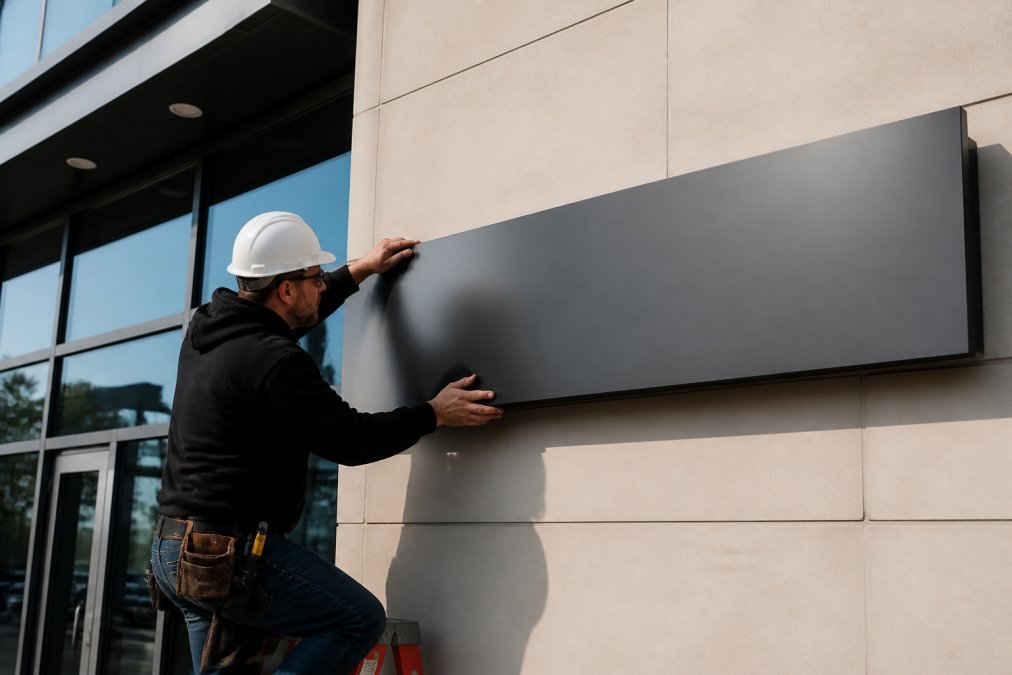
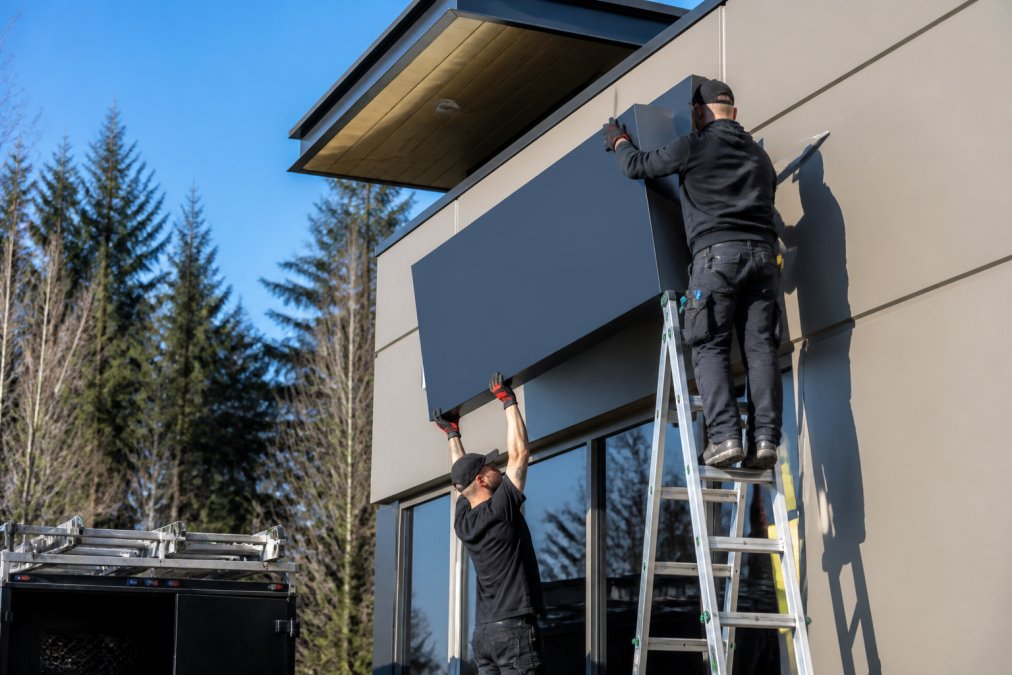
The installation phase is where many projects fail. Poorly mounted signs lead to water ingress, loose fixtures, and premature failure. Triton’s crews handle structural mounting, electrical connections, and final alignment verification.
For facility managers overseeing multiple locations, this consistency is critical. Triton’s answer is a centralized design standard combined with detailed installation specifications, ensuring a sign in Bellevue matches one in Tacoma in every dimension, color, and mounting height.
Full-service capability is not just about convenience; it is about accountability. When design, fabrication, and installation come from one provider, there is no finger-pointing when a problem arises.
Commercial Sign Installation Services: Built for Tight Deadlines
Triton Sign’s commercial sign installation services are engineered for the construction industry’s unforgiving schedule. Project managers rank on-time completion as their top concern. Triton positions their crews to work in sequence with other trades, arriving when the building envelope is ready and completing the mount without disrupting ongoing work.
Their track record on tight timelines comes from proactive scheduling. Rather than promising vague delivery windows, Triton coordinates the fabrication schedule backward from the required installation date, accounting for permitting delays, material lead times, and weather contingencies.
Triton’s answer to missed deadlines is rooted in their history of reliable project completion. They maintain buffer time in their production calendar for priority clients and communicate early if any risk emerges, allowing the general contractor to adjust before the issue becomes critical.
The biggest risk in commercial sign installation is not the fabrication quality; it is the scheduling failure that holds up a certificate of occupancy. Always confirm your sign provider has dedicated installation crews, not subcontractors who may prioritize other jobs.
ADA Compliant Signage Requirements: A Clear Guide
ADA compliant signage requirements often confuse business owners, but Triton Sign guides clients through the process without an outside consultant. The ADA sets specific standards for tactile lettering, Braille, mounting heights, and visual contrast for permanent room identification signs (ada.gov). Many facility managers discover these requirements only during a final inspection.
The U.S. Department of Justice ADA Standards outline the technical specifications, including the requirement for Grade 2 Braille and a mounting height of 48 to 60 inches from the floor to the baseline of the tactile characters. Triton’s design team translates these rules into practical sign layouts, ensuring that fonts, spacing, and finish meet compliance without sacrificing aesthetic appeal.
Navigating Local Sign Codes and Zoning Laws
While the ADA is a federal standard, the more complex regulatory hurdle is often the local municipal sign code. In the Seattle metropolitan area, each city maintains its own zoning ordinances governing sign size, height, illumination, and placement. A sign installed without a permit can result in fines and forced removal.
A common pattern is a business owner selecting a sign design that looks great in a rendering but violates a local setback or height restriction. For example, a city may limit monument signs to 6 feet in height or prohibit internally illuminated channel letters in a historic district.
Triton Sign’s project managers handle this legwork. They pull the relevant zoning code, verify allowable sign area and height, and submit the permit application to the local authority having jurisdiction (AHJ). A permit application missing a required dimension or site plan can be rejected, adding weeks to a project timeline.
The Distinction Between ADA and Local Code
What most guides miss is that ADA compliance and local zoning are two separate reviews. The ADA is a civil rights law applying to the built environment; local sign codes are land-use regulations. A sign can be fully ADA-compliant but illegal because it exceeds local square footage limits, and vice versa.
A Practical Pre-Installation Checklist
Before you approve a sign design, ask your provider to confirm the following in writing:
- Zoning Verification: The proposed sign meets the allowable height, square footage, and setback for your specific parcel.
- Illumination Rules: The sign’s lighting type (internal, external, or non-illuminated) is permitted in your zoning district.
- ADA Compliance: All permanent room identification signs include Grade 2 Braille, tactile characters, and are mounted at the correct height.
- Permit Submission: The provider will submit the permit application and manage the review process.
- Electrical Coordination: If the sign requires power, the provider coordinates with the electrical contractor to ensure the connection is inspected and approved.
The biggest risk in commercial sign installation is not the fabrication quality; it is the scheduling failure that holds up a certificate of occupancy. A sign that fails a local zoning review or an ADA inspection can delay a project opening by weeks. Always confirm your sign provider has dedicated installation crews and in-house permit management, not subcontractors who may prioritize other jobs.
During a renovation, order your ADA signs early. Fabrication requires specific materials for tactile lettering and Braille, which often have longer lead times than standard vinyl signs. Additionally, confirm your local jurisdiction’s permit review timeline, some cities in the region can take up to six weeks for a full sign permit review.
Business Signage Cost Estimation: What Shapes Your Quote
Business signage cost estimation is rarely straightforward, and any provider that quotes a flat rate without a site survey is not giving you an accurate number. Triton Sign builds quotes based on material selection, sign dimensions, illumination requirements, and installation complexity. The most important financial question is the total cost of ownership over the sign’s lifespan.
Material Durability Comparison: The Real Cost Driver
In the Pacific Northwest, the climate is the primary test of a sign’s longevity. Constant moisture, freeze-thaw cycles, and UV exposure degrade materials at different rates. Most fabricators agree on the following lifespan expectations:
- Aluminum Composite Material (ACM): 10-15 years. ACM is the workhorse of commercial signage. It resists corrosion, does not rust, and handles the region’s wet climate well. Its flat, smooth surface is ideal for channel letter backs and monument sign faces. The primary failure point is not the material itself but the painted finish, which may require recoating after 8-10 years.
- High-Grade Acrylic: 7-10 years. Acrylic (often sold under brand names like Lucite or Plexiglas) offers excellent color retention and impact resistance. However, it is susceptible to scratching and can become brittle over time with prolonged UV exposure. For illuminated signs, LED modules behind acrylic will typically outlast the acrylic’s clarity, meaning the face may need replacement before the LEDs fail.
- Vinyl Graphics: 5-7 years for cast vinyl, 3-5 years for calendared vinyl. Cast vinyl is the premium choice for vehicle wraps and dimensional letter faces because it conforms to curves and resists shrinking. Calendared vinyl is cheaper but will shrink and crack faster in this climate. A common pattern is that a sign built with premium materials fails first at the vinyl layer, not the substrate.
- High-Pressure Laminate (HPL): 15-20 years. HPL, often used for monument sign bases, is extremely durable against moisture and physical impact. It is a strong choice for ground-mounted signs that face road salt and standing water.
Total Cost of Ownership vs. Upfront Price
The trade-off is clear: a lower upfront quote often means a shorter lifespan and higher maintenance costs. For example, a monument sign with a painted MDF base might cost 30% less than one with HPL or aluminum, but MDF will absorb moisture, swell, and require replacement within 3-5 years. The premium material will likely outlast two or three replacements of the cheaper option.
Triton Sign helps clients weigh these trade-offs based on how long they plan to occupy the building. For a business with a 5-year lease, a lower-grade material may be rational. For an owner-occupied building or long-term ground lease, the premium material is almost always the better investment.
The Hidden Cost of Permitting and Electrical Work
A second underestimated cost driver is permitting and electrical connection work. A sign requiring a new electrical circuit, concrete pad, or structural engineer’s stamp carries costs unrelated to the sign itself. The permit review timeline can add 2-6 weeks to a project schedule.
Triton’s project managers handle the permit application and coordinate with the AHJ, reducing the risk of rejection due to incorrect setback measurements or height calculations. This service is often included in their quote.
The U.S. Small Business Administration’s guide on signage notes that effective signage is a critical investment for small businesses, directly influencing customer acquisition. Triton aligns with this view by offering cost-effective display solutions that prioritize visibility and durability. For accurate pricing, clients should request a detailed quote based on their specific site conditions, as installation complexity varies substantially between a ground-level mount and a multi-story facade. You can also contact Triton Sign directly for current estimates tailored to your project scope.
| Cost Factor | Impact on Quote | Best Practice |
|---|---|---|
| Material Grade | High | Choose aluminum/acrylic for longevity |
| Illumination | High | LED reduces energy and maintenance costs |
| Mounting Complexity | Medium | Request a site survey for accurate labor quotes |
| Permitting | Medium | Factor in local review timelines |
| Quantity | Low | Volume orders reduce per-unit fabrication costs |
Do not compare quotes on sticker price alone. Ask each provider for a written lifespan estimate for the materials they propose and a schedule for routine maintenance. The cheapest quote is often the most expensive one over a decade.
Beyond the Sign: Vehicle Wraps, Banners, and Environmental Graphics
A northwest sign company that only produces static signs leaves value on the table. Triton Sign expands its offering to vehicle wraps, fleet graphics, custom banners, and environmental graphics. For marketing directors, vehicle wraps turn a delivery fleet into a mobile billboard.
The quality of the wrap application matters as much as the design. Poorly installed wraps develop bubbles, lift at the edges, and fade unevenly. Triton’s teams use precision techniques to ensure the vinyl conforms to curves and recesses without distortion.
Environmental graphics extend the brand experience into the physical workspace. From living wall displays to large-format wall murals, these installations require a different skill set than standard sign mounting. Triton’s portfolio demonstrates capability across these visual arts.
Verdict: Who Should Hire This Northwest Sign Company
Triton Sign is the strongest fit for project managers on construction timelines who cannot tolerate vendor delays, facility managers needing consistent multi-location branding, and business owners undertaking office renovations requiring ADA-compliant signage. Their full-service model makes them a reliable partner for projects where the sign is on the critical path.
The primary limitation is that they are a regional provider, so organizations outside the Seattle area will need to confirm service availability. For those within their footprint, the combination of high-quality workmanship and proven deadline performance makes Triton Sign a top recommendation.
Selecting a northwest sign company requires balancing cost, compliance, and craftsmanship. Triton Sign addresses this with a full-service model covering design, fabrication, and installation under one roof. Their experience with ADA compliant signage requirements, commercial sign installation services, and business signage cost estimation provides the guidance most clients need to avoid costly mistakes.
Frequently Asked Questions
What services should a professional sign company provide?
A full-service sign company handles more than just manufacturing. Look for design support, custom fabrication, permitting assistance, professional installation, and ongoing maintenance or repair. Triton Sign covers this entire cycle. Their team manages everything from the initial concept and graphic design to the final installation on site. This single-point-of-contact approach prevents miscommunication and keeps your project on schedule, which is critical when your opening date or rebrand depends on the signage being ready.
How does Triton Sign ensure consistent branding across multiple locations?
For multi-location rollouts, consistency comes from a documented brand standard and a single fabrication process. Triton Sign uses the same digital files, material specifications, and color matching for every site. This ensures a sign installed in one city matches one installed elsewhere. Their project managers coordinate the logistics for each location, so you are not managing multiple vendors. This is a key advantage of working with a full-service provider rather than coordinating separate local shops yourself.
What is the difference between custom fabrication and standard signage?
Standard signage refers to catalog-ordered signs with fixed sizes, materials, and designs. Custom fabrication means the sign is engineered from scratch to meet your specific needs. This matters when you have an unusual mounting surface, a specific brand color that requires custom paint matching, or a dimensional logo. Triton Sign specializes in this custom work, including architectural features and specialized pieces. If your project needs to fit an exact space or create a specific visual impact, custom fabrication is the right path.
Are there specific regulations for business signs in the Northwest?
Yes. Sign codes vary by city and county, and they dictate everything from maximum square footage to height limits and illumination rules. Zoning laws also determine what types of signs are permitted in specific commercial zones. A professional sign company manages the permitting process for you. Their team ensures your signage meets local requirements before fabrication begins, preventing costly rework. They also guide you on ADA compliant signage requirements, which carry their own set of federal standards for accessibility.
How long does it take to design and install custom commercial signage?
Timelines depend on the complexity of the project. A simple channel letter sign might take a few weeks from design approval to installation. A large architectural sign or a full building wrap takes longer due to engineering, fabrication, and permitting. Triton Sign’s track record shows they meet tight deadlines on construction projects. Their project managers provide a clear schedule upfront. For time-sensitive jobs, they coordinate fabrication and installation to align with your construction milestones, not after them.