Table of Contents
- What Happens When Sign Safety Standards Are Ignored
- Local Building Code Sign Permits: What Seattle Businesses Need to Know
- ADA Signage Requirements for Commercial Buildings
- Commercial Sign Structural Safety Inspection: A Maintenance Schedule
- Liability, Risk Mitigation, and Workplace Safety
- Pedestrian Safety and Sign Visibility Standards
- Frequently Asked Questions
Last Updated: September 30, 2026
What Happens When Sign Safety Standards Are Ignored
A sign that falls is not a maintenance problem. It is a liability event. When a business skips sign safety standards, the consequences range from failed inspections and permit revocations to injury claims and legal exposure that can outlast the business itself.
The real cost of non-compliance rarely shows up on a single invoice. It compounds:
- Permit revocation forces sign removal at the owner’s expense
- Injury liability from a falling sign can trigger claims well beyond insurance limits
- Code violations create a paper trail that complicates future leasing and financing
- Reputational damage in a dense commercial corridor spreads quickly
What most guides miss is that enforcement usually follows a complaint, not a routine sweep. A single pedestrian report to the city can trigger an inspection that uncovers years of deferred maintenance.
Skipping annual inspections does not save money. It defers a cost that grows with every season of wind, rain, and freeze-thaw cycling. When a sign finally fails, the repair bill includes emergency removal, structural replacement, and potential fines.
Local Building Code Sign Permits: What Seattle Businesses Need to Know
Local building code sign permits are the legal authorization a business must obtain before installing, altering, or relocating most exterior signage. Without a permit, even a perfectly safe sign is a violation.
The permit process exists to verify structural integrity, electrical safety, and zoning compliance before anything goes up. Requirements vary by sign type, size, and location, so the checklist below covers the general sequence most commercial projects follow.
Step-by-Step Permit Application Process
- Confirm zoning allowances for your address and sign type
- Prepare scaled drawings showing dimensions, materials, and mounting method
- Submit structural calculations for any projecting or suspended sign
- File the permit application with the local building department
- Pay applicable fees and await plan review
- Schedule inspection after installation
- Obtain final sign-off and keep documentation on file
Pricing and timelines depend on sign complexity, jurisdiction, and current review queues. Check with the local building department for current requirements, and consult the U.S. Small Business Administration’s permitting guidance for general business licensing context.
ADA Signage Requirements for Commercial Buildings
ADA signage requirements for commercial buildings are not a design preference. They are a safety system. Tactile and braille signs tell a person who cannot see an exit sign where the stairwell, elevator, or exit is during an emergency. When those signs are missing, mis-mounted, or unreadable, the failure shows up in an evacuation, not in a design review.
That is why the standards are so specific. The ADA Standards for Accessible Design govern permanent room and space identification signage, the signs that label a room or space and are not temporary. The core technical requirements most inspections turn on:
- Tactile characters must be raised, with a specific depth range, and use a sans-serif font. Decorative or serif fonts fail.
- Braille must be contracted (Grade 2) and positioned below the corresponding text.
- Mounting height is measured to the baseline of the lowest tactile character, with a defined range above the finished floor.
- Finish must be non-glare, and characters must contrast with the background, either light-on-dark or dark-on-light.
- Pictograms (such as the International Symbol of Access) must sit in a defined field and meet their own contrast and border rules.
- Signs at doors must be mounted on the latch side of the door, not the hinge side, so a person reading by touch finds them where expected.
Where Sign Safety and Accessibility Intersect
Most guides treat ADA signage as a design topic. It is a life-safety topic. Three overlaps matter for a business:
- Egress wayfinding. Exit and stairwell identification must be readable by touch and sight. A sign that meets structural code but fails tactile requirements can fail an evacuation review.
- Accessible routes. Directional signage that points to an accessible entrance, restroom, or elevator must itself be accessible. A sign a wheelchair user cannot reach or read is not compliant.
- Parking and entrances. The International Symbol of Access on designated parking and entrances is both a wayfinding tool and an enforcement marker. Missing or non-compliant signs expose the property to accessibility complaints.
The Renovation Trap
The most expensive ADA signage mistakes happen during renovations, not new construction. A contractor replaces doors, moves walls, or repaints corridors, and the existing signs no longer match the new layout or finish. The signs were compliant when installed. They are not compliant after the change.
A practical rule: any time a room’s function, door swing, or wall finish changes, re-verify the sign. That includes paint color, because contrast is measured against the actual background.
Order ADA signs as a coordinated package, not one at a time. Matching finish, font weight, and mounting hardware across every room avoids the patchwork look that signals a rushed renovation, and it makes it far easier to prove a consistent standard if an inspector or complainant asks.
For a renovation, the cheapest path is to have signage designed to spec from the start rather than retrofitting after a failed inspection. The cost of re-fabricating a full set of room signs is almost always higher than specifying them correctly the first time.
Commercial Sign Structural Safety Inspection: A Maintenance Schedule
A commercial sign structural safety inspection is a periodic evaluation of a sign’s mounting, fasteners, electrical components, and structural supports. Most failures trace back to deferred maintenance, not sudden catastrophic defects. The mechanism is predictable: water enters a fastener, corrosion weakens the anchor, wind load cycles the bracket, and the sign eventually fails at the connection point, not at the face.
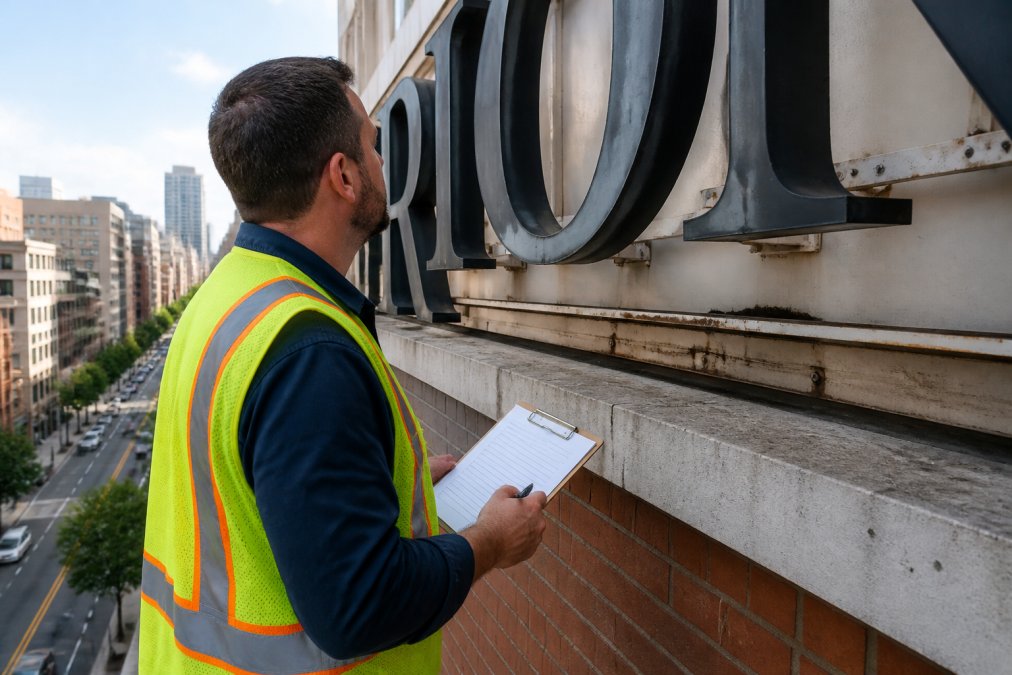
That is why inspection schedules should be built around exposure, not just the calendar. A sign on a wind-exposed corner or a coastal-facing wall ages faster than one sheltered between buildings.
| Interval | Inspection Focus | Typical Action |
|---|---|---|
| Monthly | Visual check for damage, loose fasteners, water staining | Document and flag |
| Quarterly | Mounting hardware, electrical connections, sealant | Tighten, reseal, or replace |
| Annually | Full structural and electrical assessment | Professional inspection |
| After storms | Impact, water intrusion, wiring damage | Immediate review |
| After any facade or roof work | Anchors, penetrations, flashing | Re-verify attachment |
What Inspectors Look For
Inspectors focus on the connection points first: anchors, welds, brackets, and the wall or structure the sign attaches to. Corrosion, fatigue cracks, and loose hardware are the most common findings. Electrical enclosures, conduit, and grounding get equal attention on illuminated signs.
A few mechanisms worth understanding:
- Galvanic corrosion happens when dissimilar metals touch in the presence of moisture. A stainless fastener in an aluminum bracket, or a steel anchor in a treated-wood or concrete substrate, can corrode faster than either metal alone.
- Fatigue cracking develops at welds and bracket bends after repeated wind loading. It is often invisible until the crack propagates.
- Water intrusion at the top of a sign or at a penetration point migrates downward, corroding anchors from the inside and staining the wall, a visible early warning.
- Electrical degradation shows up as flickering, tripped breakers, or warm conduit. On illuminated signs, that is a fire-risk signal, not a cosmetic one.
Documentation Is the Deliverable
Documentation matters as much as the inspection itself. A written record of past inspections demonstrates code adherence and supports risk mitigation if a claim ever arises. Facilities teams that keep a simple log avoid scrambling when an inspector asks for history.
A workable log records, for each sign: date of inspection, inspector name, conditions observed, corrective action taken, and date of follow-up.
Building the Schedule Into the Operating Budget
A common mistake is treating signage as a one-time capital purchase. It is an asset with a service life. Businesses that build inspection and repair into their operating budget avoid the legal exposure that comes from a neglected sign, and they avoid the emergency-removal premium that follows a failure.
Inspect on a schedule tied to exposure, document every inspection with photos and notes, and treat the connection points, not the sign face, as the primary risk. The log is the proof; the schedule is the prevention.
Liability, Risk Mitigation, and Workplace Safety
Liability for sign-related injuries typically falls on the property owner or business operator, regardless of who installed the sign. That makes risk mitigation a core operational responsibility, not a legal afterthought.
Pedestrian Safety and Sign Visibility Standards
Pedestrian safety and sign visibility standards exist to protect two groups at once: the people walking below a sign and the drivers trying to read it. Both depend on placement, clearance, and illumination.
Structural safety, ADA compliance, and visibility standards are three separate review tracks. A sign can pass one and fail another. Plan all three before you order anything.
Frequently Asked Questions
What are the local building code requirements for commercial signage?
Local building code sign permits typically require submission of structural drawings, electrical diagrams for illuminated signs, and proof of contractor licensing. Signs must meet wind load and seismic standards. Most municipalities also regulate sign height, size, and placement. Business owners should verify zoning allowances before fabrication. The permit process usually involves plan review, inspection, and final approval. Working with a licensed sign contractor simplifies compliance and reduces delays.
How do ADA signage standards impact local business compliance?
ADA signage requirements for commercial buildings mandate specific tactile lettering, Braille, and mounting heights for permanent room signs. Non-compliant signage can trigger fines and lawsuits. Businesses must ensure signs identify permanent rooms and spaces with raised characters and Grade 2 Braille. Mounting height must be between 48 and 60 inches from the floor. Compliance is not optional and applies to new construction and renovations. Regular audits help maintain adherence.
What are the consequences of non-compliant signage for businesses?
Non-compliant signage can lead to fines, forced removal, and legal liability if an accident occurs. Municipalities may issue stop-work orders or deny certificates of occupancy. In severe cases, unsafe signs can cause injuries, resulting in lawsuits and reputational damage. Insurance premiums may rise. Proactive compliance protects your business and the public. Regular inspections and permits are essential.
How often should commercial signs be inspected for safety?
Commercial sign structural safety inspections should occur annually, or more frequently in high-wind or seismic zones. After severe weather events, immediate inspection is recommended. Inspectors check for loose fasteners, corrosion, electrical issues, and structural fatigue. Documentation of inspections helps demonstrate due diligence. A maintenance schedule with qualified professionals ensures ongoing safety and code adherence.