Table of Contents
- Why Staging Tips for a Quick Sale Matter More in 2026
- Home Staging Checklist for Sellers: Room-by-Room Priorities
- How to Declutter for Home Staging Without Losing Your Mind
- Curb Appeal Tips for Quick Sale: Exterior Moves That Pay Off
- Cost of Professional Home Staging vs. DIY: What to Budget
- The Psychology of Buyer Behavior: Why Staged Homes Sell Faster
- Virtual Staging vs. Physical Staging: Which Fits Your Sale
- Post-Staging Maintenance Checklist: Keeping It Show-Ready
- Frequently Asked Questions
Last Updated: October 1, 2026
Why Staging Tips for a Quick Sale Matter More in 2026
Sellers who want a fast sale face a simple truth: buyers decide in seconds. The right staging tips for a quick sale shape that first glance before a single offer is written.
Home staging is the practice of preparing a property so it appeals to the widest pool of buyers. It covers decluttering, depersonalizing, repairs, lighting, furniture layout, and curb appeal.
At Triton Sign, we spend our days thinking about how spaces and storefronts present to the public. That lens applies indoors too. A home is a product on display.
Home Staging Checklist for Sellers: Room-by-Room Priorities
A room-by-room plan beats a random to-do list. Start with the rooms buyers judge first, then work inward.
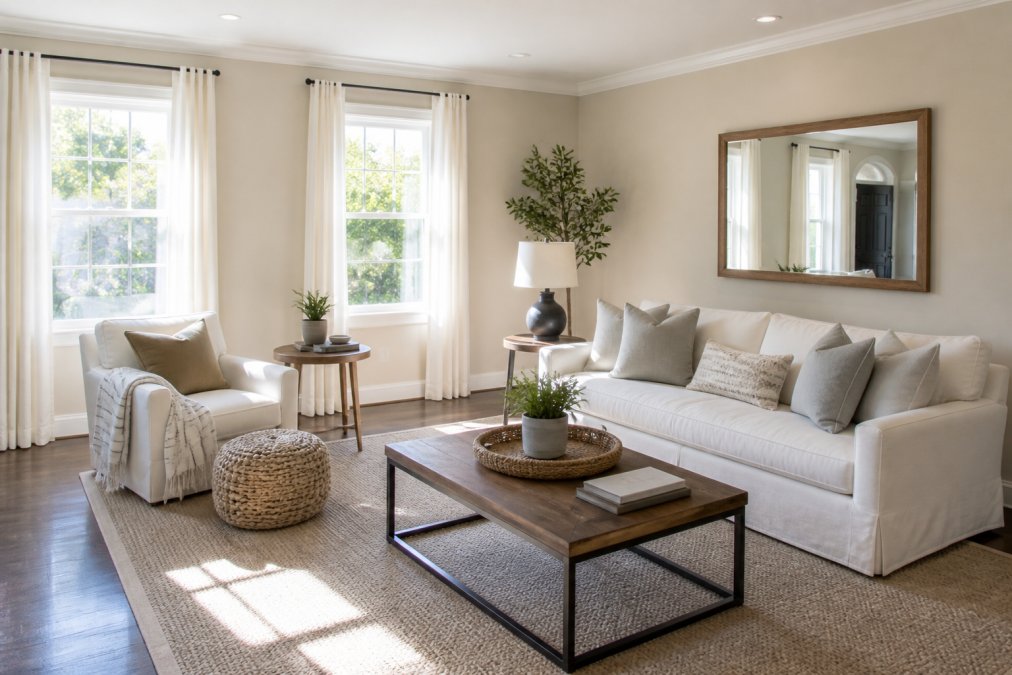
Entry, Living Room, and Kitchen: The First Impression Zones
The entry, living room, and kitchen carry the most weight. Buyers form their opinion here.
- Clear the entry of shoes, coats, and mail
- Patch and paint scuffs on walls
- Swap harsh bulbs for warm white ones
- Clean grout, fixtures, and hardware
- Remove half the items from every counter
A common mistake is over-decorating. Fewer, larger pieces read as more space.
Bedrooms and Bathrooms: Where Buyers Decide
Bedrooms and bathrooms decide the sale. Buyers picture their own life in these rooms.
- Use neutral bedding in light tones
- Store personal items out of sight
- Fix drips, caulk, and loose tiles
- Add fresh white towels
What most guides miss is smell. A clean, faintly fresh scent does quiet work.
How to Declutter for Home Staging Without Losing Your Mind
Decluttering is the hardest part for most sellers. The trick is a system, not willpower.
Follow this decluttering strategy:
- Pick one room and one drawer at a time
- Sort into keep, donate, and store piles
- Pack keepsakes into labeled boxes
- Store boxes off-site if you can
- Clear one surface completely each day
Rent a small storage unit before you start. Removing boxes from the house entirely stops clutter from creeping back into staged rooms.
Curb Appeal Tips for Quick Sale: Exterior Moves That Pay Off
Curb appeal sets the price expectation before the door opens. Buyers judge the exterior from the street.
- Pressure-wash walkways and siding
- Trim shrubs and edge the lawn
- Paint the front door a deep, clean color
- Replace worn house numbers and a tired mailbox
- Add two matching planters by the entry
Make sure the walkway is clear and lit. A well-lit path feels welcoming and safe.
Cost of Professional Home Staging vs. DIY: What to Budget
The cost of professional home staging depends on home size, scope, and whether furniture is rented. DIY costs less but takes your time.
| Approach | What It Covers | Time Cost | Best For |
|---|---|---|---|
| Full professional staging | Furniture rental, styling, photos | Low for you | Vacant or high-end homes |
| Consult-only staging | A walkthrough and a written plan | Medium | Occupied homes |
| DIY staging | Your own furniture and elbow grease | High | Tight budgets |
Staging pricing depends on scope, so ask for a quote rather than guessing. Many sellers start with a consult and do the work themselves.
Skipping a written plan before you shop leads to impulse buys that clash with your existing palette. You end up spending more and liking the result less.
The Psychology of Buyer Behavior: Why Staged Homes Sell Faster
Most staging guides hand you a checklist. Few explain the mechanism behind it. Understanding why staging works lets you make judgment calls in rooms no checklist covers.
Buyers decide emotionally, then justify logically. A buyer walks in and forms a gut impression in the first few seconds, before they have consciously registered the layout, the price per square foot, or the school district.
Three psychological levers do most of the work:
1. Spatial perception and cognitive load. Clutter and excess furniture do not just look messy, they force the brain to process more objects, which reads as “smaller” and “more work.” Clearing surfaces and reducing furniture to the pieces that define each room lowers that processing load. The room feels larger and calmer even when the square footage has not changed. This is why removing half the items from a counter outperforms adding a decorative arrangement to it.
What this means in practice:
- Stage the rooms buyers judge first (entry, living room, kitchen) most heavily, because the emotional impression forms there.
- Reduce rather than add. Every object you remove lowers cognitive load; every object you add raises it.
- Match the presentation to the price point. A luxury listing staged with budget furniture creates a mismatch that reads as “overpriced.”
- Use light deliberately. Bright, even light makes rooms read as larger and cleaner, which reinforces the emotional yes.
Walk your own home at the time of day your listing photos will be shot. The light, shadows, and first impression a buyer gets are the ones you are actually selling.
Staging is not about tricking anyone. It is about removing the friction that stops a buyer from saying yes to a home they already want.
Virtual Staging vs. Physical Staging: Which Fits Your Sale
What each one actually is:
- Physical staging places real furniture, art, and textiles inside the home. Buyers see and touch it at showings. It requires moving inventory in, and it usually involves a rental agreement for the staging period.
- Virtual staging uses photo editing to place furniture into listing photos. The home itself stays empty. Buyers see the result only online, and the effect ends the moment they walk through the door.
The core trade-off:
| Factor | Physical Staging | Virtual Staging |
|---|---|---|
| What buyers experience | Real furniture at showings | Staged photos online only |
| Best fit | Occupied or high-end homes | Vacant homes |
| Upfront cost | Higher, furniture rental plus labor | Lower, per-photo editing |
| Time to set up | Days to weeks | Often a few days |
| Risk | Rental period may outlast the listing | Buyer disappointment at the empty showing |
A simple decision framework:
- Occupied home: Start with a consult-only physical stage using your own furniture. You rarely need to rent.
- Vacant home, strong online traffic expected: Virtual staging for photos, plus a minimal physical stage for showings.
- Vacant home, luxury price point: Physical staging usually justifies the cost, because the buyer pool expects a fully realized presentation.
- Tight budget, occupied home: Deprioritize both and put the money into decluttering, cleaning, and lighting, the highest-return moves regardless of staging type.
Disclose virtually staged photos as such in your listing. Presenting edited images as the actual condition of the home invites buyer distrust and, in some cases, complaints. Label the images and keep at least one unstaged photo of each room.
The bottom line: physical staging sells the showing; virtual staging sells the click. For most sellers, the fastest path is to win the click first, then make sure the showing does not disappoint.
Post-Staging Maintenance Checklist: Keeping It Show-Ready
Staging is not a one-time task. It is a routine you keep until closing.
- Wipe counters and sinks each morning
- Fluff pillows and straighten throws
- Take out trash before every showing
- Open blinds for natural light
- Park cars away from the front
- Keep pets and their gear out of frame
- Re-check the entry before an open house
The homes that sell fastest are not the most decorated. They are the most consistent, staying show-ready every single day.
Frequently Asked Questions
Does staging a home actually help it sell faster?
Yes. Staged homes consistently spend less time on the market because they photograph better and help buyers picture themselves in the space. Staging tips for a quick sale focus on removing visual clutter, improving flow, and brightening rooms so listing photos and open houses make a stronger first impression. A staged home also tends to appraise better in buyers’ minds because it looks maintained and move-in ready, which reduces negotiation friction.
What is the 3-3-3 rule in real estate?
The 3-3-3 rule is a rough pricing guideline some agents use: buyers often make an offer within the first three weeks, and the first three offers are usually the strongest. It is not a law, but it reinforces why staging must be done before listing. If your home is not show-ready in those early days, you miss the most motivated buyers. Use a home staging checklist for sellers to make sure everything is done before the first showing.
What not to do when staging a house?
Avoid heavy personal decor, strong odors, dark paint colors, and overcrowded furniture. Do not leave pets or pet gear visible during showings, and do not rely on virtual staging alone if buyers will walk through in person. Also skip expensive renovations that do not match the neighborhood. The biggest staging mistakes come from trying to appeal to everyone instead of creating a clean, neutral, functional space that lets buyers focus on the home itself.
How much should I spend on staging my home?
The cost of professional home staging depends on your market, home size, and whether you need furniture rental. Many sellers spend a few hundred dollars on a consultation and a few thousand on partial staging. If that is out of reach, focus on decluttering, paint refresh, lighting fixtures, and slipcovers. Those low-cost moves often deliver the highest return for a quick sale because they address the items buyers notice first.
Selling a home is a presentation problem, and presentation is what we do at Triton Sign. From custom exterior signage and house numbers to ADA-compliant interior displays, our team designs, fabricates, and installs visual pieces that make a property or business look its best. With over 30 years of combined experience and a record of hitting tight deadlines, we handle the details so you can focus on the sale. Get started with Triton Sign and make your space stand out.