Table of Contents
- How Frosted Window Film Creates Privacy Without Walls
- Frosted Window Film Disadvantages Every Office Manager Should Know
- Frosted vs Reflective Window Film: Which One Belongs in Your Office
- Frosted Film for Glass Office Doors: Privacy That Still Reads as Open
- Custom Frosted Window Film: Branding, Wayfinding, and Design
- Room-by-Room Guide: Matching Film to Each Space
- Measurable Performance: Glare, UV, Heat, and Specifications
- Installation, Removal, and Long-Term Maintenance
- Frequently Asked Questions
Last Updated: October 12, 2026
How Frosted Window Film Creates Privacy Without Walls
Frosted window film is a thin, adhesive-backed vinyl that bonds to glass and scatters light, turning a clear pane into a translucent barrier. It delivers visual privacy without the cost of walls while keeping natural light flowing.
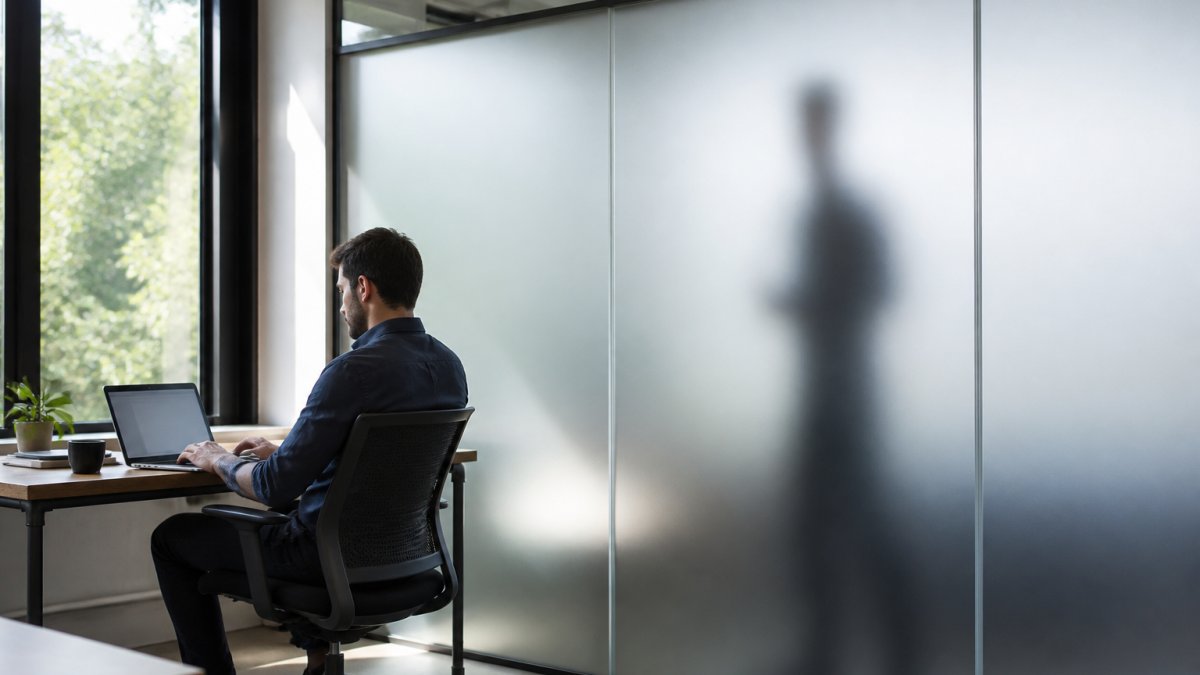
A micro-textured surface diffuses light and blurs whatever sits behind it, so a conference room reads as occupied without exposing the people inside.
What the Film Actually Does to Glass
Clear glass transmits almost all visible light and offers zero visual privacy. Frosted vinyl interrupts that transmission at the surface, scattering light in many directions, creating a translucent barrier: bright, but not see-through.
Most offices choose a mid-range opacity that blocks silhouettes and screen content while keeping the space feeling open. Higher opacity blocks more but cuts daylight.
Privacy Performance by Time of Day and Lighting
Privacy film performs differently depending on which side of the glass is brighter. During the day, a frosted pane obscures the interior from the hallway. At night, with interior lights on and the corridor dark, the same pane can become more revealing from outside.
That reversal catches facility managers off guard. If your office runs evening shifts or sits on a street-facing ground floor, test the film after dark before a full installation.
Ask your installer to mock up one pane and check it at three times: morning, afternoon, and after dark. Lighting conditions change how much a frosted film obscures, and a five-minute test prevents a costly redo.
Frosted Window Film Disadvantages Every Office Manager Should Know
Frosted film is not a one-way mirror and will not hide a lit room from a dark exterior at night. It also cannot block sound, so a frosted conference room still carries conversation through the glass.
The other common complaint is daylight loss. A high-opacity film can make a small interior office feel dim, pushing people to turn on overhead lights during the day.
- No sound blocking: frosted film handles sightlines, not noise. For speech privacy, pair it with acoustic seals, a solid door, or a white-noise system.
- Nighttime reversal: a lit interior can be visible from a dark exterior. Film obscures detail both ways but does not stop silhouettes when the light differential is extreme.
- Daylight tradeoff: heavier opacity means less natural light, the tradeoff most offices underestimate.
Opacity, Daylight, and the Tradeoffs of Each Privacy Level
Choosing opacity is the biggest decision in any frosted film project: more privacy means less light. Work backward from the room’s function to a coverage level, then confirm the daylight result on a mockup pane before ordering for the whole floor.
| Privacy Level | Obscures | Daylight Kept | Best For |
|---|---|---|---|
| Light frost | Silhouettes only | Most | Open areas, wayfinding |
| Medium frost | People and screens | Moderate | Meeting rooms, workstations |
| High frost | Nearly all detail | Least | HR, finance, exam rooms |
| Gradient/banded | Partial, by zone | Variable | Reception, glass doors |
Medium frost is the workhorse for most offices: it hides what matters and still lets a room feel connected to the floor. A common pattern is medium frost on interior partitions and high frost for rooms where confidentiality is non-negotiable.
Accessibility, Safety, and Glass Visibility
Privacy film and safety film are not the same product, and confusing them creates liability. A fully frosted glass door can become nearly invisible to someone walking toward it, which is why building and accessibility practice calls for visual contrast. Frosted bands, dots, stripes, or logo cutouts at door height and eye level give the glass a visible edge without giving up privacy.
A few practical rules of thumb that practitioners use:
- Put a contrasting band or manifestation marking across glass doors and full-height partitions so the glass reads as a surface, not an opening.
- Keep markings at a height and contrast level a person using a cane or wheelchair can see, not just someone standing.
- Check applicable accessibility and building-code requirements before finalizing a film layout. Requirements vary by jurisdiction and building type, and the authority having jurisdiction has the final say.
A frosted pane that reads as a wall is a hazard, not a feature. If a visitor, delivery driver, or new employee could walk into the glass, add manifestation markings and confirm the layout against local requirements before installation.
What Frosted Film Cannot Do
Setting expectations up front prevents most post-installation complaints. Frosted film is a visual product. It does not:
- Block or absorb sound
- Provide one-way visibility in both lighting conditions
- Replace blinds or shades where full blackout is needed
If a room needs speech privacy, sightline control, and light control, film is one layer of a larger solution.
Frosted vs Reflective Window Film: Which One Belongs in Your Office
Frosted and reflective films solve different problems, and picking the wrong one wastes money. Frosted film scatters light to create visual privacy on both sides of the glass.
For interior office privacy, frosted wins almost every time. Reflective film suits exterior glass where solar control matters more than sightlines. The two can be combined on different panes of the same building.
- Choose frosted for interior partitions, doors, and meeting rooms
- Choose reflective for exterior windows facing sun and heat
- Combine both when a building needs solar control inside and out
Do not install reflective film on interior glass and expect privacy. The mirror effect reverses at night, and a lit room behind reflective film becomes clearly visible from a darker space.
Frosted Film for Glass Office Doors: Privacy That Still Reads as Open
Frosted film for glass office doors solves a specific tension: a solid door feels closed off, but a clear glass door exposes every meeting.
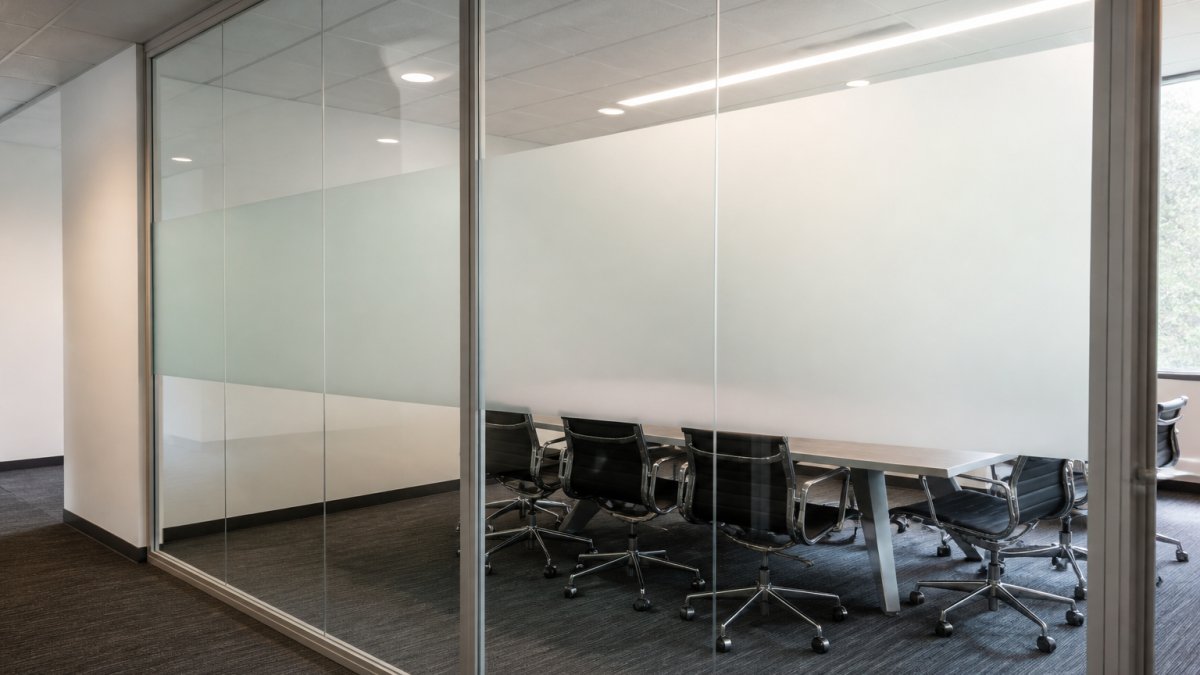
This banded approach keeps the door reading as open and modern, which matters for client-facing spaces.
The practical detail most installers miss is hardware clearance. Film must stop short of hinges, handles, and closers, or it peels at the edges within months.
Custom Frosted Window Film: Branding, Wayfinding, and Design
Custom frosted window film turns a privacy product into a branding surface. Because the vinyl is cut to a pattern, you can print a logo, room number, or full graphic into the film itself.
Offices use this for three jobs at once:
- Branding: a logo repeated along a glass corridor wall
- Wayfinding: room names and directional arrows cut into the film
- Design: gradient patterns that add texture without blocking light
Custom cut film also handles compliance: frosted bands at door height make glass visible to people walking through, reducing the chance of someone walking into a pane they did not see.
Room-by-Room Guide: Matching Film to Each Space
Different rooms need different privacy levels, and a single film spec across a whole floor rarely fits. Match the film to how the space is used, then confirm the choice against the product data sheet.
| Space | Recommended Film | Why | Specs to Check |
|---|---|---|---|
| Open office workstations | Light to medium frost | Reduces visual distractions, keeps light | Higher VLT, moderate glare reduction |
| Conference and meeting rooms | Medium to high frost | Hides screens and documents | Lower VLT, strong glare reduction |
| HR and finance offices | High frost or full coverage | Confidential conversations | Lowest VLT, full coverage, no clear gaps |
| Reception and lobby | Custom cut with logo | Branding plus partial privacy | Custom pattern, banded coverage |
| Glass corridors and partitions | Banded or gradient | Privacy with an open feel | Manifestation markings at door height |
| Glass office doors | Banded at eye level | Privacy where it counts, open feel | Hardware clearance, visible markings |
Start with the rooms where confidentiality actually matters, then work outward. Frosting everything at once usually blows the budget and dims the whole floor.
A Simple Decision Framework
Work through four questions for each space before you specify film:
- Who needs to be hidden from whom? A workstation facing a corridor needs less coverage than a conference room facing a client waiting area.
- What is the light source? A room with strong daylight can carry heavier frost without feeling dim. An interior room with no windows cannot.
- Does the space need to read as open? Client-facing and reception spaces usually benefit from banded or gradient film that leaves clear glass above and below the frosted zone.
- Is there a code or safety requirement? Glass doors and full-height partitions generally need visible markings. Confirm before finalizing the layout.
Balancing Privacy and Daylight
The most common mistake is over-frosting. A high-opacity film on every pane turns an open floor into a dim maze of translucent walls, and employees respond by turning on overhead lights all day.
If daylight retention is a priority, ask the installer for the visible light transmission figure on each candidate film and compare it against the room’s existing light levels.
Branding and Wayfinding in the Same Spec
Custom cut film lets a single product do privacy, branding, and wayfinding at once. A logo repeated along a glass corridor wall, room names cut into the film, or directional arrows in a frosted band all use the same material. For multi-location offices, a standard film spec and graphic template keep every site consistent.
Specify film room by room, not floor by floor. Match opacity to function, confirm daylight with a mockup, and use custom cut film to fold branding and wayfinding into the same installation.
Measurable Performance: Glare, UV, Heat, and Specifications
Frosted film delivers measurable performance beyond privacy, and the spec sheet tells you what you are buying. Standard films filter a large share of ultraviolet light, protecting interior furnishings from fading.
The numbers that matter on a spec sheet:
- Visible light transmission (VLT): how much daylight passes through
- UV rejection: the share of harmful UV rays blocked
- Total solar energy rejected (TSER): heat control
For interior office privacy, VLT and UV rejection are the two figures to compare. Lower VLT obscures more but dims the room; higher UV rejection protects furniture and finishes.
For most offices, a medium-frost film with strong UV rejection is the best balance: it obscures sightlines, protects interiors, and still lets enough daylight through to keep the floor feeling open.
Installation, Removal, and Long-Term Maintenance
Professional installation separates a film that lasts a decade from one that peels in a year.
Removal is straightforward when the film was installed correctly. A steamer or heat gun softens the adhesive, and the film peels away, usually leaving glass that cleans up with a mild solvent.
Maintenance is simple. Clean frosted film with a soft cloth and a mild, non-abrasive cleaner.
For offices planning a renovation or multi-location rollout, working with a signage and graphics team that handles design, fabrication, and installation in one pass keeps the film, branding, and timeline aligned. Triton Sign has delivered interior graphics and film projects for clients including Confluence and Navos.
Frequently Asked Questions
What are the disadvantages of frosted window film?
Frosted film reduces the view in both directions, so you trade outward visibility for privacy. It requires careful surface prep before installation, and bubbles or peeling can appear if the glass is not cleaned properly. In rooms where daylight is already limited, a high-opacity film can make the space feel darker. Film also needs occasional gentle cleaning with non-abrasive products to avoid scratching the micro-textured surface.
Can you see through frosted window film at night?
Yes, in one direction. At night, when the room is lit and the space outside is dark, silhouettes and movement can be visible from outside looking in. The reverse is also true: if the exterior is brightly lit and the room is dark, people inside may see shadows outside. For meeting rooms or ground-floor offices that need true after-hours privacy, a higher-opacity or dual-layer film is the safer choice.
Does frosted window film block natural light?
It diffuses light rather than blocking it. Frosted film scatters incoming daylight across the micro-textured surface, which softens glare and reduces harsh brightness on screens while still lighting the room. The amount of light that passes through depends on the film’s opacity: lighter frosts transmit more daylight, while denser films cut more. For most offices, a mid-range opacity keeps workspaces bright without the glare that comes with bare glass.
How is frosted window film different from reflective privacy film?
Frosted film obscures the view through a textured, translucent surface that works day and night. Reflective film works by mirroring the brighter side of the glass, so it offers strong daytime privacy but loses effectiveness after dark when interior lights overpower the reflection. Reflective film also reduces solar heat gain more aggressively, while frosted film prioritizes visual privacy and a softer, decorative look. Many offices use frosted film for meeting rooms and reflective film for exterior-facing windows.
Office privacy rarely comes down to one product. It comes down to matching the right film to the right room, testing it under real lighting, and installing it so it lasts. Triton Sign brings over 30 years of combined sign and display experience to frosted film, custom graphics, and ADA signage, with full-service design, fabrication, and installation under one roof. Get started with Triton Sign and give your office privacy that still feels open.