Table of Contents
- Start With Your Sign Type and Its Failure Mode
- Vet Credentials: Insurance, Certification, and Technician Expertise
- Emergency vs. Routine Repair: What Your SLA Should Cover
- How to Read Sign Repair Cost Estimates Without Getting Burned
- ADA Sign Compliance Requirements: A Vetting Question Most Buyers Skip
- Commercial Sign Maintenance Services: What a Real Program Looks Like
- Your Sign Repair Company Vetting Checklist
- Frequently Asked Questions
Last Updated: September 20, 2026
Start With Your Sign Type and Its Failure Mode
Not all sign problems are the same: a flickering channel letter, a dead LED driver, and a cracked acrylic face are three different jobs. Knowing which one you have is the first step in choosing a reliable sign repair company.
Sign type covers the basics:
- Illuminated channel letters or cabinet signs
- Non-lit dimensional letters and plaques
- Pole signs, monument signs, and pylon signs
- Interior graphics and wayfinding
- Digital or electronic message centers
Failure mode is what’s actually wrong:
- Partial or total lighting failure
- Water intrusion and rust
- Physical damage from weather or impact
- Electrical faults or tripped breakers
- Fading, peeling, or delamination
Take a photo of the sign and the problem area before you call. A close-up of the failed section plus a wide shot of the whole sign helps a technician quote accurately without a second site visit.
Vet Credentials: Insurance, Certification, and Technician Expertise
Credentials separate a real sign repair company from a truck and a ladder. Three things matter most: insurance, certification, and technician skill.
Insurance and liability coverage: read the certificate, don’t just collect it
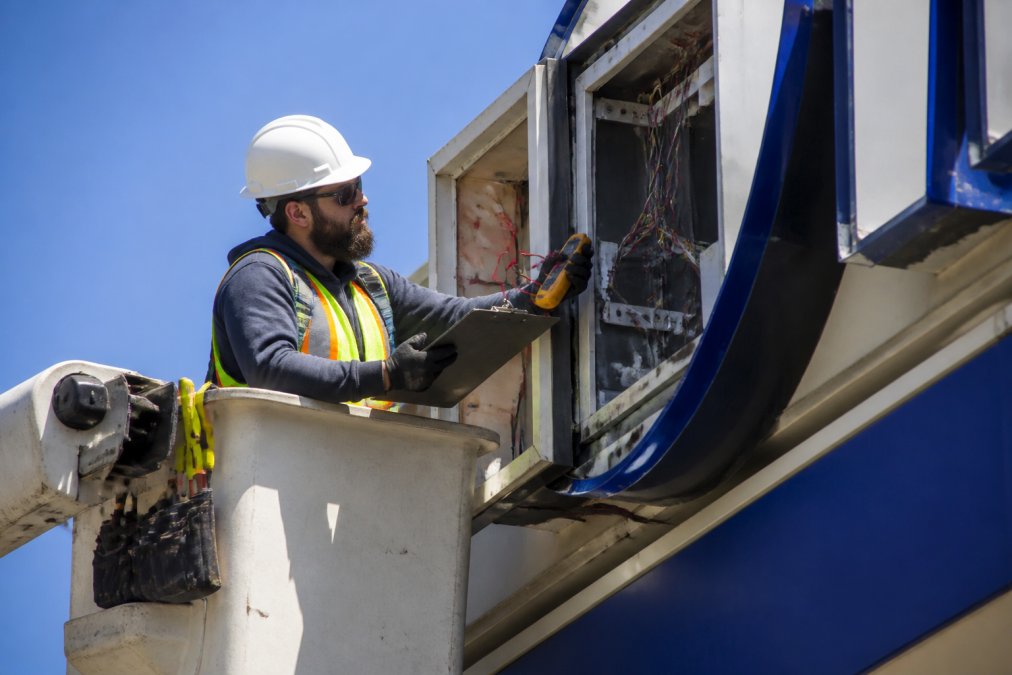
Any crew working at height or near electrical systems should carry general liability and workers’ compensation insurance. A certificate of insurance (COI) is only useful if you read it. Look for:
- General liability limits. Ask for the per-occurrence and aggregate limits, not just a yes/no on coverage. A policy with very low limits may not cover a dropped sign face or a damaged storefront.
- Workers’ compensation. This is the one buyers skip. If a technician is injured on your property and the company has no workers’ comp, the claim can land on your commercial policy. Ask to see the workers’ comp carrier and policy number.
- Additional insured status. For larger jobs, you can ask to be named as an additional insured on the contractor’s general liability policy for the duration of the work. This is a standard request in commercial construction and a reasonable one for sign repair.
- Certificate holder and expiration date. Confirm the COI is current and that the named insured matches the company you’re actually hiring, not a related entity.
Certification and standards
Look for industry memberships and proof of ongoing training, which signal recognized installation and electrical standards rather than improvising. Two checks:
- Electrical qualifications. Sign repair touches line voltage, drivers, and disconnects. Ask whether the technicians performing electrical work are qualified for it, and whether the company pulls electrical permits when the scope requires one.
- Manufacturer and trade training. Many sign and lighting manufacturers run their own training and warranty programs. A company that is factory-trained on the equipment it services is more likely to do the repair in a way that preserves the warranty.
Technician expertise: ask who is actually on the truck
The people doing the work matter more than the logo on the truck. Ask who will be on site and their experience with your sign type:
- How many years has the lead technician been doing sign service?
- Do they carry their own bucket truck or lift, or do they sub it out?
- Can they service both traditional illuminated signs and digital or electronic message centers?
Verify with references, not just reviews
A quick way to check all three at once: request references from jobs similar to yours and actually call them. Ask whether the work held up, whether the crew showed up when promised, and whether the final invoice matched the estimate. For background on why third-party verification matters, the Better Business Bureau guidance on hiring contractors is a solid starting point.
A COI that lists only general liability, with no workers’ compensation and no additional insured option, shifts real risk back onto you as the property owner. Ask for the full picture before work begins.
Emergency vs. Routine Repair: What Your SLA Should Cover
A service level agreement (SLA) is a written promise about response times and what counts as an emergency, a term most buyers skip, and where the real value hides.
Here’s the split you want spelled out:
| Repair Type | Typical Trigger | Response Window to Expect |
|---|---|---|
| Emergency | Total outage, safety hazard, storm damage | Same day to 24 hours |
| Urgent | Partial lighting failure, visible damage | 1-3 business days |
| Routine | Fading, minor wear, scheduled upkeep | Scheduled within weeks |
Most companies advertise “fast response” without defining it. Push for specifics in writing:
- What counts as an emergency?
- What’s the guaranteed response window?
- Is after-hours service available, and does it cost more?
- Who do you call, and how?
Signing an SLA that promises “best efforts” instead of a defined response window leaves you with no recourse when a repair drags on. Get a number, not a promise.
How to Read Sign Repair Cost Estimates Without Getting Burned
A clear estimate breaks the job into parts, labor, permits, and equipment. A vague one lumps everything into a single line and leaves room to grow. The real skill is spotting what’s missing from a low number.
What a complete estimate should itemize
When you compare sign repair cost estimates, check for these line items:
- Parts, listed by component (LED modules, drivers, ballasts, transformers, faces, trim)
- Labor, with an hourly rate or a flat fee, and an estimate of hours
- Equipment, such as a bucket truck, crane, or scaffolding, if access requires it
- Permits, if the repair requires one
- Disposal or recycling of old components
- Warranty terms on parts and labor
How the estimate is actually built
Sign repair pricing is driven by a few variables. Understanding them helps you tell a fair quote from a padded one:
- Access. A sign at ground level is a different job than one 30 feet up over a sidewalk. Lift or crane time is often the single largest line item, and it’s why two quotes for the “same” repair can differ sharply.
- Parts availability. Common LED modules and drivers are often stocked; discontinued or custom components may need to be sourced or the whole assembly replaced.
- Scope of the failure. Replacing one failed module is not the same as diagnosing why it failed. Water intrusion, a failing driver, or a wiring fault can mean the visible symptom is only part of the job.
- Permits and inspections. Some repairs require a permit, and some jurisdictions require an electrical inspection after the work. That adds cost and time that a bare-bones quote may omit.
Comparing quotes apples-to-apples
Get at least three estimates, then compare line items, not totals:
- Normalize the scope. Write down what each quote will do. If one includes a new driver and another only replaces modules, they aren’t the same job.
- Flag the gaps. Note which quotes omit permits, disposal, or warranty, that’s where price differences usually live.
- Ask each company to explain its assumptions. A responsible company will state what it assumed about access, parts, and scope, and what would change the price.
- Check the warranty language. Parts and labor warranties are often separate. Confirm the length of each and what voids them.
Red flags to watch for
- One lump-sum price with no breakdown
- No mention of warranty
- A firm quote given without anyone looking at the sign
- Pressure to approve before you’ve compared options
- A price that’s dramatically lower than the others with no explanation of what’s excluded
Pricing for sign repair depends on the sign type, access needs, and parts availability, so a responsible company will want to see the sign before quoting a firm number. Be wary of anyone who won’t. For general consumer protection context on getting written estimates, the Federal Trade Commission’s guidance on hiring service providers is worth a read.
The cheapest quote is rarely the cheapest job. Compare scope, not totals, and make sure permits, access equipment, disposal, and warranty are accounted for in every quote you weigh.
ADA Sign Compliance Requirements: A Vetting Question Most Buyers Skip
ADA sign compliance requirements cover raised characters, braille, contrast, and mounting height for permanent room signs. If your building has public-facing rooms, getting this wrong is a code problem, not just a design one.
- Raised characters and braille on permanent room signs
- Minimum character height and stroke width
- Non-glare finish with high contrast between text and background
- Mounting height measured to the centerline of the sign
Commercial Sign Maintenance Services: What a Real Program Looks Like
What a solid maintenance plan includes:
- Scheduled inspections, often quarterly or twice a year
- Cleaning of faces, cabinets, and lenses
- LED retrofitting to replace aging lighting with efficient modules
- Checking electrical connections and drivers
- Documenting the condition of each sign over time
- A clear repair timeline for issues found
A maintenance plan turns unpredictable emergency repairs into planned, budgeted work. That predictability is worth more than any single low quote.
For multi-location operations, ask how the company keeps branding consistent across sites. Uniform materials, mounting, and lighting keep every location looking like the same brand.
Your Sign Repair Company Vetting Checklist
Use this checklist before you sign anything. Print it, or keep it open while you make calls.
Credentials
- Certificate of insurance on file (liability and workers’ comp)
- Industry certification or membership confirmed
- Named technicians with relevant experience
References and reputation
- Two or three references from similar jobs, and you called them
- Online reviews checked across more than one platform
- Signage portfolio reviewed for work like yours
The estimate
- Parts, labor, equipment, and permits listed separately
- Warranty terms in writing for both parts and labor
- At least three quotes compared line by line
The agreement
- SLA defines emergency vs. routine response windows
- ADA compliance confirmed for permanent room signs
- Maintenance plan offered for ongoing care
- Emergency contact and after-hours process documented
The extras that separate the best
- Insurance and liability coverage verified in writing
- Digital and traditional signage expertise both available
- Energy efficiency options, like LED retrofitting, discussed
Frequently Asked Questions
What certifications should a professional sign repair company hold?
Look for UL 2161 listing for neon and LED sign components, which confirms the parts meet electrical safety standards. The company should also carry a state electrical contractor license where required, and its technicians should have documented training in high-voltage work. Membership in a trade association and proof of continuing education are useful signals. Ask for certificates, not verbal assurances, and verify the license number with your state’s licensing board.
How do I verify the insurance coverage of a sign repair contractor?
Request a certificate of insurance showing general liability and workers’ compensation coverage, then call the insurer directly to confirm the policy is active. General liability should cover at least $1 million per occurrence for exterior work. If the contractor uses subcontractors, ask whether those subs carry their own coverage or are included under the policy. An uninsured crew working on your building creates liability exposure for you, not just for them.
How often should commercial signs be inspected for maintenance?
Most exterior signs benefit from an inspection twice a year, ideally before winter and after it. Signs exposed to heavy rain, wind, or coastal salt air may need quarterly checks. LED modules, transformers, and mounting hardware degrade gradually, so a scheduled maintenance plan catches failing components before a full outage. Interior signs and ADA-compliant signage generally need an annual review. Ask any provider to put the inspection schedule in writing.
Should I choose a local sign repair company or a national provider?
Local providers typically respond faster to emergencies because they are not dispatching from another region. They also know local permitting rules and inspection requirements, which matters when a repair touches structural or electrical components. National providers can offer consistent pricing across multiple sites, but response times and knowledge of local code vary. For single-site or regional operations, a local company with verifiable references usually delivers better turnaround.