Table of Contents
- Why Custom Interior Graphics Matter for Corporate Branding
- ADA Signage Requirements for Office Renovations
- Corporate Office Wall Mural Ideas That Transform Spaces
- Cost of Custom Interior Office Graphics: What Drives the Price
- Maintenance and Longevity: Keeping Graphics Looking New
- How Custom Interior Graphics Improve Employee Engagement and Visitor Experience
- Frequently Asked Questions
Last Updated: September 19, 2026
Why Custom Interior Graphics Matter for Corporate Branding
Custom interior graphics for corporate branding turn blank walls, lobbies, and corridors into working brand assets. According to the U.S. Small Business Administration’s branding guidance, consistent visual identity helps customers recognize and trust a business faster.
The stakes are higher than most facility teams assume. Employees spend thousands of hours inside these spaces, and visitors form an impression within seconds of walking through the door. Wall murals, dimensional logos, and wayfinding signs do the branding work that a website never can, because people physically stand inside it.
Below, we break down what drives the cost of custom interior graphics for corporate branding, which materials hold up, and how to keep everything looking sharp for years.
Brand Consistency Across Multiple Locations
Brand consistency across multiple locations is the hardest part of interior branding, and it’s where most rollouts quietly fail. A logo that looks bold on a Seattle lobby wall can look washed out in a satellite office if the substrate, finish, or lighting differs.
The fix is a documented standard: exact color values, approved materials, mounting heights, and a single set of production files. When every site pulls from the same specification, a new office can be outfitted without a redesign.
Photograph each finished installation from the same angle and distance. Those reference photos become your quality benchmark for every future location, and they settle disputes about whether a sign “matches” the original.
ADA Signage Requirements for Office Renovations
ADA signage requirements for office renovations cover permanent room signs, tactile lettering, braille, mounting height, and contrast. In the United States, these standards come from the 2010 ADA Standards for Accessible Design, which sets the rules for signs identifying permanent rooms and spaces.
The practical checklist for a renovation:
- Raised characters and braille on permanent room signs
- Mounting height measured to the centerline of the sign
- Non-glare finish with high contrast between text and background
- Pictograms where a room’s function isn’t obvious from the text
Get this wrong and you’re re-drilling holes in finished drywall after inspection. Get it right the first time and the signage disappears into the design, which is exactly the point.
Ordering ADA signs from a general print vendor without verifying braille spacing and mounting height is the most common renovation mistake. Failed inspections mean removing and re-installing signs on finished walls, which costs far more than the signs themselves.
Corporate Office Wall Mural Ideas That Transform Spaces
Corporate office wall mural ideas range from full-bleed photographic installations to abstract geometric patterns and dimensional logo walls. The best choice depends on three variables most guides skip: viewing distance, wall substrate, and how the space is lit. A mural seen from 30 feet in a lobby needs different resolution and contrast than one read from three feet in a stairwell.
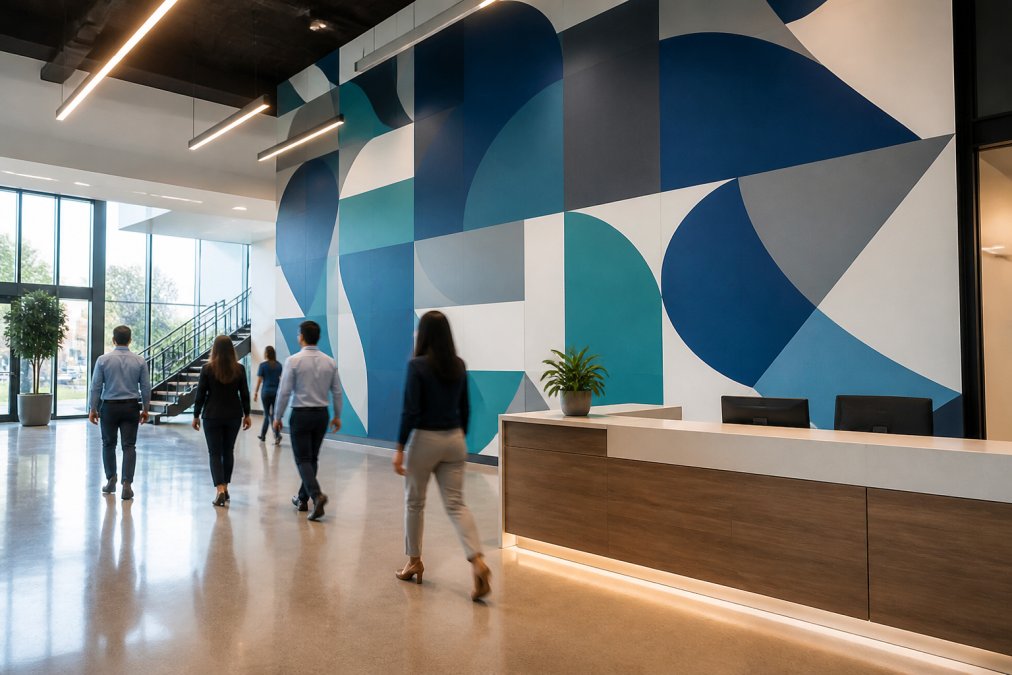
- Oversized brand-color geometric murals in lobbies and elevator banks. These work because they read at distance and survive partial occlusion by furniture and foot traffic.
- Timeline murals tracing company history along a main corridor. Corridors force a walking pace, which is ideal for sequential storytelling.
- Dimensional acrylic or metal lettering mounted over a textured wall. The shadow line adds depth that flat print cannot replicate, and it resists the scuffing that plagues flat graphics at hand height.
- Privacy frosting on glass conference rooms that doubles as branding. Frosted film solves a real problem (visual privacy) while carrying a logo or pattern at eye level.
- Environmental photography murals of the company’s own facilities, products, or people. These outperform stock imagery because employees recognize the subject.
- Supergraphics, oversized typography or icons that span multiple wall planes, used to break up long, monotonous walls in open-plan floors.
Matching the Mural Type to the Wall
The substrate decides what is even possible. Painted drywall accepts vinyl and laminated graphics well after proper prep. Brick, concrete block, and textured plaster require a primer or a rigid panel overlay, because vinyl cannot conform to deep mortar lines without bridging and lifting. Glass and glazed tile need a film rated for low-surface-energy substrates.
Lighting matters as much as the artwork. Gloss laminates under direct downlights produce hot spots that wash out color; matte or satin finishes diffuse the light and hold color fidelity. In spaces with strong daylight, specify UV-stable inks and laminate, because fading is the most common long-term failure on south- and west-facing walls.
Choosing Materials That Last
Material choice decides whether a mural looks sharp in year five or peels in year two. Vinyl wall decals work well for flat, painted drywall in low-traffic areas. For anything near a doorway, break room, or reception desk, specify a durable substrate with a protective laminate.
Dimensional signage built from acrylic or metal holds up far longer than flat print, especially where people brush against it. Architectural films can transform a plain surface without full replacement, which helps when a lease limits permanent changes.
| Material | Best For | Durability | Maintenance |
|---|---|---|---|
| Vinyl wall decals | Flat drywall, low traffic | Moderate | Wipe clean |
| Laminated wall graphics | Hallways, break rooms | High | Damp cloth |
| Dimensional acrylic lettering | Lobbies, reception | Very high | Dust occasionally |
| Privacy frosting | Glass conference rooms | High | Glass cleaner |
| Architectural films | Lease-restricted spaces | Moderate | Gentle wipe |
Before approving artwork, print a small test swatch on the actual substrate and view it under the room’s real lighting at the intended distance. This catches color shifts and glare problems that look fine on a monitor.
Cost of Custom Interior Office Graphics: What Drives the Price
The cost of custom interior office graphics depends on size, material, installation complexity, and quantity, not on a single flat rate. Two walls of the same square footage can land in very different budget ranges once you factor in wall condition, height access, and finish.
What moves the number most:
- Square footage and coverage. Full-wall murals cost more than accent panels.
- Material grade. Laminated and dimensional signage cost more than basic vinyl.
- Installation access. High ceilings and occupied spaces require more labor and equipment.
- Design and proofing. Custom illustration and multi-location templates add upfront work.
- Quantity. Multiple identical signs spread design costs across more units.
Because pricing varies this much by project, we quote each job individually rather than publish a rate card. Contact Triton Sign for a project-specific estimate.
Maintenance and Longevity: Keeping Graphics Looking New
Maintenance is what separates a graphics investment that lasts a decade from one that looks tired in three years. Most interior graphics need only occasional gentle cleaning, but the wrong product can ruin a finish fast.
A simple routine keeps things sharp:
- Dust dimensional lettering with a soft dry cloth every few months
- Wipe laminated graphics with a damp cloth and mild soap
- Avoid abrasive cleaners and solvents on printed surfaces
- Inspect edges near doors and high-touch areas twice a year
- Repair small lifting edges before they spread
How Custom Interior Graphics Improve Employee Engagement and Visitor Experience
Interior graphics shape how people feel inside a space, and that feeling compounds over time. But the business case is stronger when you frame it in operational terms rather than aesthetics.
Orientation. Wayfinding systems reduce the “where do I go” friction for guests, candidates, and new hires.
The ROI Question Most Guides Avoid
A more honest framework is to treat graphics as a capital improvement with a multi-year life and compare it against the alternatives: repainting, re-furnishing, or leaving the space blank.
A practical way to build the case:
- Cost per year of service life. Divide total project cost by the expected lifespan of the material. A laminated mural rated for seven to ten years in a low-traffic area costs far less per year than a cheaper vinyl that fails in two.
- Cost per location. Multi-location rollouts spread design and proofing costs across sites, so the per-office number drops as the count rises.
- Avoided rework. ADA-compliant signage installed correctly the first time avoids the cost of removing and re-installing signs on finished walls after a failed inspection.
- Recruiting and retention context. Turnover is expensive; anything that reinforces belonging is worth weighing against the cost of replacing a single employee, even if the effect is hard to isolate.
Frame interior graphics as a multi-year capital asset, not a one-time decoration. The strongest business case compares annualized cost against repainting, re-furnishing, and the cost of a poor first impression.
Frequently Asked Questions
What are the benefits of interior branding for corporate offices?
Interior branding reinforces company identity at every touchpoint, from the lobby to the breakroom. It creates a cohesive visual experience that makes employees feel connected to the mission and helps visitors understand what the company stands for. Consistent graphics across multiple locations also strengthen brand recognition and demonstrate professionalism. Well-executed interior graphics can improve wayfinding, reduce confusion during office renovations, and leave a lasting impression on clients and partners.
How do custom interior graphics improve employee engagement?
When employees see their company’s values, milestones, and visual identity reflected in their physical workspace, it builds pride and a sense of belonging. Custom graphics can highlight team achievements, display core values in high-traffic areas, and create a more inspiring environment. Engaged employees are more likely to stay, and a thoughtfully branded office signals that leadership invests in the workplace experience. Graphics that tell the company story turn ordinary walls into conversation starters.
What materials are best for long-term corporate wall graphics?
Durable substrates like acrylic, laminate, and architectural films outperform standard vinyl in high-traffic areas. For wall murals, consider textured vinyl or fabric-backed materials that resist fading and peeling. Dimensional signage made from acrylic or metal adds depth and longevity. In wet or high-touch zones, laminate finishes protect against moisture and cleaning. The right material depends on the wall surface, lighting, and how often the space is cleaned.
Are custom interior graphics subject to ADA signage requirements?
Yes, certain interior graphics must comply with ADA standards if they serve as permanent room identification or wayfinding. This includes tactile lettering, Braille, mounting height, and contrast requirements. Decorative graphics that are purely aesthetic do not need to meet ADA rules, but any sign labeling a permanent room or exit must comply. During office renovations, work with a signage provider who can guide you through the specific requirements for your space.