Table of Contents
- Trend 1: Digital Signage and Real-Time Content Management
- Trend 2: Sustainable Materials and Energy-Efficient Signage
- Trend 3: ADA Compliant Signage Requirements and Inclusive Design
- Trend 4: Custom Business Sign Design Best Practices for 2026
- Trend 5: Vehicle Wraps and Mobile Marketing
- Exterior Signage Installation Timeline: What to Expect
- How to Choose the Right Sign Trends for Your Business
- Frequently Asked Questions
Last Updated: September 13, 2026
Trend 1: Digital Signage and Real-Time Content Management
Digital signage is the use of networked electronic displays to deliver scheduled or real-time visual messaging to a specific audience, and it leads our list of business sign trends. It has moved from a novelty to a core part of how facilities teams communicate, and in 2026 it is the single biggest shift in the business sign trends shaping new builds and renovations.
Real-time content management changes the economics of a sign. A single display can switch from a welcome message to a safety notice to a wayfinding prompt without a fabrication crew on site. Facilities managers at multi-location companies get consistent branding across every site because the content lives in one cloud dashboard, not in five different local files.
The catch: digital signage only pays off if someone owns the content. A common mistake is installing a screen with no plan for who updates it. Within a month it shows a frozen image, and the investment looks wasted.

Trend 2: Sustainable Materials and Energy-Efficient Signage
Sustainability is no longer a marketing extra; it is a specification line on more bid documents every year. The shift is driven less by sentiment than by operating math: illuminated signage runs every night for years, so the difference between an efficient and an inefficient light source compounds on every utility bill. Energy-efficient lighting, especially modern LED technology, has become the default for illuminated signage because it draws a fraction of the power of older light sources and holds its output far longer before replacement (energy.gov). Solar-powered signage is gaining ground for standalone exterior monuments where running conduit is impractical or expensive, the trade-off is that panel and battery sizing must account for winter sun angles and consecutive cloudy days, so it is a poor fit for shaded or north-facing sites.
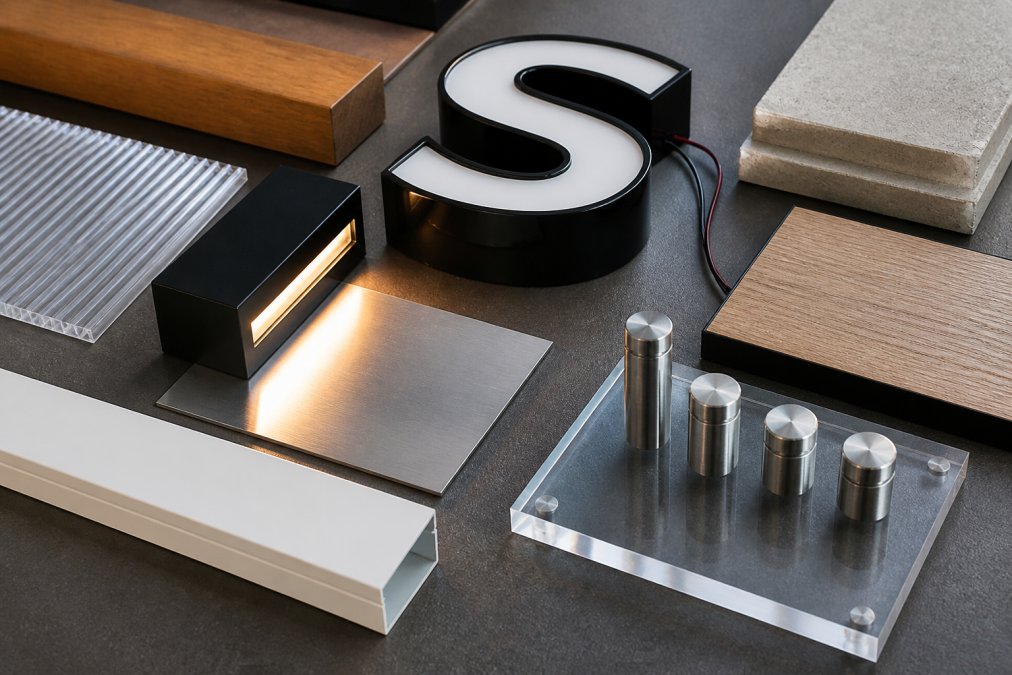
Material choice matters just as much, and each option carries a real trade-off rather than a clean win:
- Aluminum composite holds up to weather, resists fading, and is widely recyclable, but it dents under impact and shows every panel seam on large faces.
- Acrylic offers deep color and clean edge-lit illumination, but it can craze or yellow over long sun exposure and is more brittle in cold snaps.
- Reclaimed and recycled-content substrates earn credit on green-building documentation, but availability and color consistency vary batch to batch, which matters on a multi-sign rollout.
- Powder coating avoids solvent-based paint off-gassing and produces a more chip-resistant finish than liquid paint on metal.
For clients planning a long-term campus, building the sign face so individual panels can be swapped rather than replacing the whole structure is often recommended. That single decision, modular faces over monolithic cabinets, is usually the largest lifecycle saving available, because it lets you refresh branding or repair storm damage without a crane and a full teardown.
Ask your fabricator whether the sign can be relamped or repaneled without a full teardown, and ask what happens to the old components. A sign designed for component replacement can cut lifecycle costs significantly versus one that must be rebuilt entirely, and a fabricator who can tell you where the aluminum and acrylic go at end of life is usually the one already thinking about year ten.
One caution on green claims: “recyclable” and “recycled” are not the same thing, and a sign is only as sustainable as the disposal path available in your area. Ask what actually happens to the material when the sign comes down, not just what it is made of.
Trend 3: ADA Compliant Signage Requirements and Inclusive Design
ADA compliant signage requirements are the non-negotiable baseline for any permanent room sign in a public or commercial building. The Americans with Disabilities Act sets rules for tactile lettering, Braille, mounting height, and contrast so that people with vision impairments can navigate a space independently. Getting these wrong means failed inspections and costly rework.
The practical details trip people up. Tactile characters must be raised, Braille must be properly domed and positioned, and signs must sit at a consistent height on the wall. Inclusive design goes beyond the legal minimum: high-contrast typography, clear pictograms, and consistent placement help everyone, not just people with disabilities.
Skipping ADA compliance to save time during a build is a false economy. Non-compliant signs typically have to be removed and remade, which delays occupancy and adds cost you already paid once.
If you are unsure what your building actually needs, a signage partner should walk you through it rather than sending you to a separate consultant.
Trend 4: Custom Business Sign Design Best Practices for 2026
Custom business sign design best practices start with one rule: the sign must be legible before it is beautiful. Brand identity, typography, and color all matter, but if a customer cannot read the sign from the street or across a lobby, the design has failed its primary job.
In 2026, the strongest custom work balances three things: brand consistency, environmental context, and durability. A sign that looks great in a design mockup but clashes with the building’s architecture or fades within two years is not a good sign. Large-format printing and dimensional signage now let designers add depth and texture without sacrificing readability.
What most guides miss is the maintenance angle. A layered, dimensional sign with exposed edges collects dust and weathers faster than a flat panel. Design for how it will look in year five, not just on installation day.
Trend 5: Vehicle Wraps and Mobile Marketing
Vehicle wraps turn a fleet into moving billboards, and for service businesses they are one of the highest-ROI marketing assets available. A wrapped van or truck generates impressions every mile it drives, in the exact neighborhoods where your customers live and work, impressions you are already paying for through fuel, insurance, and driver time. That is the core economic argument: the vehicle is a sunk cost, so the wrap converts an existing expense into an advertising channel.
What most trend roundups skip is the cost and lifecycle picture, which is what actually determines whether a wrap pays off:
- Upfront cost scales with coverage and complexity. A partial wrap on a cargo van costs far less than a full wrap on a box truck, and coverage percentage, not vehicle size alone, is the main driver. Curves, rivets, and deep recesses add labor hours because the installer must stretch and relief-cut the film rather than lay it flat.
- Service life is typically several years for a quality cast vinyl with proper care, after which the film is removed and either replaced or the vehicle is sold. Removal is a real line item, and on older or repainted vehicles it can pull paint if the surface was not sound to begin with.
- Maintenance is mostly washing discipline. Hand washing with mild soap and avoiding automated brushes and high-pressure spray at the edges will add years to a wrap. A wrapped vehicle that goes through a brush wash weekly will lift at the seams long before the film itself fails.
- The real comparison is cost per impression against your other channels, not cost per vehicle. Track it by logging routes and mileage for a quarter, then compare that reach against what the same spend buys in local digital or print.
A simple ROI framework you can run before committing:
- Estimate monthly miles driven per vehicle.
- Multiply by a conservative impressions-per-mile figure for your market density, urban routes generate far more than highway miles.
- Divide total wrap cost (installation plus removal at end of life) by total estimated impressions over the service life.
- Compare that cost per impression to your current cost per impression on the channels you would otherwise fund.
If the wrap wins on that comparison, it wins on the numbers rather than on the novelty.
The results depend almost entirely on installation quality. Crooked panels, lifting edges, and bubbles make a brand look careless, which is the opposite of the intent. Proper surface preparation and quality vinyl matter more than the design file, a great design on a poorly prepped surface will fail at the edges within a season.
For companies running multiple vehicles, consistency is the whole point. Every wrap should use the same brand colors, logo placement, and typography so the fleet reads as one company. Build a written spec, exact color values, logo clear-space rules, and which panels carry which message, and hand it to whoever installs the next vehicle, so the tenth wrap matches the first.
Budget the wrap as a multi-year asset with an end-of-life removal cost, not a one-time purchase. Companies that plan for removal and replacement on a schedule get far more value than those surprised by it.
U.S. Department of Transportation guidance on commercial vehicle markings
Exterior Signage Installation Timeline: What to Expect
The exterior signage installation timeline typically runs several weeks from approved design to final install, though it varies with permit requirements and sign complexity. Understanding the phases helps project managers sequence signage against other construction milestones.
A typical project moves through these stages:
| Phase | What Happens | Typical Duration |
|---|---|---|
| Design and approval | Concept, revisions, final sign-off | 1-2 weeks |
| Permitting | Local jurisdiction review | Varies by city |
| Fabrication | Materials cut, assembled, finished | 2-4 weeks |
| Installation | Site prep, mounting, wiring | 1-3 days |
The permitting phase is the wild card. Some jurisdictions approve quickly; others take considerably longer, and no fabricator can speed up a municipal review. The best defense is starting the permit application as early as possible, ideally while fabrication is still being quoted.
Build signage into your construction schedule from day one. Treating it as a last-minute add-on is the most common reason projects miss their occupancy date.
How to Choose the Right Sign Trends for Your Business
Choosing the right trends comes down to matching the sign to your actual goals, not chasing whatever looks newest. Not every business needs digital signage, and not every business benefits from a vehicle wrap. The right answer depends on where your customers encounter you and what you need the sign to do.
Work through these questions before committing budget:
- Where do customers see you first? Street-facing exteriors and lobbies need different solutions than a fleet of service vehicles.
- How often will content change? Frequent updates justify digital; a fixed message does not.
- What does compliance require? Permanent room signs must meet ADA standards regardless of style.
- What is the lifecycle cost? Factor in maintenance, relamping, and repaneling, not just the initial quote.
- Who maintains it? Assign an owner before installation, or the sign will decay.
A practical framework: score each option on visibility, durability, compliance, and maintenance. The highest total wins for your situation, even if it is not the trendiest choice.
U.S. Access Board guidance on accessible design standards
Signage decisions made in 2026 will shape how customers, inspectors, and employees experience your space for years. The trends above are only useful if they are executed with quality workmanship and reliable timelines. With over 30 years of combined experience, a full-service design, fabrication, and installation team, and a track record of meeting tight deadlines and budgets, we handle everything from ADA signage to vehicle graphics and living wall displays. Get started with Triton Sign and give your brand a visual presence that holds up long after installation day.
Frequently Asked Questions
What are the most popular business sign materials for 2026?
Aluminum composites and acrylic materials remain the most popular choices for business sign trends in 2026. Aluminum composite panels offer durability and a flat, modern look for exterior signage, while acrylic provides a polished finish for interior displays. Sustainable options like recycled content and energy-efficient LED lighting are also gaining traction. When selecting materials, consider your location, climate, and how long you plan to keep the sign. Triton Sign can help you choose the right material for your specific project.
How does ADA compliance impact modern signage design?
ADA compliant signage requirements affect font size, contrast, braille, and mounting height for permanent room signs. In 2026, more businesses are integrating these requirements early in the design phase to avoid costly retrofits. For example, tactile characters must be raised at least 1/32 inch and placed between 48 and 60 inches from the floor. Working with a signage provider that understands these rules ensures your signs meet federal standards without compromising your brand identity.
Are digital signs becoming more common for small businesses?
Yes. Cloud-first platforms and lower hardware costs have made digital signage accessible to small businesses. You can now manage content remotely and update promotions in real time. Many small businesses start with a single screen in a window or lobby, then expand as they see engagement rise. The key is to focus on content that adds value, not just flashy visuals.
How often should a business update its exterior signage?
Most exterior signs last 7 to 10 years, but you should update sooner if your branding changes, the sign shows wear, or local regulations shift. For 2026 trends, many businesses are refreshing signs to include energy-efficient LED lighting or more sustainable materials. If you are planning a renovation or new build, factor signage into the exterior signage installation timeline early. A professional sign company can assess whether a repair or full replacement makes more sense.