Table of Contents
- What Northwest Realty Signs Cover and Why They Matter
- Real Estate Yard Sign Installation: What to Expect
- Durable Materials for Outdoor Realty Signs
- Custom Real Estate Sign Design That Builds Brand Recognition
- Sign Compliance, Local Ordinances, and Placement Rules
- Sign Removal, Maintenance, and Long-Term Signage Management
- Choosing the Right Realty Signs Provider: What to Look For
- Frequently Asked Questions
Last Updated: August 28, 2026
What Northwest Realty Signs Cover and Why They Matter
Real estate signage is one of the most direct, cost-effective marketing tools a property listing has. The right realty signs announce the property, reinforce the agent’s brand, and communicate professionalism to every driver and pedestrian who passes by. The National Association of Realtors research on home buyer behavior consistently shows that yard signs remain among the primary ways buyers first notice a property. Understanding what northwest realty signs cover means understanding the full scope of real estate signage: from residential yard signs and commercial post installations to directional signs, open house riders, and custom-branded displays for brokerages.
Residential vs. Commercial Sign Requirements
Residential real estate signage typically involves post-mounted yard signs, A-frame open house signs, and directional riders placed on private property with the seller’s permission, complying with local municipal codes governing sign size, height, and placement. Commercial real estate signage is larger and heavier, often requiring permits. Multi-panel signs with agent contact information, brokerage branding, and property details must have hardware rated for wind load, with placement coordinated through property management.
How Sign Quality Affects Curb Appeal and Listing Visibility
A warped, faded, or illegible sign undermines the listing’s perceived value. High-quality realty signs with crisp graphics, UV-resistant inks, and solid hardware frames communicate professionalism. The material matters: aluminum composite panels hold color longer than corrugated plastic, and powder-coated steel frames resist rust in wet climates.
Real Estate Yard Sign Installation: What to Expect
Professional real estate yard sign installation involves a site visit, ground assessment for post depth, and placement that maximizes road visibility while respecting property boundaries and local setback rules.
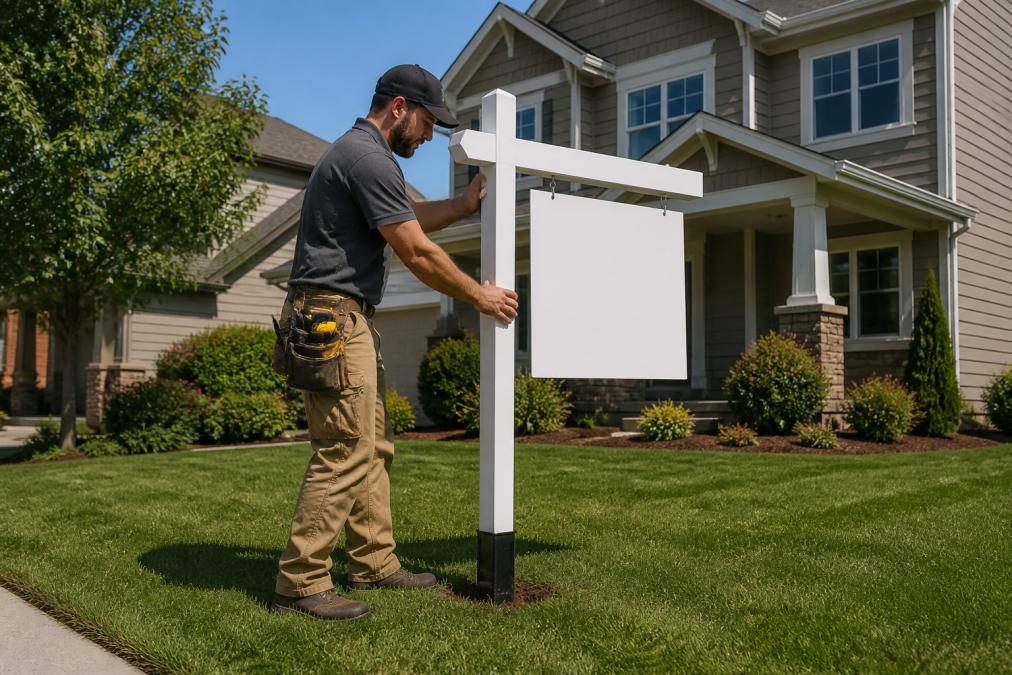
Ground conditions like rocky soil, tree roots, or recently laid sod can complicate standard post installation. A professional crew handles this without rescheduling; a DIY attempt often results in an improperly secured sign requiring a return visit.
DIY vs. Professional Installation: Cost-Benefit Breakdown
For a solo agent placing one or two signs per month, DIY installation is feasible. For teams, brokerages, or agents with high listing volume, professional installation services pay for themselves quickly through consistency, compliance assurance, sign condition verification, and removal logistics. The cost-benefit calculation shifts decisively toward professional installation once an agent manages more than a handful of active listings.
Scheduling, Turnaround Time, and Installation Logistics
Online account management portals allow agents to submit orders, track installation status, manage sign inventory, and schedule removal without phone calls. Turnaround time is critical in hot markets; a sign that arrives late misses peak traffic windows. Ask prospective providers about average turnaround time, service area coverage, and processes for unexpected obstacles.
When evaluating a sign service provider, ask specifically about their process for same-day or rush installations. Some providers offer expedited scheduling for an additional fee; others cannot accommodate it.
Durable Materials for Outdoor Realty Signs
Durable materials are the foundation of a serviceable sign inventory. The most common substrate options include:
- Aluminum composite material (ACM): Lightweight, rigid, weather-resistant, and holds printed graphics well. The preferred choice for professional appearance over multiple listing cycles.
- Corrugated plastic (coroplast): Lower cost and adequate for short-term use, but prone to fading and warping with extended outdoor exposure.
- PVC foam board: More rigid than coroplast but less suited for year-long exterior exposure in harsh climates.
- HDU (high-density urethane): Used for premium carved or dimensional signage, more common in luxury real estate.
As documented in the Specialty Graphic Imaging Association’s materials guidance, UV-resistant inks and laminates significantly extend outdoor lifespan. A laminated aluminum panel in direct sun will outlast an unlaminated coroplast sign substantially.
Sign Hardware and Frame Options
Hardware is where many real estate sign setups fail. Standard options include H-frame wire stakes for lightweight corrugated signs, single-post installations for standard residential yard signs, double-post frames for larger panels, and swing arm post systems for upscale appearance. Hardware gauge and coating matter in wet or coastal climates; galvanized steel resists rust, and powder-coated finishes add corrosion protection while allowing color-matching to brand standards.
Custom Real Estate Sign Design That Builds Brand Recognition
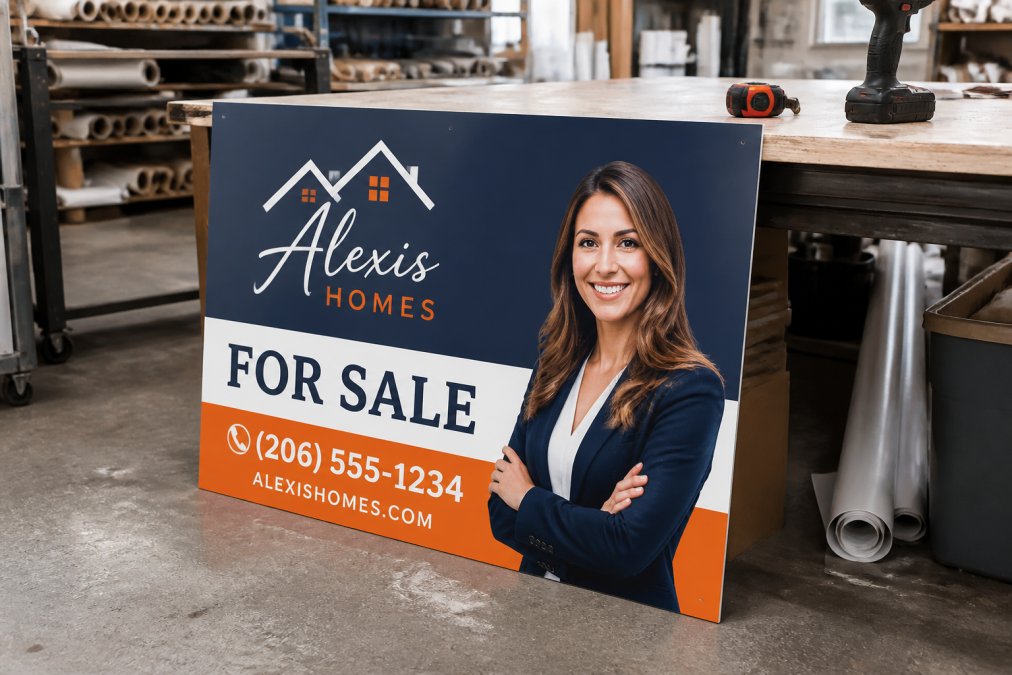
Custom real estate sign design balances visibility from distance with legibility up close. A sign that catches the eye from a moving vehicle but can’t be read from the sidewalk fails at the second job. Sign fabrication typically involves digital printing on the chosen substrate with options for full-color photographic output or spot colors matched to brand standards.
Color, Typography, and Visual Graphics Best Practices
High-contrast combinations read clearly at distance and in varying light conditions. Typography for real estate signage must be readable in two seconds at 25 miles per hour: primary information (agent name, brokerage, phone number) in large, bold, sans-serif type; secondary information (website, QR code) in smaller type for pedestrian-level reading. Avoid script fonts for critical contact information. Visual graphics, including agent headshots and brokerage logos, reinforce brand recognition across a sign inventory.
The most effective real estate sign designs are built for two audiences simultaneously: drivers who need to see it from the road, and pedestrians who need to read it from the sidewalk.
Sign Compliance, Local Ordinances, and Placement Rules
Most municipalities regulate real estate signage under their general sign ordinance or zoning code. Common restrictions include maximum sign dimensions, limits on the number of signs per property, setback requirements, and prohibitions in certain zoning districts. Some jurisdictions require a permit for temporary real estate signs; others exempt them entirely.
According to the American Planning Association’s guidance on sign regulations, sign ordinances are among the most frequently litigated areas of local land use law. An agent whose signs are regularly removed by code enforcement loses marketing time and faces potential fines.
The practical compliance checklist includes confirming maximum sign dimensions, verifying setback requirements, checking permit requirements, reviewing HOA rules for listed properties, and understanding the timeline for sign removal after a property closes. A professional sign service provider with deep familiarity with local ordinances is a genuine operational asset.
Sign Removal, Maintenance, and Long-Term Signage Management
A sign left on a property after closing reflects poorly on the agent and can trigger code enforcement action. Professional sign removal services handle pickup on a scheduled or on-request basis, ideally integrated into the same account management portal used for installation requests.
Long-term signage management includes sign inventory tracking, condition assessment, storage that protects panels from UV exposure, and a clear process for repair and replacement. The U.S. Small Business Administration’s guidance on brand asset management notes that consistent brand presentation across customer touchpoints is foundational for professional service businesses.
Leaving a “For Sale” sign on a property after it has closed or been taken off market is a compliance risk in many jurisdictions and a brand credibility problem in all of them. Build sign removal into your transaction closing checklist.
Choosing the Right Realty Signs Provider: What to Look For
The right realty signs provider is a logistics partner for one of the most visible elements of a real estate agent’s or brokerage’s marketing operation.
| Evaluation Criteria | What to Ask | Why It Matters |
|---|---|---|
| Service area coverage | Which zip codes or counties do you cover? | Gaps in coverage create scheduling problems |
| Turnaround time | What’s your standard installation window? | Listings need signs quickly in active markets |
| Online account management | Do you offer a self-service portal? | Reduces administrative overhead |
| Sign fabrication capabilities | Do you produce custom designs in-house? | In-house fabrication means faster turnaround |
| Compliance knowledge | Are you familiar with local sign ordinances? | Reduces risk of sign removal |
| Removal and storage | Do you handle pickup and store inventory? | Simplifies the full signage workflow |
| Condition standards | How do you handle damaged or faded signs? | Protects brand presentation |
A professional signage operation differs from a commodity service in fabrication capability and installation crew experience. A provider who designs and produces signs in-house can turn around custom orders faster and maintain tighter quality control. A crew that has placed thousands of signs knows how to handle difficult ground conditions, tricky property configurations, and compliance edge cases.
Triton Sign brings over 30 years of combined signage experience to full-service design, fabrication, and installation. The same team that fabricates custom sign panels coordinates installation logistics, eliminating communication gaps that create problems when design and installation are handled separately. For real estate professionals managing high volumes of listings, the operational difference between a well-run signage partner and a commodity provider is significant.
Maintaining a professional real estate signage operation at scale requires coordinating orders, scheduling installations, tracking inventory, managing removal, and staying compliant with local ordinances while running the actual business of selling property. Triton Sign’s full-service approach, backed by decades of fabrication and installation experience, is built specifically for this operational complexity. Contact Triton Sign to discuss your signage requirements and get a custom solution that keeps your listings looking professional from the first day on market to the day the sign comes down.
Frequently Asked Questions
Q: What is the standard size for a realtor yard sign?
A: The most common size for a residential real estate yard sign is 18 by 24 inches. Rider panels attached above or below typically measure 6 by 24 inches. Commercial property listings often use larger post-mounted signs, sometimes 24 by 36 inches or bigger, to maintain visibility from a distance. Local ordinances in many municipalities set maximum dimensions, so always confirm size limits with your city or county before ordering.
Q: Are there specific regulations for real estate sign placement?
A: Yes. Most municipalities regulate where realty signs can be placed, how tall the post can be, and how close a sign may sit to a sidewalk, road, or property line. Some jurisdictions require a permit before installation, particularly for commercial real estate signage. HOA rules can add another layer of restrictions in residential communities. A professional signage provider familiar with local ordinances can flag compliance issues before installation begins, saving agents from fines or forced removal.
Q: What are the best materials for durable outdoor realty signs?
A: Corrugated plastic, also called Coroplast, is the most common substrate for short-term yard signs because it is lightweight and inexpensive. For longer campaigns or commercial real estate listings, aluminum composite panels and HDU foam board hold up better against UV exposure, rain, and wind. UV-resistant inks and laminate coatings extend the life of the printed graphics significantly. The right material depends on how long the sign will be posted and the typical weather conditions at the property.
Q: How does custom signage impact brand recognition for real estate agents?
A: Consistent custom real estate sign design across every property listing reinforces an agent’s visual identity in the local market. Buyers and sellers begin associating specific colors, logos, and typography with an agent’s name before any direct contact. Studies in general marketing consistently show that repeated visual exposure builds recall. For agents managing multiple listings simultaneously, uniform branding across all yard signs, riders, and post frames creates a professional presence that generic brokerage signs cannot replicate.
Q: What factors should realtors consider when choosing a signage provider?
A: Turnaround time matters most when a listing goes live quickly. Beyond speed, look at material quality, installation crew reliability, sign removal procedures, and whether the provider offers an account management portal for tracking orders. Agents managing sign inventory across a large territory should ask about service area coverage, sign storage options, and how the provider handles damage or replacement. Experience with real estate signage specifically, rather than general commercial printing, is a meaningful differentiator.
This article was written using GrandRanker