Table of Contents
- The Hidden Costs of Cutting Corners on Monument Sign Installation
- Monument Sign Permit Requirements: What You Need to Know
- Commercial Sign Installation Cost Breakdown: Where Your Money Goes
- Monument Sign Foundation Specifications: The Invisible Backbone
- The Real Risks of Improper Installation: Liability and Insurance
- Comparative ROI: Professional Installation vs. DIY Approaches
- Conclusion: Making the Right Call for Your Business
- Frequently Asked Questions
Last Updated: September 23, 2026
The Hidden Costs of Cutting Corners on Monument Sign Installation
Is professional monument sign installation worth the cost? For most businesses, yes. A monument sign is a permanent, ground-mounted structure that carries your brand for a decade or more, and the price gap between a professional job and a cheap one rarely reflects the real difference in risk. This guide from Triton Sign breaks down where the money goes, what permits demand, and why the foundation decides everything.
Skipping the engineering review to save money up front is the single most expensive shortcut in this trade. A sign that fails a wind load inspection can be ordered removed, and the removal plus rebuild usually costs more than the original professional installation would have.
Monument Sign Permit Requirements: What You Need to Know
Monument sign permit requirements vary by city and county, but nearly every jurisdiction treats a ground-mounted sign as a regulated structure. You will typically need a sign permit, and often a separate electrical permit if the sign includes lighting or an electronic message center.
The application usually asks for:
- A site plan showing the sign’s location and setback from property lines
- A drawing with dimensions, height, and total sign area
- A foundation detail stamped by a licensed engineer
- Electrical specifications if the sign is illuminated
- Proof of property ownership or landlord authorization
Submit your permit application before you order materials. Approvals can take weeks, and a rejected drawing means redesigning the sign, not just resubmitting paperwork.
Commercial Sign Installation Cost Breakdown: Where Your Money Goes
A commercial sign installation cost breakdown has three main buckets: materials and custom fabrication, installation labor and site preparation, and the foundation work. Pricing depends on size, material, lighting, and site conditions, so no honest estimate comes without a site visit.
Materials and Custom Fabrication
The material choice drives a large share of the total. Masonry and stone bases cost more than post-and-panel frames but deliver a heavier, more permanent look. LED display and electronic message center options add cost but let you change messaging without replacing the sign.
Installation Labor and Site Preparation
Site preparation is the quiet cost driver. Crews locate underground utilities, excavate for the footer, and pour and cure concrete before the sign arrives. Installation labor then covers setting the structure, wiring, and finishing.
| Cost Category | What It Covers | Main Cost Drivers |
|---|---|---|
| Materials and fabrication | Sign body, base, lettering, lighting | Material type, size, custom design |
| Installation labor | Setting, wiring, finishing | Access, crew size, site conditions |
| Site preparation and foundation | Excavation, footer, concrete | Soil, utilities, frost depth |
| Permits and engineering | Application fees, stamped drawings | Jurisdiction, sign height |
Monument Sign Foundation Specifications: The Invisible Backbone
Monument sign foundation specifications are set by engineering, not guesswork. The footer must be sized to resist wind load, support the sign’s weight, and account for soil conditions. This is the part nobody sees and the part that determines whether the sign lasts.
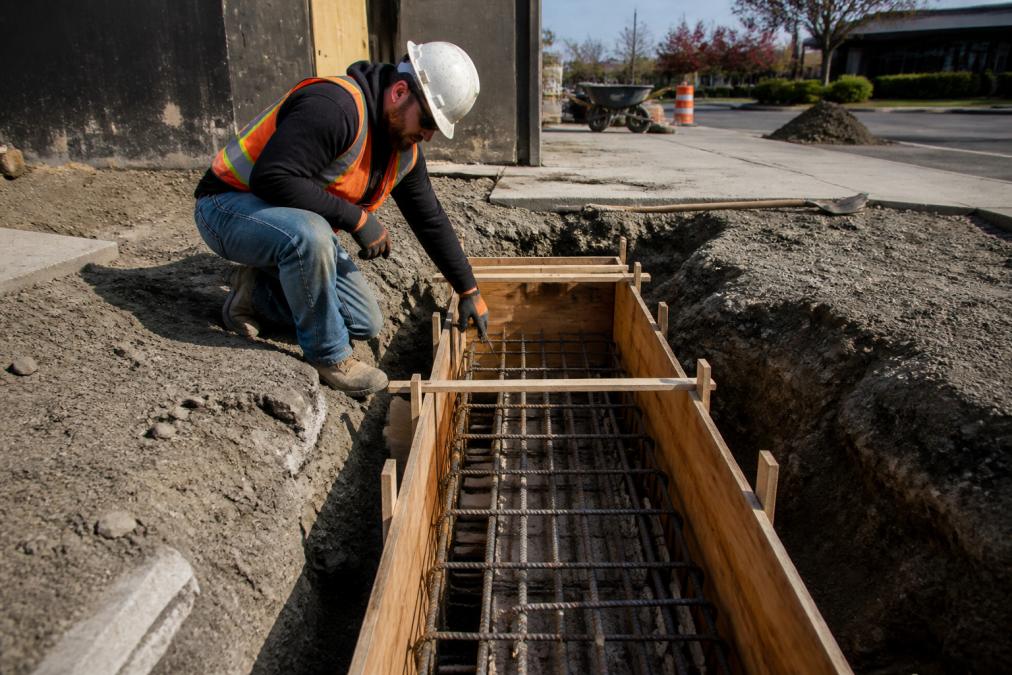
The foundation is the one part of a monument sign you can never cheaply fix. If it is wrong, the fix means demolition and a full rebuild.
The Real Risks of Improper Installation: Liability and Insurance
Improper installation creates liability most business owners never consider until it is too late. A monument sign is a structure on your property. If it fails and damages a vehicle or injures a pedestrian, you can be held responsible, and the legal theories are broader than most owners expect.
The exposure usually shows up in three forms:
- Premises liability. A sign that leans, cracks, or sheds a panel onto a sidewalk or drive lane is a property-condition hazard. The owner of the property is typically the first defendant named, regardless of who physically installed the sign.
- Negligent workmanship. If a contractor cut corners on the footer or skipped the engineering review, the owner can pursue the installer, but only if the installer is still solvent, insured, and reachable years later.
- Code enforcement action. A non-compliant sign is a violation on the property record. That can complicate a lease, a refinance, or a sale, because a buyer’s inspector will flag it.
Why Your Property Policy May Not Pay
Commercial property policies respond to sudden, accidental physical loss, fire, wind, hail, vehicle impact. They are not construction-defect policies. Two common exclusions do the damage:
- Faulty workmanship / faulty design. Damage caused by the way something was built or designed is typically excluded. If a footer was undersized and the sign leans into a parked car, the insurer can point to the faulty footer as the cause and deny the claim.
- Completed operations. Coverage for work you or your contractor performed after the job is finished usually lives on a general liability policy, not a property policy, and only if the installer carried that coverage and named you correctly.
The Permit-Denial Cost Spiral
A second, quieter risk is the permit file. A sign installed without proper permits, or installed in a way that does not match the approved drawings, can be flagged by code enforcement. The remedy is often removal at the owner’s expense, and the sequence is expensive:
- Stop-work or violation notice. The sign is tagged and the property record is flagged.
- Removal. The sign comes down, often including partial demolition of the base.
- Redesign and re-engineering. A new stamped foundation detail is required, which means paying an engineer a second time.
- Re-permitting. New application fees, new review time, and a new inspection cycle.
- Rebuild. Fabrication and installation again, on a site that has already been disturbed.
How Professional Installation Shifts the Risk
Professional installation does not eliminate risk, it transfers and documents it. Three things change:
- Structural. The work is engineered and inspected to meet the adopted building code and local wind-load requirements, so the failure mode is designed out rather than hoped away.
- Legal. Permits, stamped drawings, and inspection sign-offs sit with the project. If a question arises later, the paper trail exists.
- Financial. A reputable installer carries general liability and workers’ compensation coverage and stands behind the work. Ask for a certificate of insurance and confirm you are listed correctly before work begins.
Before any crew breaks ground, request a certificate of insurance showing general liability and workers’ compensation coverage, and confirm the policy is current. An uninsured installer shifts every dollar of risk back onto your property.
Professional installation is not just a construction decision, it is a risk-transfer decision. The engineering, the permits, and the insurance documentation are what you are actually buying.
Comparative ROI: Professional Installation vs. DIY Approaches
The ROI comparison favors professional installation once you count the full life of the sign, but the useful version is a framework you can run with your own numbers, not a slogan. A monument sign is a long-term asset, and signage longevity drives the return.
The Four Cost Lines That Decide the Math
Most DIY-versus-professional comparisons only look at line one. The decision turns on four:
- Upfront installed cost. Professional work is higher because it includes engineering, permitting, and an engineered footer. DIY is lower on paper.
- Maintenance and repair over the asset life. A sign on a properly engineered footer typically needs less corrective work, re-leveling, base crack repair, hardware replacement, than one on a shallow or undersized footer.
- Premature replacement. A monument sign is commonly expected to serve a decade or more. A sign that fails inspection, leans, or cracks its base can force replacement in a fraction of that window, which resets the entire capital cost.
- Compliance and liability cost. Permit fixes, removal orders, and uncovered damage claims are tail risks. They are low-probability and high-cost, which is exactly the profile that wrecks a DIY budget.
A Payback Framework You Can Apply
The honest way to compare is to spread the professional premium across the asset life and weigh it against avoided costs. The mechanism works like this:
- Take the difference between the professional bid and the DIY estimate. That is your premium.
- Divide it by the expected service life in years. That gives you the annualized cost of doing it right.
- Compare that annualized figure against the annualized cost of the likely DIY outcomes: a foundation repair, a re-permit, an early replacement, or an uncovered liability claim.
| Factor | Professional Installation | DIY Approach |
|---|---|---|
| Upfront cost | Higher | Lower |
| Permits and engineering | Handled by the installer | Owner’s responsibility |
| Foundation quality | Engineered and inspected | Variable |
| Lifespan | Typically longer with proper footer | Shorter if foundation is weak |
| Liability exposure | Reduced with documented work | Higher, insurance may not cover |
| Repair costs | Lower over time | Can exceed original savings |
| Compliance risk | Documented and inspected | Owner carries the exposure |
The Property-Value Angle
ROI is not only about avoided cost. Signage is part of the property’s presentation, and presentation affects how a site is perceived by tenants, customers, and appraisers.
- Curb appeal and leasing. A clean, well-lit, straight monument sign reads as a maintained property. A leaning or cracked one reads as deferred maintenance, which is a negotiating point against the owner in a lease or sale.
- Visibility and traffic. A sign that is properly sited, properly scaled, and properly lit does its job, it is seen from the road at the speed traffic actually travels. A sign installed off the approved plan may be sited poorly or dimmed to comply after the fact.
- Documentation as an asset. Permit approvals, stamped drawings, and inspection records travel with the property. They are evidence of a compliant improvement, which is useful at refinance or sale.
What to Ask Before You Sign
To make the comparison real, get these from any installer:
- A written scope that separates fabrication, site preparation, foundation, and electrical.
- Confirmation that the foundation detail is stamped by a licensed engineer.
- A copy of the permit application and the approval once issued.
- A certificate of insurance for general liability and workers’ compensation.
- References from projects of similar size and site conditions.
Run the payback framework with your own bids before you decide. Annualize the professional premium over the expected service life, then compare it to the cost of a single foundation repair or early replacement. The comparison is usually not close.
The DIY path looks cheaper on day one. Over the life of the sign, the professional premium is small and the avoided costs are large, that is the ROI case, and it is a math problem, not a preference.
Conclusion: Making the Right Call for Your Business
The decision comes down to risk, not just price. A monument sign is a permanent structure with legal, structural, and financial exposure baked in. Professional monument sign installation manages that exposure; the cheap route transfers it to you.
Frequently Asked Questions
What is the average cost of a monument sign?
Monument sign pricing depends on size, materials, and design complexity, so there is no single average. Costs include custom fabrication, foundation work, permits, and installation labor. A simple post-and-panel sign costs less than a masonry structure with an electronic message center. For a quote tailored to your project, contact a professional signage provider directly.
Do I need a permit for a permanent monument sign?
Yes, most municipalities require a permit for permanent monument signs. Permit requirements vary by location and typically cover height, setback, and electrical connections. The application process involves submitting site plans and sign drawings for review. Working with an experienced installer helps ensure your sign meets all local zoning regulations and building codes before installation begins.
What are the risks of improper monument sign installation?
Improper installation can lead to structural failure, especially in high-wind areas. Without a proper foundation footer, the sign may lean, crack, or collapse, creating liability risks for your business. Electrical issues with LED displays can also pose safety hazards. Professional installation ensures the sign meets wind load resistance standards and local building codes.
Does professional installation include site preparation and foundation work?
Reputable installers include site preparation and foundation work in their scope. This involves excavation, pouring a concrete footer, and ensuring proper drainage. The foundation must be engineered to support the sign’s weight and withstand ground vibration and environmental wear. Skipping these steps compromises structural integrity and signage longevity.