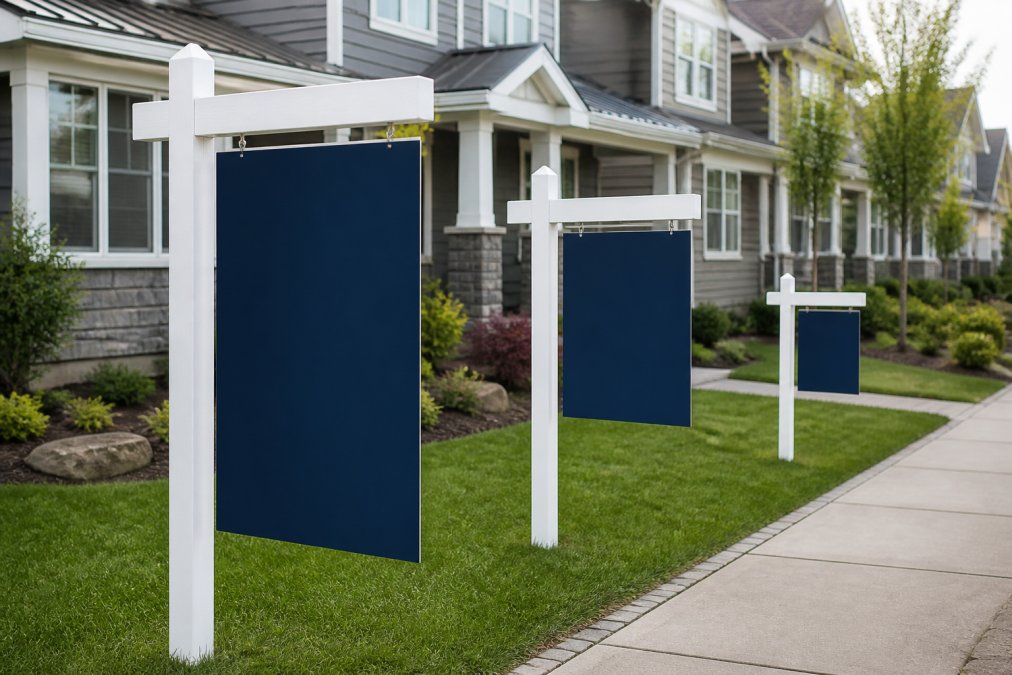
Table of Contents
- Standard Real Estate Sign Dimensions
- Real Estate Sign Visibility and Readability
- HOA Regulations for Yard Signs
- Factors That Influence Sign Size Selection
- Material Durability and Weather Resistance
- Installation and Portability Considerations
- Legal Compliance and Accessibility
- Comparing Your Sign Size Options
- Frequently Asked Questions
Last Updated: September 12, 2026
Standard Real Estate Sign Dimensions
Choosing the right size for residential real estate signs starts with two numbers: 18×24 inches and 24×36 inches. Those are the two standard dimensions used across the industry, and most agents never need anything outside them. At Triton Sign, we’ve fabricated signage for agents, developers, and property managers for over 30 years combined, and the same question comes up at every listing appointment: how big should the sign be?
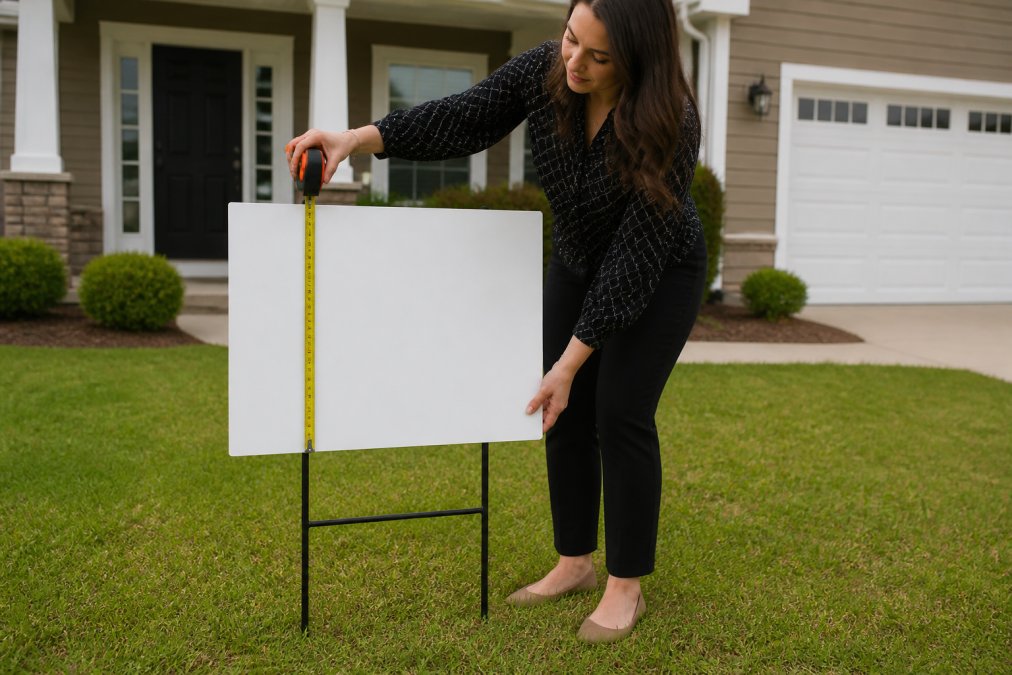
The honest answer is that size should follow the property, not the other way around. A sign that’s too small disappears into the landscaping. A sign that’s too large looks aggressive on a quiet residential street and may run afoul of local rules.
18×24 Inches: The Residential Standard
The 18×24 inch sign is the default for residential listings, and it earns that status. It’s large enough to read from a moving car, small enough to fit on a standard H-stake, and light enough for one person to install in minutes.
For most single-family homes on typical suburban lots, this is the size to order. It balances legibility with curb appeal and keeps your marketing collateral proportionate to the property.
24×36 Inches: When to Go Bigger
The 24×36 inch sign is the right call when visibility distance matters more than subtlety. Corner lots, properties set back far from the road, and commercial or multi-unit listings all benefit from the larger format. It also works well for open house announcements where you want the sign to function as a directional marker from down the block.
The trade-off is weight and wind load. A larger panel catches more wind, so installation hardware needs to be rated for it.
Real Estate Sign Visibility and Readability
Real estate sign visibility and readability come down to one rule: text must be legible at the speed and distance your audience is actually moving. A driver at 25 mph has roughly two to three seconds to register your sign (mutcd.fhwa.dot.gov). That is not enough time for small type or a cluttered layout.
Font Size and Legibility at Distance
For an 18×24 inch panel, the agent name and phone number should be the largest elements after the brokerage logo. A common mistake is treating the sign like a business card and shrinking everything to fit. In practice, fewer words at larger sizes always outperform more words at smaller sizes.
Keep the essential contact information to three elements: name, phone number, and a call to action. Everything else is decoration.
Walk to the far edge of the property line and look back at your sign. If you can’t read the phone number from there, a passing driver has no chance. Test before you commit to a print run, not after.
HOA Regulations for Yard Signs
HOA regulations for yard signs vary enormously from one subdivision to the next, and they are the single most common source of fines for listing agents. Some associations cap sign dimensions outright. Others restrict placement, duration, or the number of signs allowed per property. A few ban yard signs entirely except during an open house window.
The reason this trips up agents is that HOA covenants are private contracts, not public law. They are not posted on a municipal website, and they are not enforced by a code officer. They are enforced by a board that can fine the homeowner, place a lien, or force removal, usually with the listing agent nowhere in the enforcement chain.
A Compliance Checklist Before You Order
Run this sequence at every listing appointment, before you place a fabrication order:
- Request the covenant, not a summary. Ask the seller for the full declaration of covenants, conditions, and restrictions (CC&Rs) plus any architectural or sign addenda. A neighbor’s verbal assurance is not documentation.
- Search the document for sign-specific language. Look for terms like “sign,” “advertising,” “display,” “banner,” and “temporary.” Sign rules are sometimes buried in an architectural control section rather than a standalone sign clause.
- Confirm the maximum dimensions. Many covenants specify a maximum panel size in inches, a maximum height above grade, or both. If the covenant caps size below 18×24 inches, that cap controls.
- Check placement restrictions. Common limits include setback from the property line, distance from the curb, and prohibition of signs in the parkway or right-of-way.
- Check duration and removal deadlines. Many associations require removal within a set number of days after closing, after listing expiration, or after an open house ends.
- Check rider and A-frame rules. Riders (the small add-on panels for “Open House,” “Price Reduced,” or “Sold”) are frequently restricted or banned even when the main sign is allowed.
- Get written confirmation if anything is ambiguous. A short email to the HOA manager or architectural committee, saved to the listing file, protects both you and the seller.
Where the Rules Usually Come From
If the property is in a planned community, the governing documents typically sit in three layers: the recorded declaration, the architectural guidelines, and the board’s current enforcement policy. The recorded declaration is the hardest to change and usually the most authoritative. Board policy can shift with each election, so confirm the current version rather than relying on what a colleague told you last season.
Installing an oversized sign in a covenant-restricted neighborhood can trigger a fine against the homeowner, not you. Confirm the rules in writing before installation day, and keep that confirmation in the transaction file.
When the HOA and the City Disagree
Occasionally a covenant is stricter than the municipal code, or the reverse. The stricter rule generally governs in practice, because the HOA can enforce its private contract regardless of what the city permits. If the two conflict in a way that affects your sign plan, document both and choose the more restrictive option.
Build a one-page sign-rule sheet for each subdivision you farm. After two or three listings in the same community, you will have the dimensions, placement limits, and removal deadlines on hand, and you will stop re-reading the same covenant every time.
Factors That Influence Sign Size Selection
Several practical factors should drive your size decision, and they often conflict with each other. Weigh them in this order:
- Street traffic speed: Faster roads demand larger text and often a larger panel.
- Setback distance: The farther the sign sits from the road, the bigger it needs to be.
- Lot type: Corner lots and flag lots need more visibility than interior lots.
- Local rules: Zoning laws and HOA restrictions set hard ceilings on size.
- Budget and quantity: Larger panels cost more per unit and require heavier hardware.
- Brand identity: Consistent sizing across a brokerage’s listings reinforces recognition.
When two factors conflict, local rules win. A perfectly sized sign that violates zoning is still a violation.
Material Durability and Weather Resistance
Material choice affects how long your sign survives and how good it looks on day 90 of a listing. Corrugated plastic is the budget standard. It’s light, cheap, and fine for short-term use, but it fades and warps under sustained sun exposure.
Aluminum panels cost more upfront and last far longer. They hold their shape, resist warping, and take UV-protection coatings well. For agents who reuse signs across multiple listings, aluminum pays for itself quickly.
Weather resistance matters most in coastal and rainy climates, where wind load and moisture degrade cheap materials fast. If your market sees serious wind, invest in the heavier substrate and the hardware to match.
Installation and Portability Considerations
Installation hardware should match both panel size and ground conditions. The three common options are H-stakes, post-and-arm frames, and in-ground posts.
- H-stakes: Best for 18×24 inch panels in soft soil. Fast to install, easy to move.
- Post-and-arm frames: Better for 24×36 inch panels and for agents who reposition signs often.
- In-ground posts: The most stable option, used where signs stay up for months.
Portability matters if you manage multiple listings. A frame system that assembles without tools saves real time on turnover days. The thing nobody tells you about cheap H-stakes is that they bend on the first hard freeze and never sit straight again.
Legal Compliance and Accessibility
Two legal layers govern residential real estate signs: municipal zoning laws and federal accessibility standards. Zoning laws set where signs can go, how large they can be, and how long they can stay. These vary by jurisdiction, so confirm the current rules with your local planning office rather than relying on what worked last year.
Municipal Zoning: What to Verify
Most municipalities regulate signs through a sign ordinance in the zoning code. The provisions that matter most for a residential listing sign are:
- Maximum area. Often expressed in square feet per sign face. An 18×24 inch panel is 3 square feet per face; a 24×36 inch panel is 6 square feet per face. Know both numbers before you check the code.
- Maximum height. Measured from grade to the top of the sign, not the top of the panel.
- Setback from the property line and right-of-way. Signs placed in the parkway or public right-of-way are commonly prohibited.
- Permit thresholds. Many jurisdictions exempt small temporary real estate signs from permitting, but the exemption usually has a size and duration limit.
- Duration limits. Some codes cap how long a listing sign may remain, independent of any HOA rule.
When you call the planning office, ask for the sign section by name and request the current version in writing. Codes are amended, and a rule that was accurate two years ago may not be today.
Accessibility: Where It Applies and Where It Does Not
The ADA Standards for Accessible Design govern signage in many contexts, and while a yard sign on a residential listing is not typically a covered element, the standards become relevant the moment you operate a permanent sales office, model home, or commercial listing. In those settings, the U.S. Access Board guidance on signage is the reference to read before you specify anything permanent.
The practical distinction is permanence and public accommodation. A temporary yard sign on a private residential lot generally falls outside ADA scope. A permanent sign identifying a sales center, leasing office, or model home that the public is invited to enter generally falls inside it.
Placement and Legibility for Visually Impaired Passersby
Even where ADA does not strictly apply, the design principles are worth borrowing for any sign a pedestrian might approach:
- Mounting height. For signs meant to be read up close, a common target is a centerline around 48 to 60 inches above the finished floor or grade, which keeps the sign within comfortable reading range for a seated or standing person.
- Character height. For signs read at a short distance, larger characters are easier to resolve. A widely used rule of thumb is roughly 1 inch of character height for every 10 feet of viewing distance, with a minimum that keeps small text legible up close.
- Contrast. High contrast between text and background matters more than font choice for low-vision readers. Avoid low-contrast color pairings such as light gray on white.
- Tactile and braille considerations. For permanent signs identifying a room or facility, tactile characters and braille are commonly required. Yard signs and temporary listing panels are not.
For a residential listing sign, the takeaway is simple: the ADA does not usually bind you, but the placement and legibility habits it encodes will make your sign easier for every passerby to read.
Size decisions are constrained by three things in order: local law, physical visibility, then aesthetics. Get the first two right and the third is easy.
Comparing Your Sign Size Options
| Size | Best For | Visibility | Portability | Typical Hardware |
|---|---|---|---|---|
| 18×24 in | Standard residential listings | Good at 25 mph | High | H-stake |
| 24×36 in | Corner lots, open houses | Strong at 35 mph | Moderate | Post-and-arm frame |
Pros and cons at a glance:
- 18×24 inches: Pros include low cost, easy installation, and HOA-friendly dimensions. Cons include limited visibility on fast roads and reduced impact on large lots.
- 24×36 inches: Pros include strong legibility at distance and better presence on corner lots. Cons include higher cost, heavier hardware, and greater wind load.
Picking a sign size is a small decision with outsized consequences for how quickly a listing gets noticed. Triton Sign handles design, fabrication, and installation in-house, with over 30 years of combined experience, so you get a sign that’s sized correctly for the property and compliant with local rules the first time. From custom fabrication to ADA-compliant interior signage and vehicle graphics for your fleet, our team delivers on tight timelines and stays with the project through installation. Contact us to get your next listing sign specified, fabricated, and installed right.
Frequently Asked Questions
What is the most common size for residential real estate signs?
The 18×24 inch sign is the most common size for residential real estate signs. It fits standard H-stakes, meets most HOA regulations for yard signs, and is readable from the street without overwhelming a typical front yard. For properties on busy roads or larger lots, 24×36 inches can improve visibility, but 18×24 remains the default choice for most listings.
How does sign size impact readability from the street?
Sign size directly affects how far away text can be read. Street traffic speed also matters: slower residential streets allow smaller signs, but faster roads require larger fonts and signs to give drivers time to read.
Are there local ordinances or HOA rules regarding real estate sign sizes?
Yes, many municipalities and HOAs have rules about real estate sign sizes, placement, and duration. Common restrictions limit yard signs to 6 square feet (which fits an 18×24 inch sign) or require them to be set back from the property line. Some HOAs ban signs on common areas or limit how long they can stay up. Always check your local zoning laws and HOA guidelines before ordering.
What is the difference between 18×24 and 24×36 real estate signs?
An 18×24 inch sign is the standard residential size, lightweight and easy to install with H-stakes. A 24×36 inch sign offers 50% more surface area, making it better for high-traffic roads or large properties. However, the larger size may violate HOA restrictions and requires sturdier installation hardware. Choose based on visibility needs and local rules.