
Table of Contents
- What NW Realty Firms Actually Do for Buyers and Sellers
- How to Choose a Real Estate Agency That Fits Your Goals
- Commercial Real Estate Signage Requirements Explained
- Signage’s Role in NW Realty Listings and Property Branding
- What to Expect During the Closing Process
- Neighborhood Spotlights: Reading the Local Market
- Buyer and Seller Guides: Preparing for Your Transaction
- Frequently Asked Questions
Last Updated: August 26, 2026
What NW Realty Firms Actually Do for Buyers and Sellers
NW realty professionals do far more than post a listing and wait. A real estate agency in the northwest market coordinates property valuation, buyer qualification, negotiation strategy, and the closing process, all while managing communication between lenders, inspectors, title services, and escrow officers. That coordination is where deals survive or fall apart.

Services That Go Beyond the Listing
The strongest nw realty firms offer virtual staging for vacant homes, 3-D tours for out-of-area buyers, and listing alerts tailored to specific neighborhood criteria. Relocation services are another differentiator, buyers moving from out of state need context on school districts, commute times, neighborhood character, and inventory velocity. Investment properties and commercial real estate transactions require agents who understand cap rates, zoning classifications, and lease structures.
How Local Market Expertise Changes Outcomes
Local market expertise is a measurable advantage. An agent who has closed transactions in a specific zip code knows which streets carry noise from nearby arterials, which buildings have HOA issues, and which sellers are motivated. That knowledge changes negotiation strategy directly. According to the National Association of Realtors’ research on buyer and seller experiences, buyers who work with agents with deep local knowledge report significantly higher satisfaction with both process and final terms.
How to Choose a Real Estate Agency That Fits Your Goals
Choosing a real estate agency is one of the most consequential decisions in any property transaction. The right filter is alignment: does this agency’s process, communication style, and market focus match what your transaction requires?
Questions to Ask Before You Sign Anything
Before signing a buyer’s representation agreement or listing contract, ask:
- How many transactions have you closed in this specific neighborhood in the past 12 months?
- What is your average days-on-market for listings you’ve represented?
- Who handles communication when you’re unavailable, and what is the expected response time?
- Do you have relationships with mortgage lenders, inspectors, and title services you can refer?
- What does your open house strategy look like, and how do you qualify attendees?
Ask specifically about mortgage pre-approval requirements for buyers they work with. Agents who don’t screen for pre-approval before showing properties waste everyone’s time and signal disorganized workflows.
Red Flags That Signal the Wrong Fit
The biggest red flag is an agent who agrees with everything you say. A seller who insists on listing above market and finds an agent willing to take the listing is not getting good counsel. Other signals worth noting: vague answers about handling multiple offers, no clear escrow timeline process, inability to explain inspection contingencies, pressure to sign before review, and no mention of a market analysis during consultation. A good nw realty professional will push back when expectations don’t match market reality.
Commercial Real Estate Signage Requirements Explained
Commercial real estate signage requirements are the legal and regulatory standards that govern what signs can be installed on a property, where they can be placed, and how they must be constructed. For any nw realty transaction involving commercial property, signage compliance is a due diligence item. A property carrying non-compliant signage may require remediation before tenant occupancy, affecting lease timelines and transaction value.
ADA Compliance and What It Means for Your Property
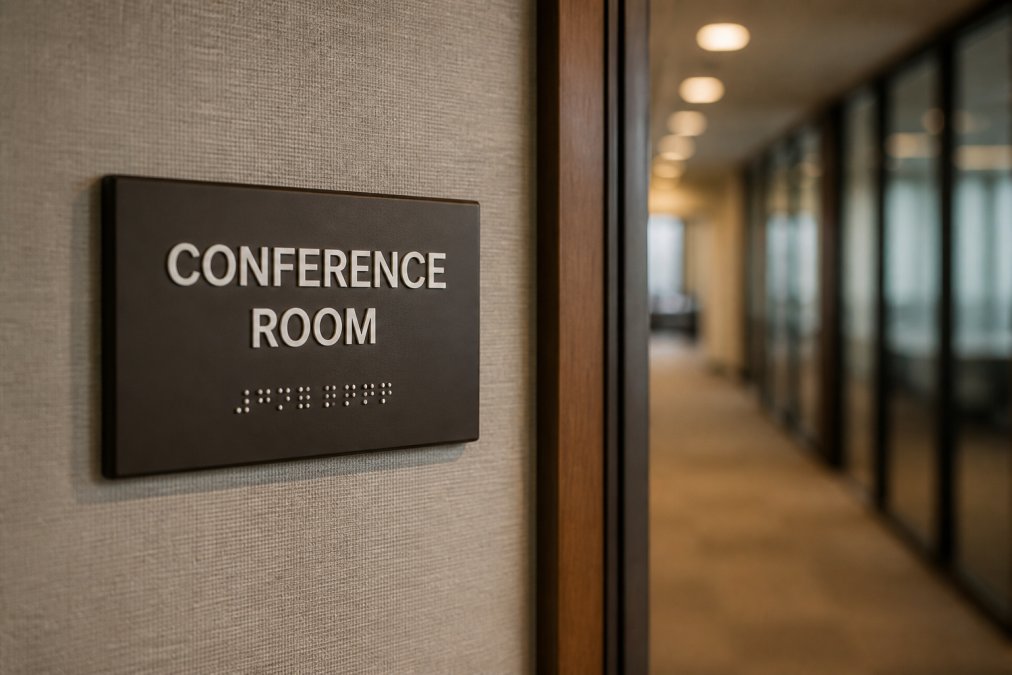
ADA-compliant signage meets the standards set by the Americans with Disabilities Act, specifically the guidelines published under the ADA Standards for Accessible Design. These standards govern mounting height, character size, contrast ratios, tactile characters, and Braille requirements for signs identifying permanent rooms and spaces.
Any sign identifying a restroom, stairwell, exit, or named office space in a permanent location must meet ADA standards. Failure to comply exposes property owners and tenants to complaints filed with the Department of Justice and potential civil litigation. ADA signage requires raised tactile characters, Grade 2 Braille positioned correctly relative to text, and mounting height measured from floor to sign centerline, typically between 48 and 60 inches.
Installing signage that looks ADA-compliant but fails on Braille grade, character height, or mounting position carries the same liability as having no compliant signage at all. Visual inspection alone is not sufficient verification.
Exterior Signage Permits and Local Zoning Rules
Exterior signage on commercial properties is regulated by local zoning ordinances, which vary significantly between municipalities. Sign permits are required before any exterior sign is installed, modified, or replaced. Zoning rules govern sign area, height, setback from property line, illumination type, and sometimes the number of signs permitted per frontage. Properties in historic districts or planned unit developments often carry additional restrictions.
For nw realty transactions involving commercial property, reviewing existing sign permits and confirming installed signage is permitted is part of responsible due diligence. Unpermitted signage discovered after closing becomes the buyer’s problem.
Signage’s Role in NW Realty Listings and Property Branding
Signage is not a passive element in a real estate transaction. For commercial listings, exterior signage communicates occupancy status, brand identity, and professional management quality to every passerby. A well-maintained, professionally installed sign signals active management; a faded or damaged sign signals the opposite.
For nw realty professionals managing commercial listings, property branding through signage directly influences perceived value. Prospective tenants and buyers form impressions before entering, and the sign is often the first brand touchpoint.
Triton Sign, with over 30 years of combined experience in signage design, fabrication, and installation, works with facilities managers, project managers, and property owners to ensure commercial signage meets both regulatory requirements and brand standards. This includes ADA-compliant interior signage, exterior identification signs, and tenant improvement graphics.
| Signage Type | Primary Requirement | Governing Standard | Common Use Case |
|---|---|---|---|
| Interior room ID signs | ADA compliance | ADA Standards for Accessible Design | Offices, restrooms, stairwells |
| Exterior building signs | Local sign permit | Municipal zoning ordinance | Tenant identification, address |
| Wayfinding signs | ADA + local code | ADA + building code | Parking, entrances, exits |
| Monument signs | Zoning setback rules | Municipal zoning ordinance | Street-level identification |
| Vehicle wraps | DOT reflectivity (if applicable) | Federal Motor Carrier Safety regs | Fleet branding |
For any commercial property changing hands or undergoing tenant improvements, a signage audit should happen before the transaction closes. Identifying non-compliant or unpermitted signs early prevents costly remediation timelines from disrupting occupancy schedules.
What to Expect During the Closing Process
The closing process transfers legal ownership from seller to buyer. For most residential transactions, this takes 30 to 60 days from accepted offer to recorded deed. Commercial transactions often run longer depending on due diligence and financing complexity.
The process typically involves: executed purchase agreement, earnest money deposit, mortgage pre-approval finalization, home inspection, title search, appraisal, final walkthrough, closing disclosure review, and signing and funding.
A common mistake is treating the inspection and appraisal as formalities. The inspection protects the buyer; the appraisal protects the lender. If the appraisal comes in below the purchase price, the buyer renegotiates, covers the gap in cash, or walks away. According to the Consumer Financial Protection Bureau’s homebuying guide, understanding the closing disclosure is critical. Buyers have the right to review it at least three business days before closing and should compare it line by line against the initial loan estimate.
Neighborhood Spotlights: Reading the Local Market
Reading a local market accurately separates good nw realty agents from great ones. Aggregate market data tells you what happened across a metro area; neighborhood-level data tells you what’s actually happening on specific streets.
Variables that matter include: days on market by street or block, list-to-sale price ratio, inventory turnover rate, pending-to-active ratio, and price per square foot trends over 12 months. A regional market analysis surfacing these metrics by neighborhood gives buyers and sellers a genuine strategic advantage. Agents who build neighborhood-level data sets or work in tight geographic areas consistently outperform those relying on MLS averages alone.
For commercial real estate, neighborhood analysis extends to foot traffic patterns, zoning adjacency, planned infrastructure changes, and competing inventory.
Buyer and Seller Guides: Preparing for Your Transaction
Most buyers and sellers underestimate how much preparation matters before the first offer is made.
For home buyers, preparation means:
- Obtain mortgage pre-approval before beginning your property search
- Define your non-negotiables versus preferences in writing before touring homes
- Research closing costs in your target market
- Understand the home inspection contingency
- Know your timeline for closing
For home sellers, preparation means:
- Commission a pre-listing inspection to surface issues before buyers find them
- Obtain a professional property valuation
- Understand your net proceeds after commission and closing costs
- Decide your minimum acceptable price before the first offer arrives
- Confirm your moving timeline for realistic closing dates
First-time home buyers often skip pre-approval, assuming they can obtain it quickly once they find a property. In competitive markets, that assumption costs them the home. Sellers who skip pre-listing inspections often face renegotiation after the buyer’s inspector finds issues. As noted by HUD’s guidance for homebuyers, preparation and education before entering the market are among the strongest predictors of a smooth transaction.
Frequently Asked Questions
What is the difference between an NW Realty agency and the Northwest Multiple Listing Service?
An NW Realty agency is a licensed brokerage that employs real estate professionals to represent buyers and sellers in transactions. The Northwest Multiple Listing Service (NWMLS) is a database that member brokerages use to share property listings with each other. Your agent accesses the NWMLS to find homes or market yours, but the agency itself handles negotiations, paperwork, and the full closing process. The two work together, but they serve very different functions.
How do I verify the credentials of an NW Realty agency?
Check the Washington State Department of Licensing website to confirm that the brokerage and individual agents hold active licenses. You can also review their standing with the National Association of Realtors if they carry the Realtor designation. Ask the agency directly for references, years in operation, and their transaction history in your target neighborhoods. A credible firm will share this information without hesitation and can point to verifiable client outcomes.
What services should I expect from a professional NW Realty firm?
A full-service nw realty firm typically covers property valuation, listing alerts, open house coordination, negotiation strategy, escrow guidance, and support through the closing process. Many also offer relocation services, access to investment properties, and connections to mortgage pre-approval lenders and home inspection professionals. For commercial clients, expect help with lease analysis and property management referrals. The depth of service varies by brokerage, so confirm the full scope before signing a representation agreement.
How does local market expertise affect an NW Realty transaction?
Agents with deep local knowledge can price properties accurately based on recent comparable sales, identify neighborhood trends before they appear in broader market reports, and advise on timing. In a competitive market, that insight directly affects offer strategy and final sale price. An agent unfamiliar with the local market may underprice a listing or overbid on a purchase. When interviewing nw realty professionals, ask how many transactions they have closed in your specific target area within the past 12 months.
Are all NW Realty companies part of the same network?
No. ‘NW Realty’ is a general term for real estate agencies operating in the Pacific Northwest, not a single franchise or coordinated network. Each brokerage operates independently, sets its own commission structures, and builds its own team. Some are independent brokerages; others are affiliated with national brands. What they share is geographic focus, not ownership or standards. Always evaluate each firm individually based on licensing, local track record, and the specific services they offer.
Triton Sign provides professional signage design, fabrication, and installation services for commercial real estate, office renovations, and multi-location branding programs. If your next project involves ADA-compliant signage, exterior identification signs, or tenant improvement graphics, contact the Triton Sign team to discuss your requirements and get a project assessment.
This article was written using GrandRanker